 KnowThis
Key Takeaways
Key Takeaways
- 1Perimeter measures a 1D distance (total edge length), area measures a 2D surface (flat space covered), and volume measures a 3D capacity (space enclosed) — each needs its own kind of unit: linear, square, or cubic.
- 2Doubling every dimension of a shape doesn't double its area or volume — area scales by the square of the size increase and volume by the cube, which is why a 'twice as big' box holds far more than twice as much.
- 3A handful of formulas cover most everyday measuring: rectangle perimeter = 2(l + w), rectangle area = l × w, triangle area = ½ × base × height, and box volume = l × w × h.
The concept
Those three formulas are simple on their own — the part that trips people up is what happens when a shape's size changes, because perimeter, area, and volume don't grow at the same rate.
A rectangular garden is 6 meters long and 4 meters wide. What is its perimeter, and what is its area?
Worked examples
Example 1: Flooring a rectangular room (baseline case)
Example 2: A triangular garden plot (edge case / variation)
To find the area of a triangle, you use ½ × base × height. What does 'height' mean in this formula?
Example 3: Volume of a moving box (real-world / applied case)
A moving box measures 50 cm long, 40 cm wide, and 30 cm tall. Volume = length × width × height = 50 × 40 × 30 = 60,000 cubic centimeters. Since 1,000 cm³ equals 1 liter, that converts to 60 liters of usable packing space — a number movers and shipping companies use directly to estimate how many boxes a room's belongings will need, or whether a box will fit a size restriction. Notice this used all three dimensions multiplied together, unlike area, which only needed two — volume genuinely requires a full 3D measurement, not a flat one.
How it works (visual)
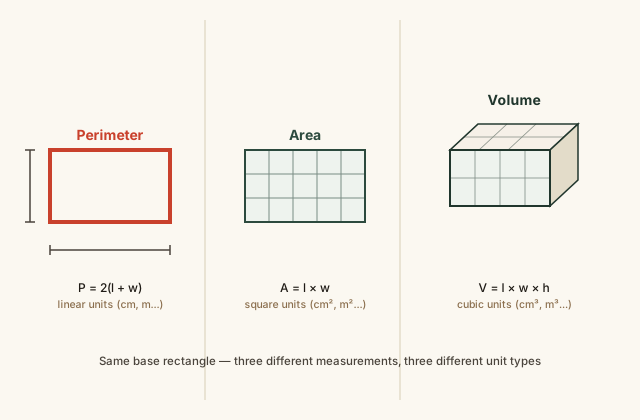
The grid overlays are the point of this diagram: perimeter only traces the outline (count linear units around the edge), area tiles the flat surface with unit squares (count how many fit), and volume packs the solid with unit cubes (count how many fit inside). That's not a metaphor — it's literally what "square meter" and "cubic meter" mean, and it's why the three measurements can't be converted into each other without more information about the shape.
Common mistakes
Common Mistakes
Reporting an area or volume answer in linear units (e.g., '12 meters' instead of '12 square meters').
→ Always match the unit to the dimension count — perimeter answers are linear (m), area answers are squared (m²), volume answers are cubed (m³). The unit itself signals whether the calculation was even set up correctly.
Adding only two sides of a rectangle for perimeter and forgetting to double the total.
→ Perimeter needs all four sides: 2 × (length + width), not just length + width. Skipping the '× 2' undercounts the perimeter by half.
Multiplying any three numbers together and calling it a box's volume, without checking they're the actual length, width, and height of that box.
→ Volume = length × width × height only works when all three numbers are genuine, matching dimensions of the same solid — mixing up a box's height with an unrelated measurement gives a meaningless result.
Common misconception
“If you double a shape's length and width, you double its area.”
Area scales with the square of the size increase, not the increase itself. A 2×2 meter square has an area of 4 m². Double both dimensions to 4×4 meters, and the area becomes 16 m² — four times as much, not two. The same effect is even stronger for volume: doubling every dimension of a box multiplies its volume by 2³ = 8. This is why a pizza with twice the diameter isn't twice the food, and why a storage box that's "just a bit bigger" in each direction can hold dramatically more than it looks like it should.
A square garden plot is 3 meters by 3 meters (area 9 m²). If you double both dimensions to 6 meters by 6 meters, what is the new area?
Try it yourself
What to do next
What to do next
- Measure a real room's length and width, then use the calculators above to find both its perimeter (for trim) and area (for flooring) — notice how different the two numbers are.
- Next time you compare two similarly-shaped products (a 'large' vs. 'medium' pizza, a 'bigger' storage box), remember that a modest increase in each dimension can mean a much larger increase in area or volume.
- Practice the triangle area formula on a triangular space you can measure, being careful to use the perpendicular height, not a slanted side.
- Read the related entry on Basic Shapes & Properties for how these same shapes are classified, and The Pythagorean Theorem for finding a missing side length before you calculate area.