 KnowThis
Key Takeaways
Key Takeaways
- 1Every metric length prefix sits a fixed power of ten away from the meter: milli- is 10⁻³, kilo- is 10³, and so on — there are no irregular ratios anywhere in the chain.
- 2Millimeters and kilometers are exactly six ×10 steps apart, meaning 1 kilometer equals 1,000,000 millimeters, a factor of one million.
- 3Converting between any two metric prefixes is arithmetically identical to converting between any other two — count the steps between them and shift the decimal point that many places.
The concept
Because every step is the same operation (×10), the actual skill here isn't computation — it's correctly counting how many steps separate the two prefixes you're converting between, since an off-by-one error in step-counting produces an answer exactly 10x too large or too small.
How many places does the decimal point move when converting a value from centimeters to kilometers?
Worked examples
Example 1: Millimeters to kilometers (baseline case)
Example 2: Kilometers back to millimeters (edge case / variation)
Example 3: A multi-prefix chain in engineering (real-world / applied case)
A lab notebook records a bacterial cell width as 0.000002 meters. Which of these is the correct value in millimeters?
How it works (visual)
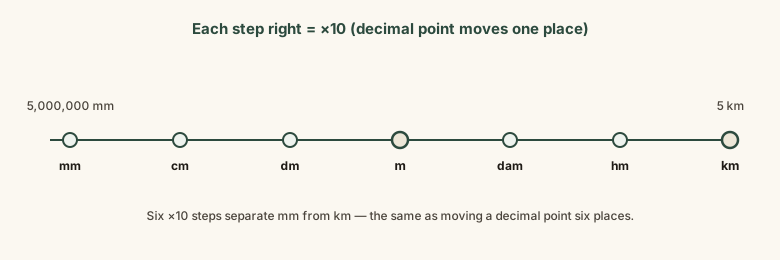
Each dot on the line is one ×10 step from its neighbor. Counting dots between your starting and ending unit tells you exactly how many decimal places to shift — six dots separate millimeter from kilometer, confirming the factor of one million.
Common mistakes
Common Mistakes
Miscounting the number of steps between two non-adjacent prefixes (e.g. treating cm-to-km as 6 steps instead of 5).
→ Write out the full ladder (milli, centi, deci, base, deka, hecto, kilo) and physically count the gaps between your two units before shifting the decimal.
Shifting the decimal the wrong direction — dividing when you should multiply, or vice versa.
→ Sanity check with size intuition first: converting a small unit to a bigger one should always produce a smaller number, and vice versa.
Losing track of trailing/leading zeros when the shift crosses many places at once.
→ For large shifts (5-6 places), it's safer to convert using scientific notation or multiply/divide explicitly by 1,000,000 rather than counting decimal places by eye.
Common misconception
“Deci-, deka-, and hecto- are somehow non-standard or unofficial metric prefixes since they're rarely used.”
All seven prefixes — milli, centi, deci, (base), deka, hecto, kilo — are equally official parts of the SI system defined by the BIPM. They're just used unevenly in practice: centi- and milli- dominate small-scale everyday measurement, kilo- dominates large-scale, and deci-/deka-/hecto- see far less everyday use (outside contexts like the hectare or the deciliter) simply by convention, not because they're less "real" than the others.
Try it yourself
What to do next
What to do next
- Memorize the full seven-prefix ladder (milli, centi, deci, base, deka, hecto, kilo) so you can count steps instead of guessing the multiplier.
- For any conversion spanning 4+ decimal places, write the multiplication out explicitly rather than shifting digits by eye.
- Double-check direction with a size sanity check: smaller unit → bigger unit should always produce a smaller number.
- Use the calculator above to build a feel for how fast the numbers grow or shrink across several metric steps.