 KnowThis
Key Takeaways
Key Takeaways
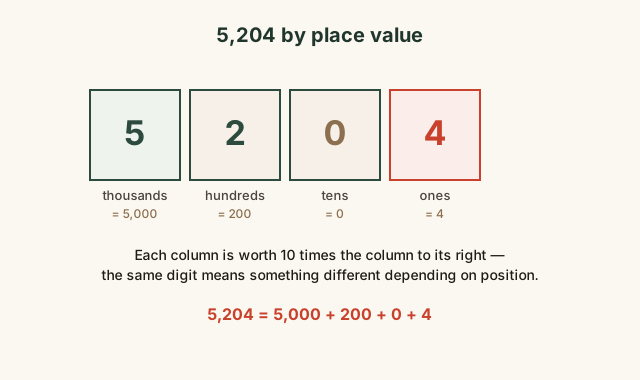
- 1A digit's value is its face value multiplied by what its position is worth — the 3 in 300 means 3×100, not just "three."
- 2Our decimal system is base-10 because it uses ten symbols (0-9) and each position is worth ten times the position to its right.
- 3Place value is what lets ten symbols represent every number that exists — without it you'd need a new symbol for every number, the way Roman numerals nearly do.
The concept
In the number 3,047, what is the value of the digit 4?
Worked examples
Example 1: Breaking a number into place values (baseline case)
Example 2: Why zero as a placeholder matters (edge case)
Example 3: Place value beyond the decimal point (applied case)
How it works (visual)
Common mistakes
Common Mistakes
Misaligning digits when adding or subtracting multi-digit numbers by hand.
→ Always line up the ones column with the ones column, regardless of how many digits each number has — pad shorter numbers with leading zeros mentally if it helps.
Reading a number's digits as just a sequence of separate values instead of positions.
→ Practice saying the place name out loud as you read each digit ("seven thousand, two hundred, ninety, six") until the position-to-value link becomes automatic.
Forgetting that a missing digit still needs a placeholder zero.
→ If a number has no hundreds, you still write 0 in that spot (e.g. 5,032, not 5,32) — the position must be held even when its value is zero.
Assuming place value only applies to whole numbers.
→ It extends symmetrically to the right of the decimal point: tenths, hundredths, thousandths — each worth one-tenth of the position to its left, mirroring the whole-number side.
Common misconception
“Base 10 is somehow mathematically special or required — it's just 'how numbers work.'”
Base 10 is a human convention, almost certainly because we have ten fingers, not a mathematical necessity. Computers run entirely on base 2 (binary), and any base works equally well for representing every number that exists — the value of the number doesn't change, only how many symbols and positions it takes to write it down.
Try it yourself
What to do next
What to do next
- Pick any multi-digit number around you (a price, a phone number, an address) and say each digit's full place value out loud.
- Next time you add or subtract by hand, deliberately check that every column is aligned by place value before calculating.
- Try writing a familiar number in expanded form (e.g. 500 + 30 + 2) to double-check you understand what each digit is contributing.