 KnowThis
Key Takeaways
Key Takeaways
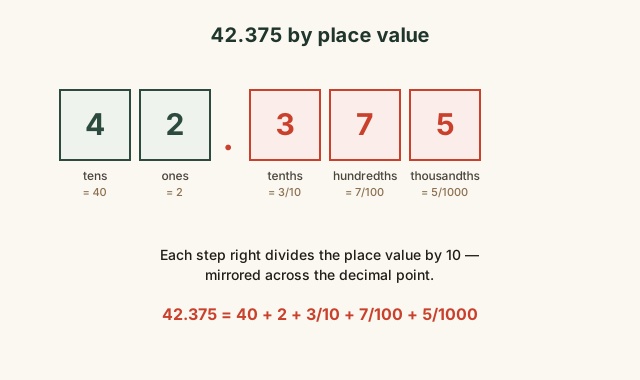
- 1Decimals are place value extended past the ones place — tenths, hundredths, thousandths, each worth one-tenth of the position before it.
- 2Every decimal is just another way of writing a fraction; 0.75 and 3/4 are the exact same number.
- 3Lining up decimal points correctly is the single most important step when adding, subtracting, or comparing decimals.
The concept
Which is larger: 0.5 or 0.45?
Worked examples
Example 1: Converting a fraction to a decimal (baseline case)
Example 2: A decimal that never terminates or repeats cleanly (edge/variation case)
Example 3: Adding decimals with different lengths (applied case)
How it works (visual)
Common mistakes
Common Mistakes
Comparing decimals by counting digits instead of comparing place value by place value.
→ Compare left to right, one place at a time (tenths, then hundredths, etc.) — stop as soon as one digit is larger.
Misaligning decimal points when adding or subtracting by hand.
→ Always stack numbers so the decimal points line up vertically, padding shorter numbers with trailing zeros if needed.
Assuming every decimal is irrational just because it looks long.
→ Check whether it terminates or repeats — both are rational. Only non-terminating, non-repeating decimals are irrational.
Common misconception
“Adding a zero to the end of a decimal changes its value.”
Trailing zeros after the decimal point never change the value — 0.5, 0.50, and 0.500 are all exactly the same number. This differs from adding a zero to a whole number (5 vs 50), where position matters completely differently.
What to do next
What to do next
- Practice converting five fractions to decimals by long division, and five decimals back to fractions.
- Next time you compare two decimals, compare digit by digit from the left rather than judging by length.
- Line up decimal points explicitly (on paper or mentally) before adding or subtracting any decimal numbers.