 KnowThis
Key Takeaways
Key Takeaways
- 1Rounding follows one consistent rule: look at the digit just past the place you're rounding to — 5 or higher rounds up, below 5 rounds down — everything else is just applying that rule at a different place value.
- 2Estimation isn't guessing. It's a deliberate, fast approximation, usually built from rounded numbers, used to sanity-check an exact calculation and catch errors before they matter.
- 3Rounding down isn't automatically the 'safe' choice — whether up or down is safer depends entirely on what the number represents. Underestimating a bridge's load limit is dangerous; underestimating a grocery bill isn't.
The concept
What is 6.849 rounded to the nearest tenth?
Worked examples
Example 1: Rounding to the nearest hundred (baseline case)
Example 2: Rounding a number that ends exactly on the boundary (edge case)
Estimate 29 × 41 quickly by rounding both numbers to the nearest ten first.
Example 3: Estimating a grocery total before checkout (real-world / applied case)
A cart holds items priced $4.75, $12.30, $2.99, and $7.10. Rounding each to the nearest dollar gives $5, $12, $3, and $7, which add up to a quick estimate of $27. The actual total is $27.14 — the estimate is off by just 14 cents, more than close enough to confirm you're carrying enough cash before reaching the register. This is front-end estimation in action: round each number individually to a convenient place value, add the simplified numbers, and trust the result as a check rather than a final answer.
How it works (visual)
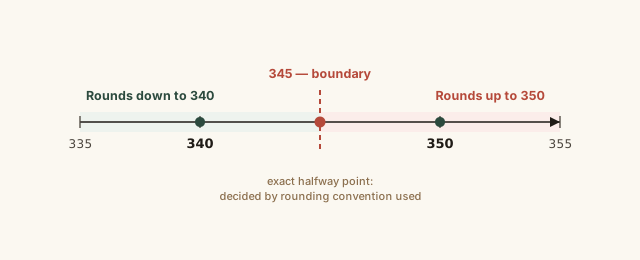
Every rounding decision reduces to which side of that halfway boundary a number falls on — nothing about the digits earlier in the number matters once you've located the boundary. The only genuinely contested case is landing exactly on the boundary line itself, which is where round-half-up and round-half-to-even disagree; everywhere else on the number line, every rounding convention in common use gives the identical answer.
Common mistakes
Common Mistakes
Rounding a number in two stages instead of once (rounding 2.449 to 2.45, then rounding 2.45 up to 2.5) — called double rounding.
→ Round directly from the original number to your target place value in a single step. Round 2.449 straight to the nearest tenth (2.4), skipping any intermediate rounding stop.
Assuming rounding down is always the 'safe' or conservative choice, regardless of context.
→ Ask what the number represents first. Underestimating capacity, dosage, or material needed is often the unsafe direction — round up when running short would cause a real problem.
Losing track of which place value you're rounding to, and rounding to the wrong one.
→ Explicitly name the target place value before starting (nearest ten, nearest hundredth) and check only the single digit immediately after it.
Common misconception
“Rounding down is always the 'safer' or more conservative choice than rounding up.”
Which direction is actually safe depends entirely on what's being measured. A school estimating how many buses to book for a field trip needs to round the number of required buses up — rounding down would strand students. An engineer estimating a structure's maximum safe load needs to round the load capacity down and the expected load up, to build in margin rather than optimism. There is no universal "safe direction" for rounding; the ceiling function (always round up) and the floor function (always round down) are each the conservative choice only for particular quantities, never for all of them at once.
A summer camp needs to know how many 12-seat vans to book for 130 campers. 130 ÷ 12 = 10.83 vans. Which rounding direction is actually the safe one here?
Try it yourself
What to do next
What to do next
- Before doing an exact calculation on paper or a calculator, round the numbers involved and estimate the answer first — a big mismatch between the two is an instant error check.
- Next time you're at checkout, round each item's price to the nearest dollar as you shop and keep a running estimate to confirm your total before it's rung up.
- When rounding matters for safety or capacity (seating, dosage, materials), explicitly ask which direction — up or down — is the conservative one for that specific situation, rather than defaulting to 'round down is safe.'
- Read the related entry on Mental Math Tricks for how rounding underpins several of the fastest shortcut calculations.