 KnowThis
Key Takeaways
Key Takeaways
- 1Mental math tricks aren't unrelated party tricks to memorize one by one — nearly all of them are the distributive property or place value rearranged into a faster shortcut.
- 2The ×11 trick (split the digits, insert their sum in the middle) works because 11 × n = 10n + n; it generalizes to any two-digit number as long as you carry correctly when the digit sum is 10 or more.
- 3Shortcuts are built for numbers with a specific shape — round numbers, numbers near 100, repeated digits. Applying the wrong trick to the wrong shape of number produces a fast, confident, wrong answer.
The concept
Using Gauss's pairing trick, what is the fastest way to find the sum of the integers 1 through 10?
Worked examples
Example 1: Multiply 34 × 11 with no carry (baseline case)
Example 2: Multiply 57 × 11 with a carry (edge case / variation)
Using the ×11 trick, what is 68 × 11?
Example 3: A 15% restaurant tip without a calculator (real-world / applied case)
A bill comes to $42.00 and you want a 15% tip. Find 10% first by moving the decimal one place left: $4.20. Half of that is 5%: $2.10. Add the two pieces together, since 15% = 10% + 5%: $4.20 + $2.10 = $6.30. The trick works because percentages are additive — 15% of a number is exactly 10% of it plus 5% of it — and 10% and 5% are both fast to compute from a decimal shift and a halving, which is far quicker than multiplying 42 × 0.15 directly in your head.
How it works (visual)
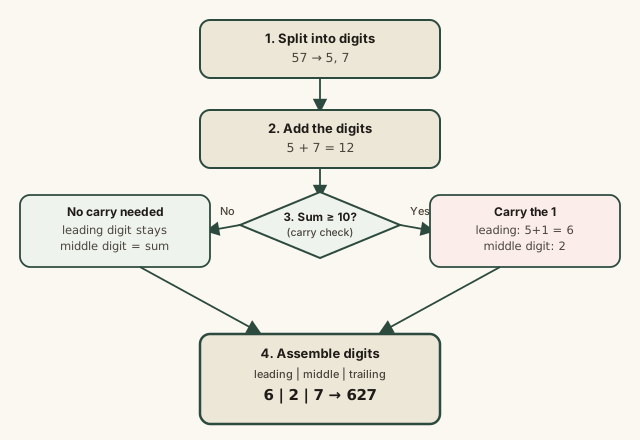
The branch in the middle of the diagram — "is the digit sum 10 or more?" — is the step every version of this trick needs and the one most often skipped when people rush. Numbers whose digits sum below 10 (like 34, giving 7) skip the carry branch entirely; numbers whose digits sum to 10 or more (like 57, giving 12) always need it. The same branching pattern — compute, check for overflow, carry if needed — shows up in the near-100 multiplication trick and in ordinary column addition, so recognizing it here transfers directly to other shortcuts.
Common mistakes
Common Mistakes
Forgetting to carry when the digit sum in the ×11 trick is 10 or greater (writing 5|12|7 instead of 627 for 57 × 11).
→ Whenever the digit sum reaches double digits, write only its last digit in the middle and add the carried 1 into the leading digit before finishing.
Applying a shortcut built for one number shape (near 100, or ending in 5) to numbers that don't fit that shape.
→ Match the trick to the number's shape first. The near-100 trick needs both numbers close to 100; forcing it onto numbers like 34 and 61 doesn't apply and won't give a valid shortcut.
Rounding a number mid-calculation to make the mental math easier, then forgetting to adjust the final answer for the rounding.
→ If you round 98 up to 100 partway through a calculation, subtract back out the 2 you added before reporting the final result.
Common misconception
“Mental math tricks are just memorized party tricks with no real mathematical reasoning behind them.”
Every mental math shortcut in regular use is a standard algebraic identity applied to numbers with a convenient shape. The ×11 trick is literally 11n = 10n + n, written out digit by digit instead of as an equation. The near-100 trick is the distributive property expanding (100-x)(100-y). None of these require accepting anything on faith — you can derive each one from the distributive property in a couple of lines, and doing so is exactly how you can tell whether a given shortcut is safe to apply to a specific pair of numbers.
Why does the ×11 trick (insert the digit sum between the two original digits) actually produce the correct product?
Try it yourself
What to do next
What to do next
- Practice the ×11 trick on ten random two-digit numbers, deliberately including several whose digits sum to 10 or more, until the carry step becomes automatic.
- Next time you're tipping at a restaurant, compute 10% and 5% separately and add them instead of trying to multiply by 0.15 directly.
- Before trusting a mental math shortcut's answer, run a rough estimate (round both numbers) as a sanity check — a wildly different estimate flags a dropped carry or a misapplied trick.
- Read the related entry on Estimation & Rounding for how rough-checking a mental math answer works as its own standalone skill.