 KnowThis
Key Takeaways
Key Takeaways
- 1The exact conversion factor is 1 mile = 1.609344 kilometers, fixed by the same 1959 international agreement that standardized the inch.
- 2For quick mental estimates, multiplying miles by 1.6 stays within about 0.6% of the exact answer for any everyday distance.
- 3Because the golden ratio (≈1.618) is close to 1.60934, reading off the next number in the Fibonacci sequence (3→5, 5→8, 8→13...) gives a surprisingly usable mile-to-km shortcut with no multiplication at all.
The concept
Both the 1.6 shortcut and the Fibonacci trick trade a small amount of precision for speed — which one you reach for depends on whether you're doing the math on paper or purely in your head while, say, driving past a distance sign.
Why does multiplying by 1.6 instead of the exact 1.609344 stay accurate enough for everyday use?
Worked examples
Example 1: Exact conversion for a road-trip distance (baseline case)
Example 2: The Fibonacci shortcut on a Fibonacci-numbered distance (edge case / variation)
Example 3: Comparing both shortcuts on a non-Fibonacci distance (real-world / applied case)
For which situation would the ×1.6 mental shortcut be inappropriate to rely on?
How it works (visual)
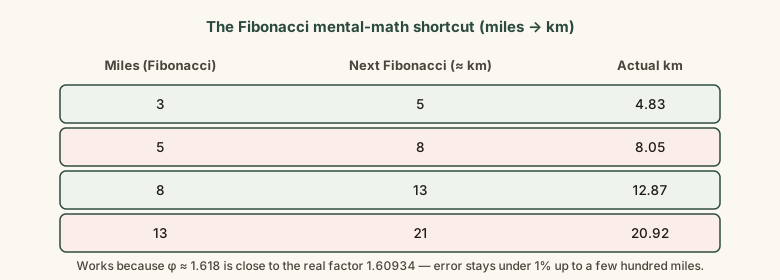
Each row shows how closely the "next Fibonacci number" guess tracks the real conversion — the gap stays under about half a kilometer even as the distances grow, because the golden ratio and the real conversion factor differ by only half a percent.
Common mistakes
Common Mistakes
Using the ×1.6 shortcut for a distance where the number isn't small (compounding error grows with scale).
→ For distances beyond a few hundred miles, switch to the full 1.609344 factor, since the absolute error scales with the distance even though the percentage error doesn't.
Applying the Fibonacci trick to a non-Fibonacci number by just picking the nearest Fibonacci pair loosely.
→ The trick only works cleanly on actual Fibonacci numbers (3, 5, 8, 13, 21...) — for other values, either interpolate carefully or just multiply by 1.6.
Confusing the direction of the golden-ratio approximation (going km to miles instead of miles to km).
→ The shortcut runs one direction: mile count → next Fibonacci number = approximate km. Going km to miles requires the previous Fibonacci number instead, which is less intuitive and more error-prone.
Common misconception
“The golden ratio connection means there's some deep mathematical reason distance 'wants' to follow Fibonacci numbers.”
It's a numerical coincidence, not a physical law. The mile is a historically inherited unit with no relationship to Fibonacci numbers or the golden ratio in its definition — it just so happens that the real conversion factor (1.60934) lands close to φ (1.61803). Swap in a different historical unit (say, the old Roman mile) and the coincidence disappears entirely.
Try it yourself
What to do next
What to do next
- Use ×1.6 for any quick mental estimate under a few hundred miles — the error stays small enough to ignore.
- Switch to the full 1.609344 factor for anything precision-sensitive: fuel planning, engineering, or large distances.
- Try the Fibonacci trick next time a distance happens to be 3, 5, 8, 13, or 21 miles — it's a fun, genuinely useful party trick.
- Use the calculator above to compare the exact answer against your mental estimate and build a feel for how close ×1.6 really gets.