 KnowThis
Key Takeaways
Key Takeaways
- 1"Vedic Mathematics" refers to 16 mental-arithmetic sutras (short rule-phrases) compiled and published in 1965 by the Indian scholar Bharati Krishna Tirtha, who presented them as derived from the ancient Vedas.
- 2The techniques themselves are genuinely valid, verifiable shortcuts grounded in ordinary algebra — squaring numbers ending in 5, or multiplying numbers near a round base like 100, both work exactly as claimed and check out with real arithmetic.
- 3Historians of mathematics, including a well-known critical analysis by S.G. Dani of the Tata Institute of Fundamental Research, have been unable to locate these specific sutras within the actual ancient Vedic texts — the name reflects Tirtha's own framing, not verified textual origin.
The concept
Setting the historical debate aside, the techniques themselves are worth learning purely on the merits — they're fast, verifiable, and easy to check against ordinary multiplication once you see the pattern.
What have historians who examined the actual ancient Vedic texts generally concluded about the 16 sutras published in 1965?
Worked examples
Example 1: Squaring a number ending in 5 (baseline case)
Example 2: Multiplying two numbers near 100, including the carry case (edge case / variation)
In the Nikhilam multiplication method, multiplying 88 x 88 produces a deviation product of 144 — too large to fit in the normal two-digit slot. What happens next?
Example 3: Fast estimation using difference of squares in everyday mental math (real-world / applied case)
A related mental-math shortcut, useful for quick estimates while shopping or checking a bill, uses the algebraic identity (a-b)(a+b) = a² - b². To multiply 97 x 103 quickly: notice both numbers sit exactly 3 away from the round number 100 (97 = 100-3, 103 = 100+3). So 97 x 103 = 100² - 3² = 10,000 - 9 = 9,991. Check with standard multiplication: 97 x 103 = 9,991. Correct — and computed in a few seconds without a calculator. This is the same underlying algebraic principle as the Nikhilam technique above, just applied to a pair of numbers symmetric around a round base rather than a single number close to one.
How it works (visual)
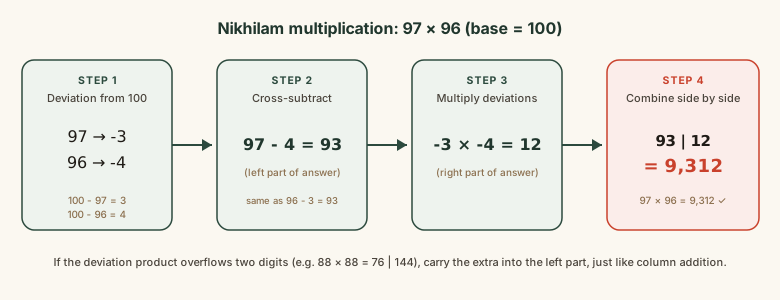
Follow the four boxes left to right and the shortcut becomes mechanical: find how far each number sits from a convenient round base, combine the numbers on one side, multiply the small deviations on the other side, then join the two results together (carrying if the deviation product overflows its digit slot, as in the 88 x 88 example). The entire method is really just the standard algebraic expansion of (base - x)(base - y) done in a specific, fast order.
Common mistakes
Common Mistakes
Forgetting to carry when the deviation product in the Nikhilam method has more digits than its slot allows (as in 88 x 88).
→ Treat the deviation product like any multi-digit result — if it overflows its two-digit slot, carry the extra into the left-hand part of the answer before finalizing.
Trying to apply Ekadhikena Purvena (the squaring-numbers-ending-in-5 trick) to a number that doesn't end in 5.
→ This specific shortcut only works for numbers ending in exactly 5 — it relies on the algebraic identity (10a+5)², which doesn't hold for other final digits.
Assuming these are the only valid mental-math shortcuts, or that standard arithmetic methods are somehow 'wrong' by comparison.
→ These are alternate, often faster routes to the same correct answers you'd get from standard column multiplication — both are valid; the sutras are a convenience for specific number patterns, not a replacement for general arithmetic.
Common misconception
“Vedic Mathematics techniques come directly from the ancient Vedas, the sacred texts of Hinduism.”
The 16 sutras that make up "Vedic Mathematics" were compiled and published in 1965 by Bharati Krishna Tirtha, who described them as intuitively reconstructed from the Vedas rather than quoted from a specific, locatable passage. Multiple historians of Indian mathematics who have since examined the actual Vedic texts directly — including a widely cited critical analysis by S.G. Dani of the Tata Institute of Fundamental Research — have not been able to find these specific sutras within them. This doesn't make the arithmetic shortcuts themselves invalid: every technique checks out as ordinary, provable algebra, and many are genuinely fast and useful. What's disputed is specifically the claim of ancient textual origin, which the mathematical community treats as Tirtha's own framing rather than an established historical fact.
Given that historians haven't found the 16 sutras in the actual Vedic texts, what's the accurate way to think about the arithmetic techniques themselves?
Try it yourself
What to do next
What to do next
- Use the calculator above with a few leading digits, then verify each result by squaring the full number the standard way.
- Practice the Nikhilam method on two numbers close to 100 of your choosing, and check your mental answer against a calculator.
- Try the difference-of-squares shortcut from Example 3 next time you need a fast estimate while shopping or checking a bill.
- Read the related entry on Famous Mathematicians & Their Contributions to see how other real historical figures in Indian mathematics — including Brahmagupta and Ramanujan — are documented and sourced.