 KnowThis
Key Takeaways
Key Takeaways
- 1Euclid's Elements (c. 300 BCE) organized geometry into a logical system built from a small set of starting axioms, a structure so influential it shaped how mathematics is proven for over 2,000 years.
- 2Carl Friedrich Gauss, sometimes called the 'Prince of Mathematicians,' made foundational contributions across number theory, statistics, and physics — including, as a child, instantly finding a shortcut to sum the integers 1 through 100.
- 3Srinivasa Ramanujan, largely self-taught in India with no formal advanced training, produced results in number theory so original that some of his conjectures are still being proven and applied by mathematicians today; Emmy Noether's work founded much of modern abstract algebra and produced a theorem now central to theoretical physics.
The concept
Reading a list of names and dates doesn't explain why these contributions mattered. Working through even one of them with real numbers shows exactly what made the breakthrough a breakthrough.
Gauss, as a child, found a fast way to sum the integers from 1 to 100. What was the key insight behind his method?
Worked examples
Example 1: Reproducing Gauss's pairing trick with real numbers (baseline case)
Example 2: Euclid's proof that there are infinitely many primes (edge case / variation)
Euclid's proof that primes are infinite starts by assuming there IS a finite, complete list of primes. Why does the proof do this?
Example 3: Ramanujan's partition function in action (real-world / applied case)
The partition function p(n) counts how many distinct ways a whole number can be broken into a sum of positive integers, ignoring order. For a small number like 4, you can check this by hand: 4, 3+1, 2+2, 2+1+1, and 1+1+1+1 — that's 5 distinct partitions, so p(4) = 5. Counting partitions by hand becomes impossibly slow for large numbers (p(100) is already over 190 million), which is exactly the problem Ramanujan and G.H. Hardy solved together: they developed an asymptotic formula that estimates p(n) for any n with remarkable accuracy, without needing to enumerate every partition individually. Partition functions like this one aren't just a historical curiosity — they show up today in statistical physics (counting the ways energy can be distributed among particles) and in areas of cryptography and combinatorics that rely on counting problems at scale.
How it works (visual)
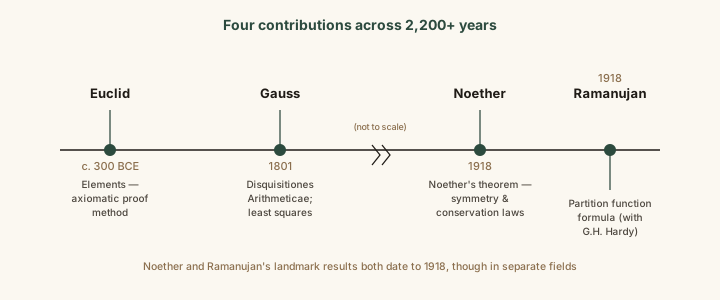
Spread across more than two thousand years, the timeline shows these contributions building on each other in method more than in direct content — Euclid's insistence on airtight logical proof from a small set of axioms is the same standard Gauss, Noether, and Ramanujan's results were all held to and had to satisfy, even though each worked in a completely different branch of mathematics.
Common mistakes
Common Mistakes
Assuming Ramanujan's lack of formal advanced education meant his results were less rigorous or less proven.
→ Ramanujan's specific results (like the partition function formula developed with Hardy) were formally proven and verified through standard mathematical peer review — his unconventional path to the results doesn't make the results themselves less rigorous.
Treating Euclid's Elements as only a geometry textbook, with no broader influence.
→ Its lasting influence is the axiomatic method itself — building all results from a small set of explicit starting assumptions through strict logical steps — which became the standard for how proofs are structured across all of mathematics, not just geometry.
Assuming Emmy Noether's contributions were confined to pure mathematics with no relevance to physics.
→ Noether's theorem, connecting mathematical symmetry to physical conservation laws, is considered one of the most important theorems underlying modern theoretical physics — Einstein himself praised it directly.
Common misconception
“Groundbreaking mathematical discoveries only come from people with elite, traditional academic training.”
Srinivasa Ramanujan is one of the clearest counterexamples in the field's history. Largely self-taught in Madras, India, with no formal training in advanced mathematics and having failed non-mathematics coursework that kept him from completing a college degree, he independently derived thousands of original mathematical results by studying on his own. He sent a letter of his findings to the Cambridge mathematician G.H. Hardy in 1913; Hardy recognized the work as extraordinary and arranged for Ramanujan to come to Cambridge, where their collaboration (including the partition-function formula) produced results still studied and applied today. He was elected a Fellow of the Royal Society in 1918 — one of the youngest ever at the time, and an exceptionally rare honor for someone without a conventional academic path.
What does Ramanujan's career suggest about the pathway to making genuine mathematical discoveries?
Try it yourself
What to do next
What to do next
- Use the calculator above with different values of n, then verify small cases (like n=10) by adding the numbers directly.
- Work through Euclid's infinite-primes proof from Example 2 with a different starting list of primes to see the contradiction appear again.
- List the partitions of a small number like 5 or 6 by hand, the way Example 3 does for 4, to feel how fast the counting problem grows.
- Read the related entry on History of the Number Zero to see how Brahmagupta, another major historical mathematician, fits into this same broader story.