 KnowThis
Key Takeaways
Key Takeaways
- 1A nautical mile is defined as exactly 1.852 kilometers (about 1.15 statute miles) — longer than the familiar land mile.
- 2Unlike the statute mile, the nautical mile has a direct geometric origin: it equals one minute of arc of latitude anywhere on Earth's surface, which is why it's the natural unit for chart-based navigation.
- 3A knot (nautical mile per hour) is the standard speed unit at sea and in the air specifically because it lets navigators read distance directly off a chart's latitude gridlines.
The concept
This geometric definition is what separates the nautical mile from every other unit of length in daily use — nearly every other unit (foot, meter, mile) was fixed by a physical prototype or later redefined against atomic constants, but the nautical mile's definition ties directly back to the shape of the Earth itself.
Why can a navigator measure distance directly off a nautical chart's latitude scale, but not off its longitude scale?
Worked examples
Example 1: Converting nautical miles to kilometers (baseline case)
Example 2: Reading distance directly off chart latitude (edge case / variation)
Example 3: Comparing statute miles and nautical miles for the same trip (real-world / applied case)
A flight covers 2,500 nautical miles. Is the same trip more or fewer statute miles?
How it works (visual)
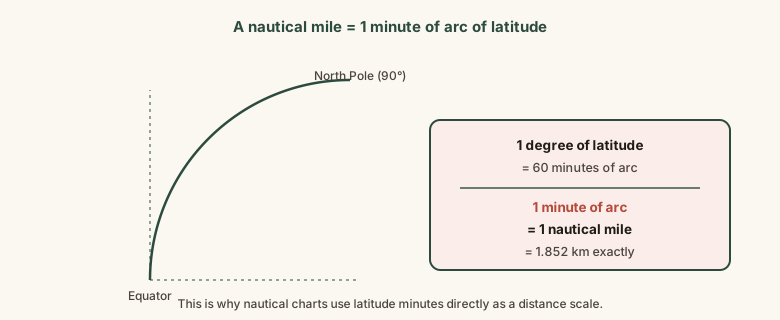
Zooming into a single degree of latitude out of Earth's 90-degree quarter-arc from equator to pole shows the one-minute slice that defines the nautical mile — a physically meaningful geometric unit rather than an arbitrary historical measurement.
Common mistakes
Common Mistakes
Confusing nautical miles with statute miles when reading a flight or shipping distance.
→ Always check which mile is being used — aviation and marine sources default to nautical miles unless explicitly labeled otherwise; road and everyday sources default to statute miles.
Trying to measure distance off a chart's longitude scale instead of its latitude scale.
→ Only latitude minutes correspond reliably to nautical miles everywhere on Earth — longitude minutes shrink toward the poles and can't be used as a universal distance ruler.
Assuming 'knot' means a unit of distance rather than speed.
→ A knot is always a speed (nautical miles per hour) — saying '20 knots per hour' is redundant, since the per-hour is already built into the unit.
Common misconception
“The nautical mile is just an old-fashioned unit that modern GPS navigation has made obsolete.”
Nautical miles and knots remain the standard units in modern marine and aviation navigation worldwide, GPS included — international aviation regulations and virtually all marine charting still use nautical miles and knots because the unit's direct tie to latitude keeps chart-based and satellite-based navigation consistent with each other, not because of tradition alone.
Try it yourself
What to do next
What to do next
- Remember the two key numbers: 1 nautical mile = 1.852 km, and it's about 15% longer than a statute mile.
- When reading a flight or ship distance, check whether it's stated in nautical or statute miles before comparing it to a road-trip figure.
- If you ever read a nautical chart, use the latitude scale (not longitude) as your distance ruler.
- Use the calculator above to convert real nautical-mile figures you encounter (flight distances, sailing routes) into more familiar units.