 KnowThis
Key Takeaways
Key Takeaways
- 1Human height in the US and UK is conventionally written as a mixed-unit measurement — feet AND inches together (5'9") — rather than a single decimal number, unlike almost any other everyday length measurement.
- 2Converting to centimeters requires first combining both parts into a single number of inches (feet × 12 + inches), then multiplying that combined total by 2.54.
- 3Converting feet and inches to centimeters separately and adding the results is a common shortcut that actually works, as long as both parts are converted using the same 2.54 cm/inch factor consistently.
The concept
The core skill here isn't really about the conversion factor itself — it's about correctly collapsing a two-part mixed measurement into one number before that factor gets applied, since applying the factor to the parts separately and forgetting to recombine them correctly is where most height-conversion mistakes happen.
Someone converts a height of 5 feet 9 inches to centimeters by calculating 5 × 2.54 = 12.7 cm and stopping there. What went wrong?
Worked examples
Example 1: Converting a common height to centimeters (baseline case)
Example 2: Converting the parts separately and adding (edge case / variation)
Example 3: Converting centimeters back to feet and inches (real-world / applied case)
Why does converting 182 cm to feet and inches require checking whether the 'inches remainder' rounds up to 12?
How it works (visual)
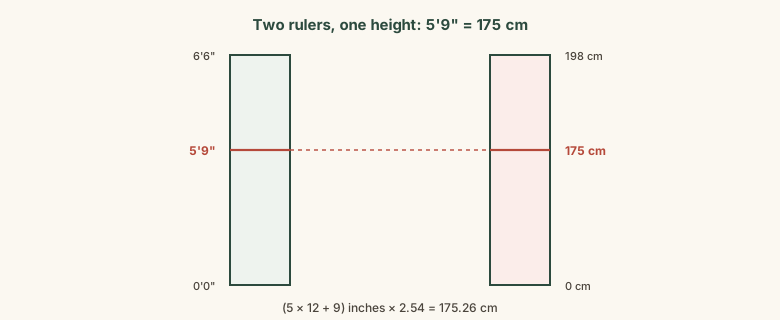
Lining up the two scales side by side shows the same physical height read two completely different ways — the feet-and-inches scale requires two numbers to pin down a height, while the centimeter scale needs only one.
Common mistakes
Common Mistakes
Converting only the feet portion of a height and forgetting to add the inches portion.
→ Always combine feet and inches into a single number (either total inches or decimal feet) before doing the final unit conversion.
Letting an inches remainder round up to 12 or higher without carrying it over into an extra foot.
→ After converting cm back to feet and inches, check that the leftover inches value is less than 12 — if not, carry the extra into the foot count.
Mixing decimal feet (5.75 ft) with feet-and-inches notation (5'9") without realizing 0.75 feet is 9 inches, not 75 inches.
→ Remember 0.75 feet means 0.75 × 12 = 9 inches — the decimal fraction of a foot must be multiplied by 12, not read as inches directly.
Common misconception
“5.75 feet and 5 feet 75 inches represent the same height, just written differently.”
They're very different. 5.75 feet means 5 feet plus 0.75 of a foot, and since 1 foot is 12 inches, that 0.75 converts to 0.75 × 12 = 9 inches — so 5.75 feet equals 5'9", not 5'75". Reading the decimal portion of a foot value as if it were directly a number of inches is a common and sizeable error (75 inches is over 6 feet on its own).
Try it yourself
What to do next
What to do next
- Always combine feet and inches into one number before applying the 2.54 cm/inch conversion factor.
- When converting cm back to feet/inches, double-check the inches remainder doesn't round up to 12 or more.
- Remember that a decimal fraction of a foot must be multiplied by 12 to get inches — it isn't the inches value directly.
- Use the calculator above to check any height conversion you need for a form, a passport, or a comparison across countries.