 KnowThis
Key Takeaways
Key Takeaways
- 1An acre (43,560 sq ft, ~4,046.86 m²) has a farming-tool origin — historically the area one ox-team could plow in a single day.
- 2A hectare is a clean metric unit: exactly 10,000 square meters, with no historical baggage in its definition.
- 31 hectare ≈ 2.47 acres, and 1 acre ≈ 0.4047 hectares — an acre is a little over 40% the size of a hectare.
The concept
Because both units describe area rather than length, converting between them isn't a simple linear scale-up the way converting feet to meters is — but the conversion is still handled the same way, by a single fixed multiplication factor, since a fixed area ratio exists between any two area units once their definitions are pinned down.
If 1 meter is about 9% longer than 1 yard, why is 1 hectare (2.47 acres) so much bigger than 1 acre, rather than just 9% bigger?
Worked examples
Example 1: Converting acres to square feet (baseline case)
Example 2: Converting hectares to acres for an international comparison (edge case / variation)
Example 3: A farm subdivision calculation (real-world / applied case)
A 200-hectare farm is divided into 5-acre parcels. Why does the calculation leave a remainder instead of dividing evenly?
How it works (visual)
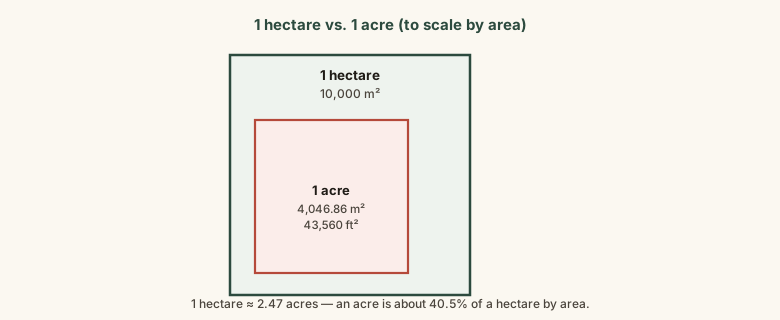
Nesting the acre inside the hectare at true relative scale makes the roughly 2.47-to-1 ratio visually obvious — a hectare isn't just "a bit bigger" than an acre, it's well over double.
Common mistakes
Common Mistakes
Assuming a hectare and an acre are roughly the same size because they're both 'big land units.'
→ Remember the ratio: 1 hectare ≈ 2.47 acres. A hectare is more than double an acre, not roughly equal to it.
Using the linear length conversion factor (like 0.3048 for feet to meters) directly for an area conversion.
→ Area conversions require squaring the linear factor (or using the correct pre-computed area factor) — never apply a length conversion factor directly to an area figure.
Forgetting that 'acre' historically implied a specific rectangular shape (1 furlong by 1 chain), not just any 43,560 sq ft plot.
→ For modern purposes, an acre is just a unit of area regardless of shape — the historical furlong-by-chain rectangle is background, not a requirement for how the unit is used today.
Common misconception
“A hectare is 'metric for acre' the same way a meter is 'metric for yard' — a similarly-sized unit just measured differently.”
Unlike the meter and yard (which are close in size, about 9% apart), the hectare and acre differ by a much larger factor — 2.47x. A hectare isn't a metric restatement of roughly-the-same-sized land unit; it's an independently defined, considerably larger unit that happens to be used for the same broad purpose (describing land parcels).
Try it yourself
What to do next
What to do next
- Memorize the core ratio: 1 hectare ≈ 2.47 acres, or the reverse, 1 acre ≈ 0.4047 hectares.
- Never apply a length conversion factor directly to an area — square it first, or use a dedicated area conversion factor.
- When comparing international land listings (like vineyards or farms), convert to one common unit before judging relative size.
- Use the calculator above with real acreage or hectare figures from a property listing you're curious about.