 KnowThis
Key Takeaways
Key Takeaways
- 1A map scale like 1:50,000 is a representative fraction — a ratio, not a distance — meaning 1 unit on the map equals 50,000 of that same unit in the real world.
- 2To convert a measured map distance to real-world distance, multiply the map measurement by the scale denominator, then convert the result to a convenient unit.
- 3Map scale terminology is counterintuitive: a 'large-scale' map has a small denominator (1:1,000) and shows a small area in fine detail, while a 'small-scale' map has a large denominator (1:1,000,000) and shows a huge area with little detail.
The concept
Once the scale ratio is understood as "how many real units per map unit," the actual conversion arithmetic is just a two-step multiplication-then-unit-conversion, identical in structure to any other unit conversion covered elsewhere in this series.
Why is a 1:1,000 map called 'large-scale' even though it shows a smaller physical area than a 1:1,000,000 map?
Worked examples
Example 1: Reading a distance off a 1:50,000 map (baseline case)
Example 2: A much larger scale denominator (edge case / variation)
Example 3: Planning a hike using a topographic map's scale (real-world / applied case)
Why does the scale denominator matter so much when comparing the 'same' measured distance on two different maps?
How it works (visual)
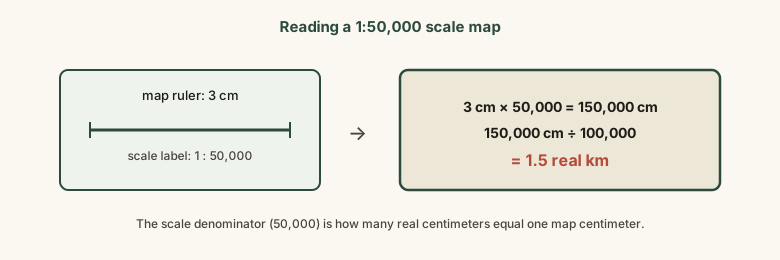
The scale label is what turns a raw ruler measurement into a real-world distance — without it, "3 cm on the map" carries no usable information about actual distance at all.
Common mistakes
Common Mistakes
Forgetting to check a map's scale before measuring, and assuming a familiar-looking scale carries over from a different map.
→ Always read the specific scale label on the map you're using — different maps of even the same region are commonly printed at different scales.
Confusing 'large-scale' and 'small-scale' terminology when discussing map detail level.
→ Remember: large-scale = small denominator = small area, high detail. Small-scale = large denominator = large area, low detail.
Skipping the final unit conversion step and reporting a distance in centimeters instead of kilometers or miles.
→ The scale multiplication gives you a distance in the same unit you measured with (usually cm) — always convert that final figure into a practically usable unit.
Common misconception
“A map's scale bar and its representative fraction (like 1:50,000) always say the exact same thing, so you only need one of them.”
They're usually consistent but serve different purposes — the representative fraction is a precise ratio useful for calculation, while a printed scale bar is a rough visual ruler meant for quick eyeballing. A scale bar remains accurate even if the map image itself is later resized or photocopied at a different size, while the printed representative fraction becomes wrong the moment the map is scaled up or down without reprinting the fraction to match.
Try it yourself
What to do next
What to do next
- Before measuring anything on a map, locate and note its representative fraction (scale ratio).
- Use the formula real distance = map distance × scale denominator, then convert to a convenient unit like km or miles.
- Trust a printed scale bar over a representative fraction if the map has been resized, photocopied, or screenshotted.
- Use the calculator above with real measurements from a hiking map or atlas page you have on hand.