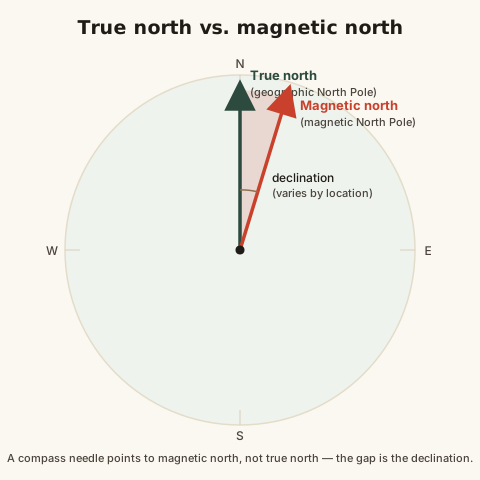
A compass needle points toward magnetic north, not true (geographic) north, and the angular gap between the two — magnetic declination — must be corrected for accurate navigation.
Reading time
— 5 min
Updated
— Aug 16, 2026
Fact-reviewed
— Aug 16, 2026
Key Takeaways
Key Takeaways
1A compass needle points to magnetic north, not true (geographic) north — these are two different locations, and the angle between them, called declination, varies depending on where you're standing.
2Directions are measured as a bearing: degrees clockwise from north, from 0° to 359°, which lets navigation be described with a single precise number instead of a vague word like 'northeast-ish.'
3Earth's north magnetic pole isn't fixed — it drifts over time, and in recent decades it has been moving unusually fast, from northern Canada toward Siberia at tens of kilometers per year.
The concept
A compass needle lines up with Earth's magnetic field and points toward magnetic north — but that's not the same place as true north, the actual geographic North Pole that Earth spins around. The two are usually close enough that it doesn't matter for a casual walk, but the gap between them, called magnetic declination, can be large enough in some places to send you seriously off course if you don't correct for it — which is exactly why hikers and pilots are taught to check it before relying on a compass for precise navigation.
That gap between magnetic and true north isn't just a technicality — it's a real, calculable number, and correcting for it is a genuine skill with a genuine formula behind it.
Quick check
A compass needle in most locations does NOT point exactly at which of the following?
Worked examples
Example 1: Correcting a compass bearing for declination (baseline case)
A hiker's compass reads a bearing of 45° (northeast) toward their destination. Their location has a declination of +8° (east declination, common in parts of the western United States). To find the true bearing: true bearing = magnetic bearing + declination = 45 + 8 = 53°. Following the uncorrected 45° reading instead of the corrected 53° would send the hiker walking in a direction 8° off from their intended path — over a distance of several kilometers, that's easily enough error to miss a trail junction or a landmark entirely.
Example 2: West declination flips the correction's sign (edge case / variation)
In parts of the eastern United States, declination is negative — for example, -14° in parts of Maine, meaning magnetic north sits 14° to the west of true north there. A compass reading of 90° (due east) at that location corresponds to a true bearing of 90 + (-14) = 76°. The sign of the declination correction genuinely flips depending on which side of the agonic line (the line of zero declination) you're on, which is precisely why declination is always published as a signed value (east positive, west negative, by convention) rather than a single number that could be misapplied in the wrong direction.
Quick check
A location has a declination of -14° (west). A hiker reads a compass bearing of 90° toward their destination. What is the correct true bearing?
Example 3: Why aviation and maritime navigation take declination seriously (real-world / applied case)
Airport runway numbers are based on their magnetic compass heading rounded to the nearest 10 degrees (a runway numbered "27" faces roughly 270° magnetic, or due west) — and because magnetic declination slowly drifts over years, runways occasionally have to be officially renumbered decades after construction once the magnetic heading has shifted enough to round to a different number. Commercial pilots and ship navigators build declination correction into every flight or voyage plan as a matter of routine, using either the World Magnetic Model or a magnetic variation printed directly on aeronautical and nautical charts, precisely because the error from ignoring it compounds significantly over long distances.
How it works (visual)
True north vs. magnetic north, and the declination angle between them
The declination angle shown here isn't a fixed universal number — it's specific to a location and a point in time, which is exactly why serious navigation always starts by looking up the current local declination rather than assuming a compass reading is already true north.
Common mistakes
Common Mistakes
✕
Assuming a compass points at true (geographic) north.
→ Remember a compass points at magnetic north, a different and constantly shifting location — apply the local declination correction for precise navigation.
✕
Applying a declination correction with the wrong sign.
→ Double-check whether your location's declination is east (positive) or west (negative) before adding it — getting the sign backward doubles the actual error instead of removing it.
✕
Treating declination as a fixed, permanent number for a given location.
→ Check a current source like the World Magnetic Model, since declination slowly changes over years as Earth's magnetic field shifts — old maps or old memorized values can be measurably out of date.
Common misconception
“A compass needle points directly at the true, geographic North Pole.”
A compass needle points toward Earth's magnetic north pole, a separate location from the geographic North Pole that shifts over time — currently drifting through the Arctic Ocean toward Siberia. The angular gap between magnetic north and true north at any given location is called magnetic declination, and it must be added or subtracted from a raw compass reading to get an accurate true bearing. In parts of the world, this gap exceeds 15-20 degrees, easily large enough to cause significant navigation error over any real distance if ignored.
Quick check
Why do pilots and ship navigators need to know their location's specific magnetic declination rather than using one universal correction number?
Try it yourself
Correct a magnetic compass bearing to a true bearing
True bearing (degrees)53
What to do next
What to do next
Try the calculator above with your own region's declination (look it up via NOAA's magnetic declination calculator) and a compass reading of your choice.
Next time you use a compass outdoors, check whether you're east or west of the agonic line before trusting a raw reading for precise navigation.
Practice converting a cardinal direction like 'southeast' into its exact bearing (135°) to build fluency with bearing-based navigation.
Read the related entry on GPS & How Location Technology Works to see how satellite navigation solved the magnetic-declination problem entirely.
FAQ
FAQ
Related terms
Related terms
True north
The direction toward the geographic North Pole, the fixed point Earth rotates around, used as the reference for latitude and longitude.
Magnetic north
The direction a compass needle points, toward Earth's north magnetic pole, which is a different, constantly slowly shifting location from true north.
Magnetic declination
The angular difference between true north and magnetic north at a given location, which must be added to or subtracted from a compass reading for accurate navigation.
Bearing
A direction expressed as a specific number of degrees measured clockwise from north, from 0° (due north) to 359°.
Cardinal directions
The four primary compass directions: north, south, east, and west.
Dead reckoning
A navigation technique that estimates current position using a known starting point, heading, speed, and elapsed time, without external reference points.
This entry was researched from public sources and drafted with AI-assisted tools, then edited — errors are still possible. Spot one, or want a topic covered? Read our disclaimer.
 KnowThis