 KnowThis
Key Takeaways
Key Takeaways
- 1A fraction is a numerator (part) over a denominator (whole), and it's literally a division that just hasn't been carried out numerically yet.
- 2Two fractions can look completely different and still be equal — 2/4, 3/6, and 50/100 are all exactly 1/2.
- 3To add or subtract fractions they need a common denominator; to multiply or divide them, they don't.
The concept
What is 1/2 + 1/3?
Worked examples
Example 1: Simplifying a fraction (baseline case)
Example 2: Multiplying and dividing fractions (edge/variation case)
Example 3: Splitting a recipe (applied case)
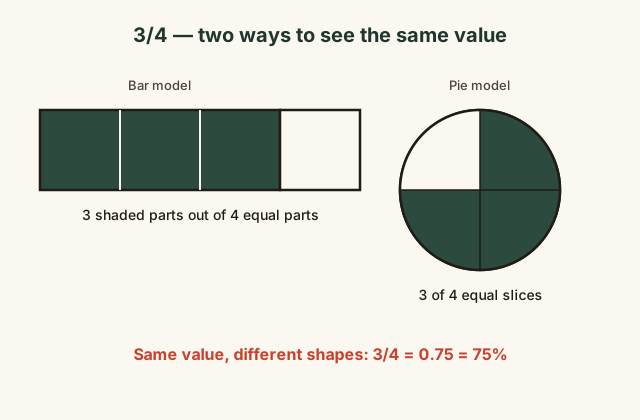
How it works (visual)
Common mistakes
Common Mistakes
Adding or subtracting fractions without finding a common denominator first.
→ Always convert both fractions to the same denominator (their LCM works best) before adding or subtracting the numerators.
Forgetting to simplify a final answer.
→ Divide numerator and denominator by their HCF at the end — 4/8 and 1/2 are equal, but 1/2 is the expected simplified form.
Applying "add tops and bottoms" to addition instead of the operations it actually applies to.
→ That shortcut never applies to addition or subtraction. Multiplication is (num×num)/(denom×denom); division flips the second fraction first.
Common misconception
“A bigger denominator always means a bigger fraction.”
The opposite is often true when the numerator is fixed — 1/8 is smaller than 1/4, because the whole is being split into more, smaller pieces. Denominator size alone tells you nothing about the fraction's value without also knowing the numerator.
Try it yourself
What to do next
What to do next
- Practice simplifying five random fractions by finding the HCF of numerator and denominator first.
- Next time you add fractions, write out the common-denominator conversion step explicitly rather than skipping to the answer.
- Try converting a handful of everyday fractions (like a recipe measurement) into decimals to build the fraction-decimal connection.