Types of Numbers (natural, whole, integers, rational, irrational)
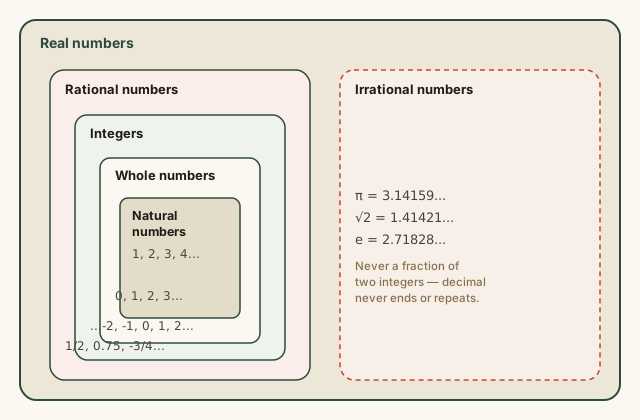
Every number you'll ever use belongs to a small set of nested categories — natural numbers sit inside whole numbers, which sit inside integers, which sit inside rational numbers, all inside the real numbers, with irrationals filling the rest.
Reading time
— 4 min
Updated
— Sep 24, 2026
Fact-reviewed
— Aug 16, 2026
Key Takeaways
Key Takeaways
1Every number category you learn in school nests inside the next one — natural numbers are a subset of whole numbers, which are a subset of integers, which are a subset of rational numbers.
2The one test that actually separates rational from irrational is whether the number can be written as a fraction of two integers — not how long or messy its decimal looks.
3"Real numbers" isn't a vague catch-all — it's the precise name for every rational and irrational number combined, i.e. every point on the number line.
The concept
Numbers get sorted into a small number of nested boxes. Natural numbers are what you count with: 1, 2, 3, and so on. Add zero and you get whole numbers. Add negatives and you get integers. Add fractions and terminating or repeating decimals and you get rational numbers. The numbers left over — the ones whose decimals never end and never repeat, like π or √2 — are irrational. Rational and irrational together make up the real numbers, which is every number you'll meet in ordinary math.
That nesting is the whole system. The next question is what actually goes wrong when people try to sort a specific number — and the answer is almost always about decimals that look messy but aren't actually irrational.
Quick check
Is 0.777777... (repeating forever) a rational number or an irrational number?
Worked examples
Example 1: Sorting a simple list (baseline case)
Take the numbers 7, -3, 0, 2.5, and √9. Start from the outside in. All five are real numbers. √9 simplifies to 3, which is a whole number, an integer, and — since it can be written as 3/1 — a rational number too; it just isn't natural under the "starts at 1" convention some curricula use, though it is under the "starts at 0" one, and it's always at minimum a whole number and an integer either way. 7 is natural, whole, an integer, and rational. -3 is an integer and rational, but not natural or whole (whole numbers don't go negative). 0 is whole and an integer, rational, and natural only under the count-from-zero convention. 2.5 is rational — it's 5/2 — but not an integer, since it has a genuine fractional part.
Example 2: The number that looks rational but isn't (edge case)
√2 is the classic trap. It looks like it should simplify to something clean the way √9 does, but 2 isn't a perfect square, and no fraction of integers equals √2 exactly — its decimal (1.41421356...) never terminates and never falls into a repeating pattern, no matter how far you calculate it. Calculators round it, which can trick people into thinking 1.414 is √2 rather than a rounded approximation of an irrational number that has no exact decimal form at all. The same is true of π: 3.14 and 22/7 are both useful rational approximations, but neither one is actually equal to π.
Example 3: Why this classification matters in real math (applied case)
This isn't just taxonomy for its own sake. Whether a length, area, or measurement is rational or irrational determines whether it can ever be represented exactly by any measuring tool or by any digital display, which only show finite decimals. A carpenter cutting a diagonal brace using the Pythagorean theorem is very likely to land on an irrational length (most right-triangle diagonals are), which is precisely why real-world measurements always carry a stated precision ("accurate to the nearest millimeter") instead of claiming exactness — the true value literally cannot be written down in full.
How it works (visual)
The nested number system: natural numbers inside whole numbers inside integers inside rational numbers, with irrationals filling out the real numbers
Each ring is a strict superset of the one inside it — nothing is ever removed as you move outward, only added. Irrational numbers sit outside the rational ring entirely, never overlapping it, but both rings together are enclosed by the outermost "real numbers" boundary, since every number on this diagram is real.
Common mistakes
Common Mistakes
✕
Assuming a long or ugly-looking decimal must be irrational.
→ Check whether it terminates or repeats. 0.123123123... repeating is rational (it equals 123/999); only non-repeating, non-terminating decimals are irrational.
✕
Treating "real number" as meaning "a normal, everyday number" rather than its actual technical meaning.
→ "Real" is a formal category — every rational and irrational number — not a vague synonym for "regular." It specifically excludes complex numbers like 3 + 2i.
✕
Thinking negative numbers can be natural or whole numbers.
→ Natural and whole numbers are both defined as non-negative. Negative values start becoming valid only once you reach the integers.
✕
Believing a calculator's decimal display of an irrational number is the exact value.
→ Calculators truncate or round. √2 displayed as 1.4142135624 is an approximation to 10 decimal places, not the exact, infinite value.
Common misconception
“Fractions and decimals are two different, separate kinds of numbers from whole numbers and integers.”
Fractions and decimals aren't a separate category — they're just other ways of writing rational numbers, which already include every integer. 4 and 4.0 and 4/1 are the exact same number written three different ways; none of them "become" a different type by being written differently.
What to do next
What to do next
Next time you see a decimal, check whether it terminates, repeats, or does neither — that's the fastest way to classify it as rational or irrational on sight.
Practice sorting a mixed list of numbers (including negatives, fractions, and square roots) into natural/whole/integer/rational/irrational — most confusion clears up after doing this a few times by hand.
When you next use π or √2 in a calculation, notice that your calculator is always giving you a rounded rational approximation, never the true irrational value.
FAQ
FAQ
Related terms
Related terms
Natural numbers
The counting numbers: 1, 2, 3, 4... (some definitions include 0).
Integer
A whole number, positive, negative, or zero, with no fractional or decimal part.
Rational number
Any number that can be written as a fraction of two integers, a/b, where b is not zero.
Irrational number
A number that cannot be written as a simple fraction — its decimal goes on forever without repeating.
Real number
Any number on the number line — every rational and irrational number combined.
This entry was researched from public sources and drafted with AI-assisted tools, then edited — errors are still possible. Spot one, or want a topic covered? Read our disclaimer.
 KnowThis