 KnowThis
Key Takeaways
Key Takeaways
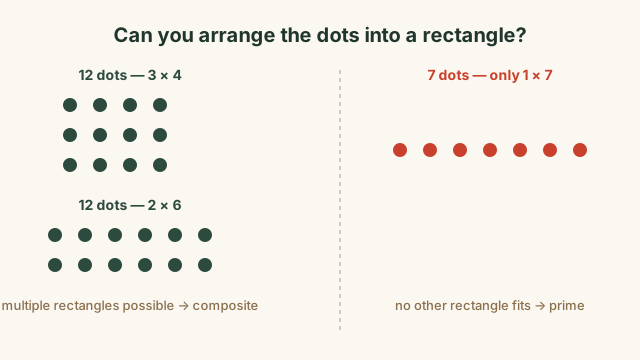
- 1A prime number has exactly two factors — 1 and itself — no more, no fewer.
- 21 is neither prime nor composite, because it has only one factor (itself), not two.
- 3Every composite number breaks down into a unique set of prime factors — this is the foundation of modern encryption.
The concept
Is 1 a prime number?
Worked examples
Example 1: Checking a small number by hand (baseline case)
Example 2: Prime factorization of a composite number (edge/variation case)
Example 3: Why primes matter outside the classroom (applied case)
How it works (visual)
Common mistakes
Common Mistakes
Assuming 1 is prime because it's "only divisible by itself."
→ The definition needs exactly two distinct factors. 1 has only one factor total (itself), so it fails the definition and is excluded from both categories.
Assuming all odd numbers are prime.
→ Plenty of odd numbers are composite — 9 (3×3), 15 (3×5), 21 (3×7) are all odd and composite. Being odd only rules out one specific factor (2), not all others.
Checking every number up to n instead of up to √n when testing primality by hand.
→ You only need to check divisors up to the square root of the number — if no factor exists below that point, none exists above it either.
Forgetting that a prime factorization can repeat the same prime.
→ Repeated factors are normal and expected — 8 = 2×2×2 (written 2³), not just "2 and something else."
Common misconception
“Prime numbers become rarer and eventually run out as numbers get bigger.”
Primes do get sparser on average as numbers grow, but they never run out — Euclid proved over 2,000 years ago that there are infinitely many primes. The largest known prime (as of recent record-setting searches) has tens of millions of digits, and there's always a next one to find.
Try it yourself
What to do next
What to do next
- Practice listing all primes under 50 by hand using the sieve method: cross out multiples of 2, then 3, then 5, then 7 — everything left over is prime.
- Take any composite number you see today (a price, a house number) and find its full prime factorization.
- Remember 2 as the one exception whenever someone claims "all primes are odd" — it isn't quite true.