 KnowThis
Key Takeaways
Key Takeaways
- 1Radius, diameter, and circumference are locked to each other by fixed ratios: diameter = 2 × radius, and circumference = π × diameter (equivalently, 2πr) — true for every circle that exists, big or small.
- 2Pi (π) is irrational: its decimal digits never terminate or repeat, so 3.14 and 22/7 are useful rounded approximations, never the exact value.
- 3Because circumference scales directly with radius but area scales with radius squared, doubling a circle's radius only doubles its circumference — but it quadruples its area.
The concept
The radius-diameter-circumference relationship is simple arithmetic once you have one measurement — the part worth double-checking is which one you actually started with.
A circular table has a diameter of 1.2 meters. What is its radius?
Worked examples
Example 1: Circumference and area from a given radius (baseline case)
Example 2: Working backward from circumference to find radius (edge case / variation)
If you know a circle's circumference but not its radius, how do you find the radius?
Example 3: Comparing a 12-inch and a 16-inch pizza (real-world / applied case)
Pizza sizes are named by diameter. A 12-inch pizza has a radius of 6 inches, so its area is π × 6² = π × 36 ≈ 113.1 square inches. A 16-inch pizza has a radius of 8 inches, so its area is π × 8² = π × 64 ≈ 201.1 square inches. The diameter only grew by about 33% (from 12 to 16 inches), but the actual amount of pizza grew by about 78% (from 113.1 to 201.1 square inches) — because area scales with the square of the radius, not the radius itself. Ordering "one size up" on a pizza gets you proportionally far more food than the size label alone suggests.
How it works (visual)
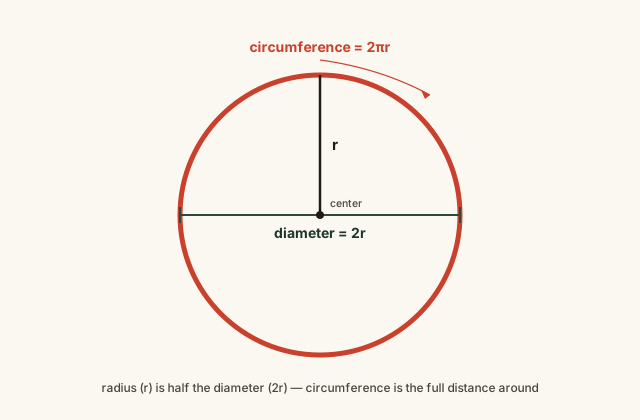
The key relationship to see visually is that the diameter is simply two radii placed end to end through the center, while the circumference is that same radius, scaled by 2π, wrapped all the way around the curved edge instead of drawn as a straight line. Every other circle fact — including why area behaves so differently from circumference as a circle grows — follows from those two relationships.
Common mistakes
Common Mistakes
Using diameter in a formula that calls for radius, or vice versa (e.g., writing circumference = πr instead of 2πr).
→ Always confirm which measurement you were given before plugging it in — if you were given diameter, either convert it to radius first (divide by 2) or use the diameter-based version of the formula (C = πd) consistently.
Treating 3.14 as the exact value of pi rather than a rounded approximation.
→ Pi is irrational and never terminates — 3.14, 3.14159, and 22/7 are all useful approximations at different levels of precision, not the true value. For large-scale calculations, small rounding differences compound.
Assuming circumference and area scale by the same amount when a circle's size changes.
→ Circumference scales linearly with radius (double the radius, double the circumference), but area scales with radius squared (double the radius, quadruple the area) — the two measurements grow at fundamentally different rates.
Common misconception
“Pi is exactly 3.14.”
Pi is an irrational number — its decimal expansion continues forever without ever terminating or repeating (3.14159265358979...). 3.14 and the fraction 22/7 are both convenient, widely used rounded approximations for hand calculation, not the true value. Even extremely precise engineering rarely needs more than a handful of digits: NASA's Jet Propulsion Laboratory has noted that about 15 digits of pi are sufficient for its most demanding interplanetary navigation calculations, even though mathematicians have computed pi out to trillions of digits purely as a mathematical and computational exercise.
Why can using 3.14 instead of a more precise value of pi cause a meaningful error in a very large-scale calculation, like Earth's circumference?
Try it yourself
What to do next
What to do next
- Measure the diameter of a round object near you (a mug, a wheel, a clock face), then use the calculators above to predict its circumference and area before checking with a tape measure.
- Next time you order a larger pizza or drink size, remember that a modest jump in diameter can mean a much bigger jump in actual area or volume.
- Practice converting between radius and diameter both directions until it's automatic — half one way, double the other.
- Read the related entry on Perimeter, Area & Volume to see how a circle's area and circumference formulas compare to rectangles and triangles, and The Pythagorean Theorem for straight-line distance math.