 KnowThis
Key Takeaways
Key Takeaways
- 1No bat species is truly blind — nearly all of the roughly 1,400 known species have functional eyes, and several fruit bats see about as well as humans do in dim light.
- 2Echolocation is an added sense, not a substitute for sight: it lets insect-hunting bats track fast, small prey in total darkness where eyes alone can't resolve enough detail.
- 3The phrase “blind as a bat” predates any real study of bat vision — it describes clumsy nighttime flying, not an anatomical fact.
The concept
That's the mechanism in outline. The specific numbers behind it — how fast the calls fire, how short the delay is, and what a bat can actually resolve from it — are where the misconception really falls apart. Bats aren't the only animal behavior that sounds like fiction but holds up under real research — some parasites genuinely do control their host's behavior, down to specific, measurable changes.
A microbat that hunts moths at night is flying through a pitch-black cave. What is it primarily relying on to avoid the walls?
Worked examples
Example 1: Timing a single echo (baseline case)
Example 2: Closing in on a moth (edge case / variation)
Example 3: Why megabats mostly skip it (real-world / applied case)
Why do most large fruit bats (megabats) not use echolocation, while most small insect-hunting bats (microbats) do?
How it works (visual)
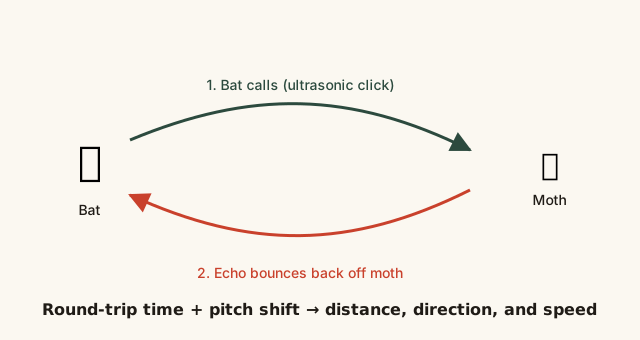
The outgoing call and the returning echo aren't identical — a moth moving away stretches the echo to a slightly lower pitch, and one closing in compresses it higher, the same Doppler shift that makes a passing ambulance siren change pitch. Some bat species use that shift to sense a target's speed and direction, on top of its distance from timing alone.
Common mistakes
Common Mistakes
Assuming echolocation means a bat has no eyes or can't see at all.
→ Echolocating bats still have anatomically normal eyes and use them — for example, spotting a cave entrance or a predator silhouetted against the sky, tasks sound isn't especially good at.
Treating 'echolocation' and 'sonar' as if only bats and submarines use them.
→ The same active-sound-ranging principle is used by toothed whales and dolphins underwater, and by some cave-dwelling birds (oilbirds, some swiftlets) — it's a mechanism that's evolved independently more than once.
Thinking all bats hunt insects and all bats echolocate.
→ Of roughly 1,400 bat species, most megabats (fruit and nectar feeders) don't echolocate at all — the trait tracks hunting style and lighting conditions, not the whole order.
Common misconception
“Bats are blind.”
Every bat species studied has functional eyes, and most use them regularly. The phrase "blind as a bat" describes bats' awkward, fluttering flight path in daylight — often just avoidance behavior or disorientation from bright light after a nocturnal lifestyle — not an anatomical absence of sight. Some fruit bat species have vision on par with cats in low light. Echolocation, where it exists, is a second sense that fills the specific gap vision can't: precise ranging on fast targets with zero ambient light.
Try it yourself
What to do next
What to do next
- Next time you hear “blind as a bat,” treat it as an idiom about clumsiness, not a claim about anatomy.
- Try the calculator above with a shorter round-trip time (like 0.006 seconds) to see how close a target has to be before a bat needs its rapid feeding-buzz call rate.
- Look up which bat species live in your region — most of North America and Europe's bats are microbats (echolocating insect-hunters), while megabats are concentrated in the Old World tropics.