Light and sound both travel as waves, but light is an electromagnetic wave that needs no medium while sound is a mechanical wave that needs one — which is why light reaches you almost instantly and sound noticeably lags behind, like in a thunderstorm.
Reading time
— 4 min
Updated
— Sep 27, 2026
Fact-reviewed
— Aug 19, 2026
Key Takeaways
Key Takeaways
1Light and sound are both waves, but fundamentally different kinds — light is electromagnetic and needs no medium; sound is mechanical and needs one (usually air).
2Light travels about a million times faster than sound, which is why you see lightning well before you hear thunder.
3Color is just the wavelength of visible light your eyes detect — red has the longest visible wavelength, violet the shortest.
The concept
Both light and sound travel as waves, carrying energy from one place to another. Light is made of electric and magnetic fields and can travel through empty space — that's how sunlight crosses millions of miles of vacuum to reach Earth. Sound is a vibration passing through a physical substance like air, water, or a solid wall — no air, no sound, which is why space is silent even during a massive explosion.
That huge speed difference between light and sound isn't just trivia — it's directly measurable in a very common weather event.
Quick check
During a thunderstorm, you see a lightning flash and count 5 seconds before hearing the thunder. What does that tell you?
Worked examples
Example 1: Timing a thunderstorm's distance (baseline case)
Count the seconds between a lightning flash and its thunder, then multiply by sound's speed (about 343 m/s, or roughly 1 km per 3 seconds as a quick rule of thumb). A 9-second gap means the storm is about 3 km away — light's travel time is negligible enough to ignore entirely at these distances.
Example 2: Why a rainbow always appears opposite the sun (edge case / variation)
A rainbow forms when sunlight enters a raindrop, bends (refracts), reflects off the drop's back, and bends again exiting — and different wavelengths of light bend by slightly different amounts, spreading white light into its component colors. This only produces a visible rainbow at a specific ~42° angle relative to the sunlight's original direction, which is why a rainbow always appears in the patch of sky directly opposite the sun from where you're standing, never near the sun itself.
Example 3: Why noise-canceling headphones work (real-world / applied case)
Noise-canceling headphones use a microphone to detect incoming sound waves, then generate a new sound wave that's an exact mirror image (inverted) of the unwanted noise. When the original wave's high pressure lines up with the generated wave's low pressure, they cancel each other out — a direct, deliberate application of how sound waves add and subtract, called destructive interference.
Quick check
Noise-canceling headphones reduce unwanted sound by generating a new sound wave. What must be true about that generated wave for it to cancel the noise?
Example 4: Pitch versus loudness, and why concerts damage hearing (real-world / applied case)
Frequency and amplitude control two completely independent properties of a sound wave: frequency (cycles per second) sets pitch — how high or low a sound is — while amplitude (the height of the wave, how much the air pressure swings) sets loudness. A high-pitched whistle and a low-pitched foghorn can be equally loud, or a deep bass note can be either a whisper or ear-splitting, because pitch and loudness are set by different properties of the same wave. Loudness is measured in decibels (dB), a logarithmic scale — a quiet whisper sits around 30 dB, normal conversation around 60 dB, a rock concert or a car horn around 110-120 dB, and because the scale is logarithmic, that gap isn't "a bit louder," it's roughly a million times more sound energy. Sustained exposure above about 85 dB — well within range for concerts, power tools, and loud headphones — is enough to gradually damage the inner ear's hair cells, which is why hearing protection matters even when a sound doesn't feel painfully loud in the moment.
Quick check
A tiny bird chirps at a very high pitch, and a large truck horn blares at a very low pitch but is far louder. What does this tell you about pitch and loudness?
How it works (visual)
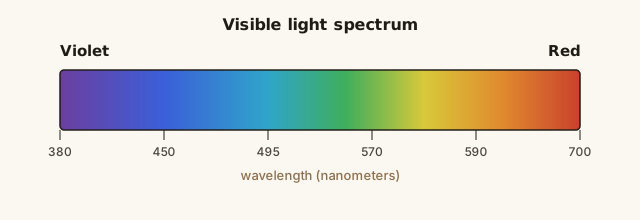
The visible light spectrum by wavelength
Violet light has the shortest visible wavelength and the most energy per photon; red has the longest visible wavelength and the least. Beyond either end, the same electromagnetic spectrum continues invisibly — ultraviolet past violet, infrared past red.
Common mistakes
Common Mistakes
✕
Assuming sound can travel through the vacuum of space, like in movie space battles.
→ Sound needs a physical medium to travel — space is a vacuum, so real explosions in space would be completely silent to a nearby observer.
✕
Thinking an object's color is a property of the object itself rather than the light it reflects.
→ An object appears a given color because it reflects that wavelength of light and absorbs the others — a red apple looks red because it reflects red wavelengths and absorbs the rest of the visible spectrum.
✕
Believing white light has no color, or is the 'absence' of color.
→ White light is actually a mixture of all visible wavelengths at once — a prism or raindrop doesn't add color to it, it separates the colors that were already combined inside it.
✕
Assuming a higher-pitched sound is automatically louder, or that pitch and loudness are the same thing.
→ Pitch comes from frequency; loudness comes from amplitude — they're independent. A high note can be whisper-quiet and a low note can be deafening.
Common misconception
“Objects that look black are simply colorless, reflecting nothing at all.”
A black object absorbs nearly all visible wavelengths of light rather than reflecting them — it's not an absence of color interaction, it's a very strong, specific one. That's also why black surfaces heat up faster in sunlight than white ones: white reflects most visible light away, while black absorbs most of it and converts that absorbed energy into heat.
Try it yourself
Estimate a thunderstorm's distance from the flash-to-thunder delay
Approximate distance (meters)—
What to do next
What to do next
Next thunderstorm, count the seconds between flash and thunder and try the calculator above to estimate distance.
Look at a prism or a CD's reflective surface in sunlight and notice the separated spectrum — that's the same physics as a rainbow.
Notice how a swimming pool muffles and distorts voices from underwater — a direct, everyday demonstration of sound behaving differently in a denser medium.
Check the volume level on your headphones against a decibel-meter app, or notice if you have to raise your voice to be heard — both are practical signs you're in hearing-damage range.
FAQ
FAQ
Related terms
Related terms
Wavelength
The distance between successive peaks of a wave — determines color for light, pitch for sound.
Electromagnetic wave
A wave of electric and magnetic fields, like light, that can travel through empty space.
Mechanical wave
A wave that needs a physical medium (air, water, solid) to travel through, like sound.
Frequency
How many wave cycles pass a point per second, measured in hertz (Hz) — determines pitch for sound.
Amplitude
The size (height) of a wave's vibration — determines loudness for sound and brightness for light, independent of pitch or color.
Decibel (dB)
A logarithmic unit measuring sound intensity — every 10 dB increase represents roughly a 10-fold increase in sound energy, not a small linear step.
Test yourself
Question 1 of 5
Why can light cross the vacuum of space but sound can't?
This entry was researched from public sources and drafted with AI-assisted tools, then edited — errors are still possible. Spot one, or want a topic covered? Read our disclaimer.
 KnowThis