Human Body Systems: How the Body's Major Systems Work Together
The human body is organized into about 11 major organ systems, each handling a distinct job, that constantly exchange oxygen, nutrients, and signals to keep the whole body functioning.
Reading time
— 8 min
Updated
— Aug 19, 2026
Fact-reviewed
— Aug 19, 2026
Key Takeaways
Key Takeaways
1The body isn't one machine but roughly 11 organ systems — circulatory, respiratory, nervous, digestive, skeletal, muscular, endocrine, immune/lymphatic, urinary, reproductive, and integumentary (skin) — each handling a distinct job.
2No system works in isolation: the circulatory system can't deliver oxygen without the respiratory system supplying it, and the muscular system can't move without signals from the nervous system and fuel from the digestive system.
3Heart rate is a measurable window into how hard the circulatory and muscular systems are working together, and it can be estimated with a simple age-based formula used by exercise physiologists and clinicians.
The concept
An organ system is a group of organs that work together on one broad job. The circulatory system (heart, blood, blood vessels) moves things around the body. The respiratory system (lungs, airways) brings in oxygen and removes carbon dioxide. The nervous system (brain, spinal cord, nerves) sends and receives signals. The digestive system breaks food down into usable pieces. Add the skeletal, muscular, endocrine, immune, urinary, reproductive, and integumentary (skin) systems, and you have the roughly 11 major systems that, together, make up a functioning human body. None of them could keep you alive on its own.
The 11 systems, one by one
Skeletal system — an adult has 206 bones, forming a rigid framework that supports the body's weight, protects vital organs (the skull around the brain, the ribcage around the heart and lungs), and does two jobs most people don't associate with bone at all: it stores about 99% of the body's calcium as a mineral reserve, and the soft marrow inside certain bones manufactures red blood cells, white blood cells, and platelets. Muscular system — roughly 600 skeletal muscles move the body by contracting: microscopic protein filaments (actin and myosin) inside each muscle fiber slide past each other and shorten the fiber, pulling on tendons that are anchored to bone. Skeletal muscle is voluntary; smooth muscle (lining the gut and blood vessels) and cardiac muscle (the heart) work involuntarily, without conscious control.
Digestive system — food is broken down in stages: chewing and saliva start mechanical and chemical breakdown in the mouth, the stomach's acid and enzymes liquefy it further, and the small intestine (about 6 meters long) does most nutrient absorption into the bloodstream, aided by enzymes from the pancreas and bile from the liver and gallbladder. The large intestine absorbs remaining water and compacts waste. Endocrine system — glands including the pituitary, thyroid, adrenal glands, and pancreas release hormones straight into the bloodstream as chemical instructions: the thyroid's hormones set the body's baseline metabolic rate, the adrenal glands release adrenaline and cortisol during a stress response, and the pancreas releases insulin and glucagon to keep blood sugar within range — the same negative-feedback pattern described above, running on a different signal (hormones instead of nerve impulses).
Immune and lymphatic system — white blood cells patrol the bloodstream and tissues, identifying and destroying pathogens, while a separate network of lymphatic vessels drains excess fluid from tissues and routes it through lymph nodes, where white blood cells concentrate to filter out and attack anything foreign before the fluid rejoins the bloodstream — the swollen "glands" people feel in their neck during an infection are lymph nodes working overtime. Urinary system — the two kidneys filter the body's entire blood supply roughly 40 times a day through microscopic units called nephrons, pulling out waste products like urea and rebalancing water and salt levels; the filtered waste leaves as urine, carried by the ureters to the bladder for storage and eventual release.
Reproductive system — produces the reproductive cells (sperm or eggs) and, in the female body, supports gestation; its organs are also a source of several of the body's sex hormones, tying it into the endocrine system's signaling network. Integumentary system — the skin, hair, and nails, and technically the body's largest organ by surface area, forms a physical barrier against pathogens and injury, helps regulate temperature (via sweat glands and blood vessel dilation, as in the fever example below), synthesizes vitamin D on sun exposure, and carries the touch, pressure, and temperature receptors that feed the nervous system — one input among the full set the body relies on for its five senses, with vision handled by its own specialized organ, the eye. Between them, these 11 systems cover every major function the body performs — no system's job overlaps completely with another's, which is exactly why losing even one (kidney failure, for example) can't simply be compensated for by the others.
Naming what each system does is one thing; watching them actually depend on each other in real time is where the concept becomes concrete — and heart rate is one of the easiest places to observe that dependency directly.
Quick check
During a run, your digestive system, respiratory system, and circulatory system are all working harder at once. What does this best illustrate?
Worked examples
Example 1: Estimating a 40-year-old's target heart rate zone (baseline case)
A widely used estimate for maximum heart rate is 220 minus age. For a 40-year-old: 220 − 40 = 180 beats per minute (bpm) estimated maximum. The CDC-recommended target zone for moderate-to-vigorous exercise is roughly 50-85% of that maximum, which works out to about 90-153 bpm. Someone exercising well under 90 bpm is likely working at a light intensity; someone consistently above 153 bpm is pushing into a more vigorous zone. This formula is a population-level estimate, not a lab measurement — it's useful as a starting reference point, not a precise individual ceiling.
Example 2: Why the 220-minus-age formula breaks down for some people (edge case / variation)
The 220-minus-age estimate is a population average with real individual variance — actual maximum heart rate for people of the same age can differ by 10-20 bpm or more. It also doesn't account for medications: beta-blockers, commonly prescribed for high blood pressure or heart conditions, deliberately blunt how high heart rate can climb, so someone on that medication will show a lower measured maximum than the formula predicts, without that meaning anything is wrong. Highly trained endurance athletes, meanwhile, often have a lower resting heart rate (sometimes below 50 bpm) because a stronger heart muscle pumps more blood per beat — a different circulatory adaptation than maximum heart rate itself. This is why clinicians treat the formula as a general guide and use direct measurement (like a supervised stress test) when precision actually matters.
Quick check
A patient taking a beta-blocker medication has a measured maximum heart rate noticeably lower than the 220-minus-age estimate predicts. What's the most likely explanation?
Example 3: How multiple systems coordinate during a fever (real-world / applied case)
When an infection is detected, the immune system releases signaling molecules that travel to the hypothalamus — part of the brain's nervous system — and reset the body's temperature set point upward, from the usual ~37°C to something higher. The nervous system then triggers responses to reach that new set point: shivering (muscular system generating heat) and reduced blood flow to the skin (circulatory system conserving heat), which is why a person with a rising fever often feels cold and shivers even as their actual temperature climbs. The higher temperature itself makes conditions less favorable for many pathogens to reproduce, while faster circulation helps deliver immune cells where they're needed. A fever is a coordinated, deliberate response involving at least four systems working together — not a system failure.
How it works (visual)
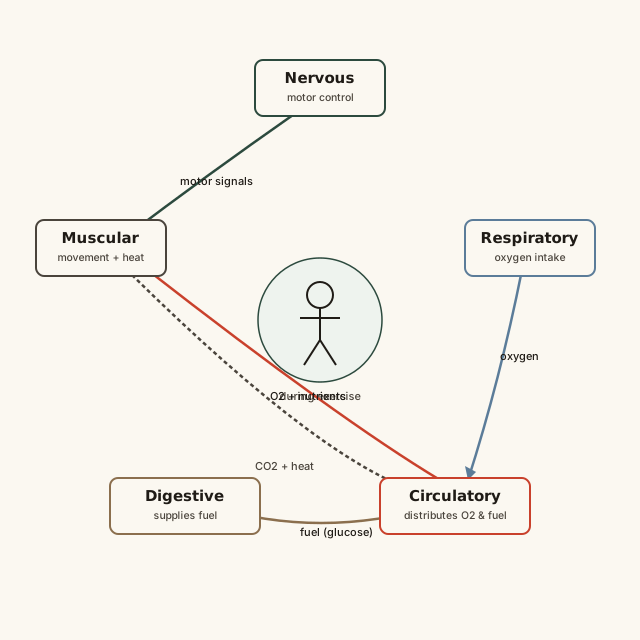
How major organ systems interact during physical exertion
Follow the arrows and notice that no system is a dead end — each one both sends something out and receives something back from at least one other system. The respiratory system feeds oxygen into the circulatory system, which distributes it to working muscles; the muscular system, in turn, generates heat and waste products (like carbon dioxide) that flow back through the circulatory system to the respiratory system and skin to be released. This closed-loop pattern, not a one-way chain of command, is the general model for how organ systems relate to each other throughout the body.
Common mistakes
Common Mistakes
✕
Thinking of each organ system as working in isolation, like separate departments with no communication.
→ Picture them as one interlocking network instead — nearly every major body function (movement, digestion, temperature regulation) draws on multiple systems working together in real time.
✕
Confusing an 'organ' with an 'organ system.'
→ An organ (like the stomach) is a single structure; an organ system (like the digestive system) is the full group of organs — stomach, intestines, liver, pancreas, and more — that work together on that broader job.
✕
Treating the 220-minus-age maximum heart rate formula as an exact, individualized ceiling.
→ Use it as a starting estimate only — real maximum heart rate varies by 10-20 bpm or more between individuals of the same age, and factors like medication change it further.
Common misconception
“Cracking your knuckles causes arthritis.”
The popping sound from cracking a knuckle comes from gas bubbles forming or collapsing in the fluid that lubricates the joint (synovial fluid) — a mechanical event, not joint damage. Multiple studies, including a well-known long-term self-experiment by physician Donald Unger (who cracked the knuckles on only one hand for over 60 years and compared both hands), found no meaningful difference in arthritis rates between habitual knuckle-crackers and non-crackers. Chronic joint pain and reduced grip strength have occasionally been associated with very forceful, repeated cracking in some studies, but the specific claim that cracking knuckles causes arthritis is not supported by the evidence.
Quick check
What actually causes the popping sound when someone cracks their knuckles?
Try it yourself
Estimate your maximum heart rate (220 − age)
Estimated maximum heart rate (bpm)190
Estimate your target heart rate at a given exercise intensity
Estimated target heart rate (bpm)133
These are general population estimates, not medical measurements — check with a healthcare provider before starting a new exercise program, especially if you have an existing heart condition or take medication that affects heart rate.
What to do next
What to do next
Use the calculator above to find your estimated target heart rate zone, then check it against how you actually feel during light versus vigorous activity.
Next time you have a cold or mild fever, notice the shivering-then-sweating pattern and connect it to the nervous system resetting your temperature set point, not a malfunction.
List the last three times you exercised, ate, or got sick, and identify at least two organ systems that had to cooperate each time.
Read the related entry on Diseases, Immunity & How the Body Fights Illness to see how the immune system fits into this same interconnected picture.
FAQ
FAQ
Related terms
Related terms
Organ system
A group of organs that work together to perform a broad function, such as the circulatory system moving blood throughout the body.
Homeostasis
The body's tendency to keep internal conditions — temperature, blood sugar, pH, and more — stable within a narrow working range.
Negative feedback loop
A control mechanism where a change triggers a response that pushes the condition back toward its normal set point, the way a thermostat reacts to temperature.
Circulatory system
The heart, blood vessels, and blood that transport oxygen, nutrients, hormones, and waste throughout the body.
Target heart rate
A recommended heart-rate range during exercise, usually estimated as a percentage of an age-based maximum heart rate.
Hormone
A chemical messenger released by an endocrine gland directly into the bloodstream, which travels to distant target cells and changes how they behave.
Nephron
The microscopic filtering unit inside a kidney — about a million per kidney — that removes waste and excess fluid from blood to form urine.
Lymph node
A small, bean-shaped structure in the lymphatic system that filters lymph fluid and traps pathogens for white blood cells to attack.
This entry was researched from public sources and drafted with AI-assisted tools, then edited — errors are still possible. Spot one, or want a topic covered? Read our disclaimer.
 KnowThis