 KnowThis
Key Takeaways
Key Takeaways
- 1Sleep isn't a single passive state — the brain cycles through distinct stages (light sleep, deep/slow-wave sleep, and REM sleep) roughly every 90 minutes throughout the night.
- 2Deep sleep and REM sleep serve different, measurable roles: deep sleep supports physical restoration and memory consolidation, while REM sleep supports emotional processing and produces most vivid dreaming.
- 3Sleep timing is set by the circadian rhythm, an internal roughly 24-hour clock run by the brain's suprachiasmatic nucleus and synchronized mainly by light exposure — not simply by how tired you feel.
The concept
Knowing the stages exist is one thing; seeing how many complete cycles actually fit into a real night's sleep — and what happens when that math gets cut short — is where the concept becomes practical. Human sleep, cycling through stages every night, is a fundamentally different state from the months-long metabolic shutdown of bear hibernation — different mechanism, different purpose, despite the surface-level resemblance.
During REM sleep, brain activity looks almost as high as when a person is awake, yet their body is mostly still and unmoving. What explains this?
Worked examples
Example 1: How many sleep cycles fit into 8 hours (baseline case)
Example 2: A short, 5-hour night and disproportionate REM loss (edge case / variation)
A person who normally sleeps 8 hours instead gets only 5 hours by going to bed 3 hours later than usual but waking at their normal time. Which sleep stage is disproportionately affected?
Example 3: Jet lag and circadian misalignment (real-world / applied case)
Jet lag happens when travel moves a person faster across time zones than their circadian rhythm can adjust. The suprachiasmatic nucleus resets its internal clock mainly based on light exposure, and that resetting process happens gradually — commonly estimated at roughly one time zone per day for many travelers — not instantly. Arriving somewhere 8 hours ahead of the departure time zone means the internal clock is still signaling "night" hours after the local clock says it's daytime, producing the fatigue, poor concentration, and disrupted sleep timing associated with jet lag. Shift workers experience a related, often more persistent version of this same mechanism, since work schedules can keep pulling their circadian rhythm out of sync with natural light-dark cycles.
How it works (visual)
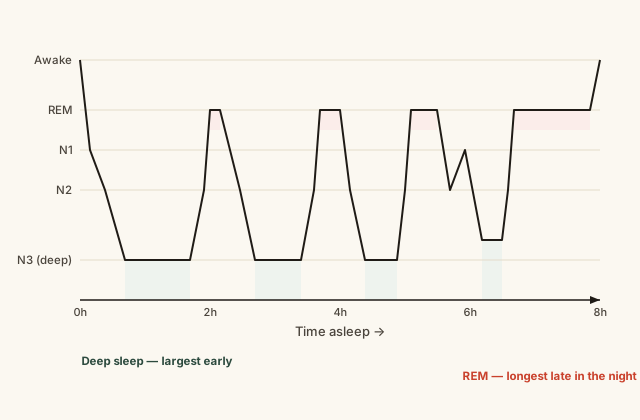
Trace the line from left to right and notice two patterns: the deep, slow-wave dips are tallest (deepest) in the first one or two cycles and shrink in later cycles, while the REM segments — marked separately — start short and get progressively longer toward morning. This is why a night cut short from the end (an early wake-up) disproportionately removes REM sleep, while a night cut short from the beginning (a late bedtime with a fixed wake time) can still preserve a reasonable amount of deep sleep if enough hours remain.
Common mistakes
Common Mistakes
Thinking sleep is one uniform, passive state from lights-out to waking up.
→ Sleep is an active, cycling process — the brain moves through distinct light, deep, and REM stages roughly every 90 minutes, each doing different restorative work.
Believing a couple of long weekend 'catch-up' sleep sessions fully reverses a week of sleep debt.
→ Extra weekend sleep can help but doesn't fully restore the specific functions tied to lost cycles on the nights they were missed — consistent nightly sleep duration is a stronger long-term strategy than occasional catch-up sleep.
Assuming melatonin supplements work like a general sedative that forces sleep.
→ Melatonin primarily signals timing to the circadian system rather than directly sedating the body — it's more useful for shifting when sleepiness occurs (like with jet lag) than for treating sleep difficulty unrelated to timing.
Common misconception
“The brain 'shuts off' or goes dormant during sleep.”
The brain stays highly active throughout sleep — during REM sleep specifically, electrical brain activity closely resembles the waking state, and even deep NREM sleep involves organized, purposeful activity rather than a general shutdown. Sleep is better described as the brain switching into different, structured processing modes — supporting memory consolidation, waste clearance, and emotional processing — than as the brain simply powering down for the night.
An EEG (brain activity recording) taken during REM sleep looks almost as active as one taken while a person is awake. What does this tell us about the common idea that the brain 'shuts off' during sleep?
Try it yourself
What to do next
What to do next
- Use the calculator above to see how close your usual sleep duration lands to a whole number of 90-minute cycles.
- Keep a consistent bedtime and wake time for a week and notice whether waking up feels less groggy than on inconsistent nights.
- Next time you cross time zones, expect roughly one time zone's worth of circadian adjustment per day rather than an overnight reset.
- If sleep difficulty persists for weeks despite consistent habits, talk to a healthcare provider rather than assuming it will resolve on its own — persistent insomnia can have treatable underlying causes.