How Chronic Stress Actually Damages Long-Term Health
Chronic stress damages health not because the stress response is harmful, but because it is designed for short bursts and stays switched on. When you face a threat, the sympathetic nervous system and the hypothalamic-pituitary-adrenal (HPA) axis release adrenaline and cortisol, raising heart rate, blood pressure and blood sugar; normally these return to baseline once the threat passes. Neuroscientist Bruce McEwen called the cumulative cost of repeated or prolonged activation allostatic load. Research links it to measurable outcomes. In a 1991 study of 394 volunteers exposed to cold viruses, people with higher stress scores were more likely to become infected and develop colds. A 2012 study found chronic stress can make immune cells less responsive to cortisol's anti-inflammatory signal, allowing inflammation to run higher. A 2012 Lancet meta-analysis of about 197,000 workers found job strain was associated with a 23% higher risk of coronary heart disease. A 2004 review of more than 300 studies linked chronic stressors to broad suppression of immune measures. These are associations measured in groups, not predictions for any individual. NIMH and MedlinePlus describe general coping steps and advise seeing a health care provider when stress feels unmanageable.
Reading time
— 5 min
Updated
— Sep 30, 2026
Fact-reviewed
— Sep 30, 2026
This entry explains general stress physiology and research findings. It is not medical advice and can't diagnose or treat any condition. If stress is affecting your health, sleep or daily life, talk to a doctor or other qualified health care provider. In the U.S., if you're in crisis, call or text 988.
Key Takeaways
Key Takeaways
1The stress response is built to switch on for minutes and then off. Chronic stress keeps it running, and that cumulative wear is called allostatic load.
2Prolonged stress is linked to weaker immune defenses, higher inflammation, higher blood pressure and a higher risk of heart disease.
3The effects are real but modest per person: job strain was linked to about 23% higher coronary heart disease risk in a 197,000-person analysis.
4These are group-level associations, not a diagnosis. Persistent stress is worth raising with a health care provider.
The concept
Your stress response is like a car's turbo: brilliant for overtaking, damaging if you drive with it on all day. When you face a threat, your body releases adrenaline and cortisol, your heart speeds up, your blood pressure rises and stored sugar floods your blood. That's helpful for a short burst. The trouble starts when the threat never fully goes away, such as months of caregiving, money worries or a job you can't control. Then the system keeps running, and the parts it pushes hardest (your blood vessels, your immune system, your metabolism and your sleep) start to wear. The damage isn't from one bad day; it's from the system never getting to switch off.
Quick check
What makes chronic stress harmful when short bursts of stress are not?
Worked examples
Example 1: The job interview vs the long caregiving year (baseline case)
Before a job interview, your heart rate jumps, your palms sweat and your cortisol rises. An hour after you leave, it's settling back to normal. That's allostasis working as designed. Now picture someone caring for a parent with dementia for a year: interrupted nights, constant vigilance, little control. The same systems fire many times a day and rarely get a full reset. That second pattern is what researchers mean by chronic stress, and it's the pattern behind the long-term findings below. The hormones are the same; the dose over time is not.
Example 2: The cortisol paradox and the common cold (edge case)
Cortisol suppresses inflammation, so you might expect chronic stress to calm it. The research points the other way. In 1991, Cohen, Tyrrell and Smith gave cold viruses to 394 healthy volunteers. As psychological stress scores rose, so did the rates of infection and of clinical colds, in a dose-response pattern; from the lowest to the highest stress group, clinical colds rose from about 27% to about 47%. A 2012 follow-up by Cohen's team helped explain why: in people under prolonged stress, immune cells became less responsive to cortisol's signal, and those people produced more inflammatory chemicals when infected. The edge case is the paradox itself: plenty of cortisol, but tissues that have partly stopped listening to it.
Example 3: Reading a 23% heart-risk headline correctly (applied case)
The 2012 Lancet meta-analysis pooled 13 European studies with about 197,000 workers and found that job strain (high demands, low control) was associated with about a 23% higher risk of coronary heart disease. What does that mean in practice? It's a relative increase. If a group's baseline 10-year risk were 5%, a 23% increase would make it about 6.2%, roughly one extra case per 100 people over a decade. The authors estimated that job strain accounted for about 3.4% of coronary heart disease cases, a smaller share than factors such as smoking or physical inactivity. Chronic stress matters, and it adds up across a population, but it's one risk factor among several, which is why a doctor looks at the whole picture rather than stress alone.
Quick check
A study reports '23% higher risk'. What's the most accurate reading?
How it works (visual)
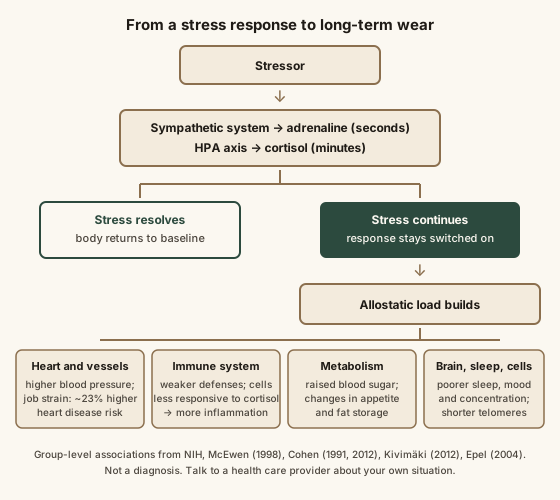
From a stress response to long-term wear
The fork in the middle is the whole story. The same response that helps in a crisis becomes a cost when it doesn't switch off, and the effects show up wherever the response pushes hardest.
Common mistakes
Common Mistakes
✕
Treating all stress as damaging.
→ Short, resolved stress is normal and often useful. The research concern is stress that is prolonged or never resolves.
✕
Reading relative risks as personal predictions.
→ A 23% higher risk is a group-level relative figure; the absolute change depends on your starting risk.
✕
Trying to 'lower cortisol' with supplements based on online claims.
→ Cortisol is essential. Discuss concerns about stress hormones with a doctor rather than self-treating.
✕
Assuming symptoms are 'just stress'.
→ Chest pain, persistent fatigue or sleep problems can have other causes and deserve a medical evaluation.
✕
Ignoring the behavior side.
→ Sleep, activity and alcohol use often shift under stress and carry their own health effects.
Common misconception
“Stress damages your health mainly by flooding your body with too much cortisol.”
Part of the damage comes from the system staying switched on, and part from tissues becoming less responsive to cortisol. Research by Cohen and colleagues linked prolonged stress to immune cells that partly ignore cortisol's anti-inflammatory signal, which can let inflammation run higher. It's a problem of regulation over time, not simply of one hormone being too high. Digestion is another area where vague symptoms get pinned on a single cause; what gut health actually means separates what's established from the hype.
What to do next
What to do next
Notice whether your stress has an end point or has been running for weeks or months.
Keep an eye on signs NIMH lists, such as sleep changes, headaches, irritability or trouble concentrating.
Use the general coping steps NIMH describes: regular physical activity, relaxing activities, sleep, and staying connected with people you trust.
If stress feels unmanageable or symptoms last for weeks, talk to a doctor or other health care provider.
Mention long-running stress at routine checkups, since your provider considers it alongside blood pressure and other risk factors.
In the U.S., if you're in crisis, call or text 988.
FAQ
FAQ
Related terms
Related terms
Allostasis
The body's process of staying stable by changing: adjusting heart rate, hormones and energy use to meet a challenge, then returning to baseline.
Allostatic load
The cumulative wear and tear on the body from stress responses that are activated too often, last too long or don't shut off properly.
HPA axis
The hypothalamic-pituitary-adrenal axis, a hormone chain from the brain to the adrenal glands that ends in cortisol release.
Glucocorticoid receptor resistance
A state in which immune cells respond less to cortisol's signal to calm inflammation, observed in some people under prolonged stress.
Job strain
A work situation combining high demands with low control over how the work gets done, a widely studied form of chronic stress.
Telomere
A protective cap on the ends of chromosomes that shortens as cells divide; shorter telomeres are used in research as a marker of cellular aging).
This entry was researched from public sources and drafted with AI-assisted tools, then edited — errors are still possible. Spot one, or want a topic covered? Read our disclaimer.
 KnowThis