What Resting Heart Rate Actually Reveals About Fitness
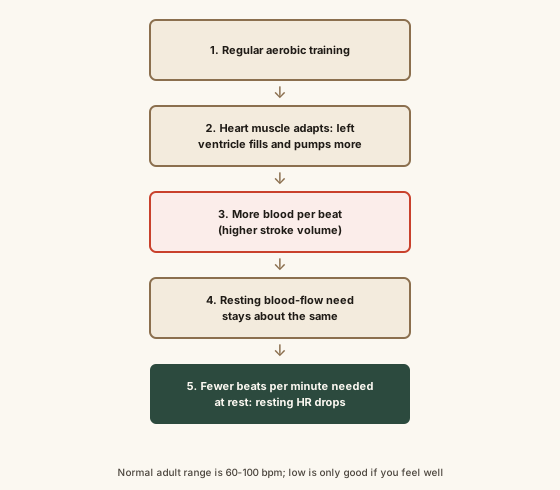
Resting heart rate, the number of heartbeats per minute while at complete rest, normally ranges from 60 to 100 beats per minute for adults, per the American Heart Association and MedlinePlus, and well-trained athletes often have rates closer to 40. Regular aerobic exercise tends to lower it because the heart adapts to pump more blood with each beat (higher stroke volume) and resting parasympathetic tone increases, so fewer beats are needed to supply the same blood flow. A resting rate that stays higher than usual can also reflect poor sleep, stress, dehydration, illness, caffeine, or overtraining, while some medications such as beta blockers lower it, and Harvard Health notes that higher resting rates have been associated with greater cardiovascular risk in population studies. The most useful signal is an individual's own trend measured consistently over time, not comparison with other people; a low rate accompanied by dizziness or fainting, or a rate persistently above 100, warrants medical evaluation. This article is general educational information, not medical advice.
Reading time
— 4 min
Updated
— Sep 25, 2026
Fact-reviewed
— Sep 25, 2026
Key Takeaways
Key Takeaways
1Normal adult resting heart rate is 60 to 100 beats per minute. Well-trained athletes are often closer to 40, per the American Heart Association.
2Aerobic training lowers it mainly because the heart pumps more blood per beat, so it needs fewer beats to do the same job at rest.
3Sleep, stress, illness, caffeine, medications, and genes all move it too, so your own trend over weeks tells you more than one reading or a comparison with anyone else.
The concept
At rest, your body needs a fairly steady flow of blood. Your heart can deliver it with many small pumps or fewer bigger ones. Regular cardio, like brisk walking, running, cycling, or swimming, trains the heart to push out more blood with each squeeze. So when you're resting, it can beat less often and still keep up. That's why a resting heart rate drifting down over months of training is a good sign. But lots of other things also nudge it: a bad night's sleep, a stressful week, a cold coming on, or coffee. So the number is a helpful clue, not a fitness score by itself.
Wearables estimate resting heart rate automatically, usually from optical sensors on the wrist, and are generally decent at resting values; how fitness trackers measure heart rate explains where they're reliable and where they aren't. For the plumbing behind all this, see the circulatory system in depth.
Quick check
After six months of regular cycling, someone's resting heart rate drops from 74 to 64. What's the most likely explanation?
Worked examples
Example 1: Measuring it properly (baseline case)
Right after waking, before getting up or having coffee, place two fingers on the inside of your wrist below the thumb, as MedlinePlus describes. Count the beats for 30 seconds and double it: 34 beats means 68 per minute. Do this for a week and average the results. One reading can be off by several beats; a weekly average is a baseline you can actually track.
Example 2: The unexplained jump (variation)
A runner's morning average has been 56 for months. Over three days it reads 63, 64, and 62. Their fitness hasn't collapsed in three days. Common explanations are a coming cold, poor sleep, a very hard training block, alcohol, or a stressful week. Many coaches treat a sustained rise of several beats above baseline as a cue to take an easier day, which is exactly the kind of personal-trend use the number is good for.
Example 3: Low for different reasons (applied case)
Two people both read 50 beats per minute. One is a marathoner who feels great: a classic training effect. The other rarely exercises, recently started a beta blocker for blood pressure, and has had lightheaded spells. Same number, different meaning. The AHA notes that a slow rate with symptoms like dizziness, fatigue, or fainting is a reason to see a clinician, whatever someone's fitness level.
Quick check
In Example 2, what's the most sensible reading of the runner's higher numbers?
How it works (visual)
Why aerobic training tends to lower resting heart rate
Common mistakes
Common Mistakes
✕
Comparing your resting heart rate with someone else's to judge fitness.
→ Compare with your own baseline over weeks. Genes and age shift the number a lot between people.
✕
Measuring at random times of day.
→ Measure at the same time, ideally right after waking, and average several days.
✕
Assuming a lower number is always better.
→ Low is good only if you feel well. A low rate with dizziness or fainting, or a rate persistently above 100, is worth a medical check.
Common misconception
“Resting heart rate is a direct measure of how fit you are: the lower the number, the fitter the person.”
It's a useful but indirect signal. Aerobic training does tend to lower it, which is why many athletes sit near 40 per the American Heart Association. But genes, age, sleep, stress, hydration, caffeine, illness, and medications like beta blockers all shift it too. Two people with the same number can be very differently fit. The reliable use is watching your own trend under consistent conditions, alongside how you actually feel and perform.
What to do next
What to do next
Measure your resting heart rate on waking for 7 days and write down the average as your baseline.
Recheck the weekly average once a month if you're starting a cardio routine.
Treat a sustained rise of several beats above your baseline as a cue to look at sleep, stress, and recovery.
See a clinician if your resting rate is persistently above 100, or low with dizziness, fainting, chest pain, or unusual fatigue. This article isn't medical advice.
FAQ
FAQ
Related terms
Related terms
Resting heart rate
The number of times the heart beats per minute while you're fully at rest, best measured after waking and before getting up.
Stroke volume
The amount of blood the heart's left ventricle pumps out with each beat. Aerobic training tends to increase it.
Cardiac output
The total blood the heart pumps per minute: heart rate multiplied by stroke volume.
Bradycardia
A resting heart rate below 60 beats per minute. It's normal in many fit people but can signal a problem if it comes with symptoms like dizziness or fainting.
Tachycardia
A resting heart rate above 100 beats per minute. It can be temporary (fever, caffeine, anxiety) or a sign of a condition worth checking.
Parasympathetic tone
The steady 'rest and digest' influence of the nervous system, carried largely by the vagus nerve, which slows the heart at rest.
This entry was researched from public sources and drafted with AI-assisted tools, then edited — errors are still possible. Spot one, or want a topic covered? Read our disclaimer.
 KnowThis