 KnowThis
Key Takeaways
Key Takeaways
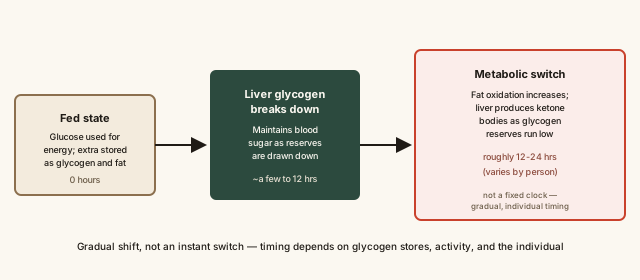
- 1During a fasting window, the body first draws down stored liver glycogen to maintain blood sugar — it doesn't switch straight to burning fat the moment a meal ends.
- 2As glycogen reserves deplete — commonly somewhere in a roughly 12-to-24-hour range, though this varies by person — the body gradually shifts toward fat oxidation and ketone production.
- 3This metabolic shift itself is well documented, but evidence on intermittent fasting's broader health benefits in humans is still developing; this is general educational information, not medical advice.
The concept
It's worth being direct about the evidence status here too: per NIA and NIDDK, much of the most striking research on intermittent fasting's health benefits so far comes from animal studies or relatively short-term human trials. Some studies suggest possible benefits for weight and certain metabolic markers, but evidence on long-term human outcomes — including effects on lifespan — remains limited, and researchers describe this as an active, ongoing area of study rather than settled science.
A person eats dinner and then doesn't eat again for 14 hours overnight and into the next morning. What is most likely happening metabolically for most of that window?
Worked examples
Example 1: A 16:8 time-restricted eating schedule (baseline case)
Example 2: A hard workout the evening before (edge case / variation)
Example 3: A longer 24-hour fast (real-world / applied case)
Why might two people following the exact same 16-hour fasting schedule experience the metabolic switch at noticeably different points?
How it works (visual)
Common mistakes
Common Mistakes
Assuming fat-burning starts the instant you stop eating.
→ Understand the body draws on stored liver glycogen first — the shift toward meaningfully increased fat oxidation and ketone production happens gradually as those reserves deplete.
Treating 'the metabolic switch happens at 12 hours' (or any single number) as a fixed rule that applies to everyone.
→ Recognize the commonly cited range is roughly 12 to 24 hours, and the exact timing for any individual depends on glycogen stores, recent activity, and other individual factors, per NIA.
Treating early or animal-study findings on intermittent fasting's health benefits as settled proof for humans.
→ Represent the evidence honestly — some studies suggest possible benefits, but human evidence, especially for long-term outcomes, is still limited and actively being studied, per NIA and NIDDK.
Common misconception
“Intermittent fasting immediately switches your body into 'fat-burning mode' the moment you stop eating.”
Per NIA descriptions of this process, the body doesn't flip an immediate switch. It first relies on stored liver glycogen to maintain blood sugar. Only as those reserves gradually deplete — commonly described as happening somewhere in a roughly 12-to-24-hour range, and varying by individual — does the body increasingly shift toward fat oxidation and ketone production. The metabolic switch is a real, gradual process, not an instant on/off event triggered by simply skipping a meal.
What to do next
What to do next
- Understand this describes a normal metabolic process — glycogen depletion followed by increasing fat oxidation — not a specific guaranteed health benefit.
- Don't treat the commonly cited '12 to 24 hour' window as a fixed number that applies identically to you; individual factors shift the timing.
- Treat claims about intermittent fasting's broader health benefits with appropriate caution — per NIA and NIDDK, human evidence is still developing for many outcomes.
- This is general educational information, not medical advice — talk with a doctor before starting any fasting regimen, especially with a medical condition, medication, pregnancy or breastfeeding, or a history of disordered eating.