 KnowThis
Key Takeaways
Key Takeaways
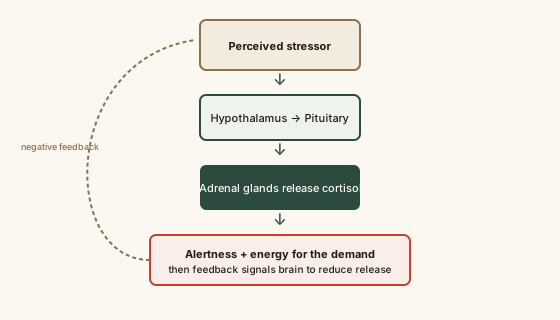
- 1Cortisol is released by the adrenal glands, controlled by the brain's HPA axis, to temporarily raise alertness and energy in response to a stressor.
- 2A normal stress response includes cortisol rising, then falling back down once the stressor passes, through a negative feedback loop.
- 3Per NIH-affiliated sources, the documented health concerns are mainly linked to chronically elevated cortisol over weeks or months, not a normal short-term spike.
The concept
This distinction between a normal short-term spike and sustained chronic elevation is also why occasional stressful events (a deadline, a difficult conversation) aren't inherently harmful — the documented concerns specifically involve stress that doesn't let up for weeks or months at a time.
Someone experiences a stressful, high-pressure meeting, feels alert and keyed-up during it, and feels back to normal within a couple of hours afterward. What does this pattern most likely reflect?
Worked examples
Example 1: A normal acute stress response (baseline case)
Example 2: Cortisol's normal daily rhythm, independent of stress (edge case / variation)
Example 3: Sustained chronic stress over months (real-world / applied case)
Why is time of day an important factor when interpreting a cortisol test result, per MedlinePlus guidance?
How it works (visual)
Common mistakes
Common Mistakes
Treating cortisol as inherently bad and something to eliminate entirely.
→ Recognize a normal, short-term stress response with cortisol rising and falling is healthy and adaptive, not a problem to fix.
Assuming a single cortisol measurement is meaningful without accounting for time of day.
→ Interpret cortisol test results against the hormone's normal daily rhythm, per MedlinePlus guidance.
Overlooking the difference between an occasional stressor and chronic, ongoing stress.
→ Understand that documented health concerns are specifically linked to chronic elevation over weeks or months, not everyday short-term stress.
Common misconception
“Cortisol is simply a harmful 'stress hormone' that the body would be better off without.”
Per NIH-affiliated medical references, cortisol is a normal, necessary hormone that supports alertness and energy availability during real short-term demands, and it follows an ordinary daily rhythm independent of stress. The documented health concerns associated with cortisol — per APA guidance on stress and the body — come from chronic, sustained elevation over an extended period, not from the ordinary, adaptive rise-and-fall pattern that happens during everyday short-term stress.
What to do next
What to do next
- Don't treat an occasional stressful event as inherently harmful — a short-term cortisol rise followed by a return to baseline is a normal, adaptive response.
- Pay closer attention to stress that persists over weeks or months without relief, since that's the pattern linked to documented health concerns.
- If a cortisol test is ordered, ask how time of day was accounted for, since cortisol follows a normal daily rhythm.
- This is general educational information, not medical advice — for symptoms of concern or a suspected hormonal condition, consult a licensed healthcare provider.