 KnowThis
Key Takeaways
Key Takeaways
- 1Sleep moves through repeating ~90-minute cycles of light sleep, deep sleep, and REM sleep, not one uniform state from lights-out to waking.
- 2Deep sleep does more of the physical restoration work, while REM sleep supports memory consolidation and emotional processing — different stages, different jobs.
- 3Being woken mid-cycle, especially out of deep sleep, tends to cause more grogginess than waking at a natural cycle boundary, even with the same total sleep time.
The concept
This staged structure is exactly why sleep quality can't be reduced to hours alone — when you wake up relative to your cycle, and how much of each stage you got, both genuinely matter to how rested you feel.
Two people each sleep exactly 7 hours, but one is woken by an alarm in the middle of deep sleep while the other wakes naturally at the end of a full cycle. What does sleep-stage research suggest about how they'll likely feel?
Worked examples
Example 1: A full, uninterrupted 8-hour night (baseline case)
Example 2: A 5-hour night cut short at the end (edge case / variation)
Example 3: Shift work with irregular sleep timing (real-world / applied case)
Why might a night-shift worker sleeping a full 8 hours during the day still feel less rested than someone sleeping the same 8 hours at night?
How it works (visual)
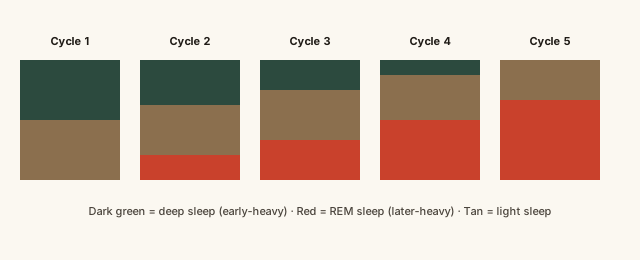
This shifting balance across the night is exactly why cutting sleep short at different points costs you different things — an early wake-up costs REM-heavy time, while sleep-onset delay costs early deep-sleep time.
Common mistakes
Common Mistakes
Judging sleep quality by total hours alone, ignoring when interruptions happen.
→ Consider both total sleep time and how continuous it was — mid-cycle waking has real costs independent of total hours.
Assuming all sleep hours are functionally interchangeable.
→ Recognize deep sleep and REM sleep support different functions, and cutting sleep short at different points costs you different things.
Dismissing shift-work sleep problems as just needing 'the same number of hours' during the day.
→ Account for circadian rhythm misalignment as a separate, real factor affecting sleep quality beyond total duration.
Common misconception
“As long as you get your target number of sleep hours, it doesn't matter when in the cycle you wake up.”
Per NIH sleep research, waking abruptly mid-cycle — particularly out of deep sleep — is associated with sleep inertia, a period of grogginess and reduced alertness, independent of total sleep duration; total hours and where in the cycle you wake are both genuinely relevant factors, not just the one number most people track.
What to do next
What to do next
- Aim for a consistent sleep and wake schedule, which supports more predictable, complete sleep cycles over time.
- If possible, avoid cutting sleep short right in the middle of a typical cycle length (roughly every 90 minutes from sleep onset).
- For shift work, prioritize a dark, quiet daytime sleep environment to reduce circadian misalignment effects on sleep quality.
- If you consistently feel unrested despite adequate total sleep time, discuss it with a qualified healthcare provider rather than assuming more hours alone will fix it.