 KnowThis
Key Takeaways
Key Takeaways
- 1Memory forms in stages — encoding, consolidation, and retrieval — and a breakdown at any stage produces a different kind of forgetting.
- 2Sleep plays a measurable role in consolidation, which is a major reason memory and learning suffer after poor sleep.
- 3Memory is reconstructive, not a fixed recording — each time you recall something, you're rebuilding it, which is exactly why confident, vivid memories can still be partly inaccurate.
The concept
Understanding memory as reconstructive rather than recorded has real consequences — it's a core reason eyewitness testimony, however confidently delivered, can still contain genuine errors.
An eyewitness describes a crime in vivid, confident detail months later. Based on how memory actually works, what does that confidence actually tell you about accuracy?
Worked examples
Example 1: Cramming the night before a test (baseline case)
Example 2: A childhood memory that changed over retellings (edge case / variation)
Example 3: Spaced repetition for language learning (real-world / applied case)
Why is spacing out study sessions over increasing intervals generally more effective than cramming the same total study time into one sitting?
How it works (visual)
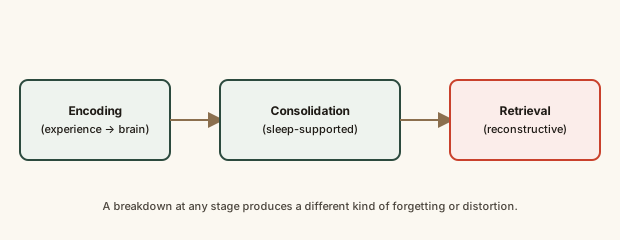
Each stage is a separate point of failure — poor attention breaks encoding, poor sleep breaks consolidation, and outside information breaks retrieval accuracy, even when the earlier stages went fine.
Common mistakes
Common Mistakes
Assuming a vivid, confident memory must be an accurate one.
→ Recognize memory is reconstructive — treat even confident recollections as generally reliable but not infallible, especially for fine details.
Cramming all studying into one session right before it's needed.
→ Space review sessions over increasing intervals to give consolidation, including sleep-supported consolidation, time to work.
Sacrificing sleep to fit in more study time.
→ Protect sleep around learning sessions specifically, since sleep plays a documented, measurable role in consolidating new memories.
Common misconception
“Memory works like a video recording — an accurate, unchanging replay of what actually happened.”
Per NIH research summaries on memory and the brain, recall is a reconstructive process — each retrieval rebuilds the memory from stored fragments, which can be influenced by later information, emotional state, or repeated retelling, and a memory can feel completely vivid and certain while still containing genuine inaccuracies the person has no way of detecting from the inside.
What to do next
What to do next
- Use spaced repetition (reviewing material at increasing intervals) instead of cramming when you need long-term retention, not just short-term recall.
- Protect sleep around important learning, since consolidation is genuinely sleep-dependent.
- Treat your own confident memories, especially of stressful or long-past events, as generally reliable but not perfectly accurate.
- If you notice significant or worsening memory changes in yourself or someone you know, talk to a qualified healthcare provider rather than assuming it's normal aging without checking.