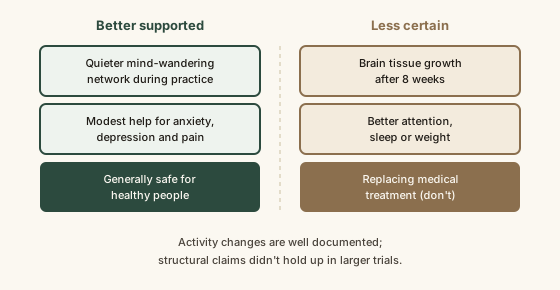
Meditation practices train attention and awareness, and brain imaging shows they change how the brain behaves. Brewer and colleagues (2011, PNAS) found experienced meditators had lower activity in the default mode network, a set of regions active during mind-wandering. A 2011 study by Hölzel and colleagues reported increases in gray matter density in regions such as the hippocampus after an 8-week mindfulness-based stress reduction (MBSR) course, and it became widely cited. But a larger 2022 analysis of two randomized controlled trials by Kral and colleagues (Science Advances) found no evidence that MBSR changed brain structure compared with control groups. On outcomes that matter to people, a 2014 JAMA Internal Medicine meta-analysis by Goyal and colleagues found moderate evidence that mindfulness meditation programs improve anxiety, depression and pain, with small-to-moderate effects. The NIH's National Center for Complementary and Integrative Health describes meditation as generally safe for healthy people and not a replacement for medical care.
Reading time
— 4 min
Updated
— Sep 26, 2026
Fact-reviewed
— Sep 26, 2026
Key Takeaways
Key Takeaways
1Meditation reliably changes brain activity while you practice, such as quieting the network linked to mind-wandering.
2Early studies suggested eight weeks of practice grows brain tissue, but a larger 2022 analysis of randomized trials didn't find structural changes.
3The best-supported benefits are modest improvements in anxiety, depression and pain. It's a useful tool, not a cure.
The concept
Your brain has a kind of "autopilot" that switches on whenever you're not focused: replaying conversations, planning dinner, worrying about Monday. Meditation is practice at noticing when autopilot has taken over and gently coming back to something simple, like your breath. Brain scans show that this practice changes how the brain behaves: the autopilot regions get quieter during meditation, especially in experienced meditators. What's less certain is the popular claim that a few weeks of meditation physically grows parts of your brain. Bigger, better studies haven't confirmed that. The more reliable finding is simpler: for many people, regular practice modestly eases anxiety, low mood and pain.
Meditation overlaps with other recovery habits. Stress and sleep influence each other, so the ideas in how sleep cycles affect recovery are a useful companion to this page.
Quick check
A headline says 'Eight weeks of meditation grows your brain.' Based on current evidence, what's the most accurate response?
Worked examples
Example 1: Ten minutes of breath focus (baseline case)
You sit, set a timer for ten minutes, and focus on the feeling of breathing. Within a minute, you're thinking about an email. You notice, and return to the breath. That cycle, drift, notice, return, may happen dozens of times. Each return is the actual exercise, much like each lift in a gym set. Brain imaging suggests this is when default mode activity dips and attention-control regions engage. The feeling of calm afterward is a real, short-term state change.
Example 2: When the famous finding didn't hold up (edge case)
The 2011 gray-matter study compared a small MBSR group with a small waitlist group and reported density increases in several regions. It was widely cited as proof that meditation rebuilds the brain. Eleven years later, Kral and colleagues ran the test with randomized trials, more participants and an active comparison program, and found no structural difference attributable to MBSR. This doesn't mean meditation is useless. It means one striking claim was probably too strong, which is common with early brain-imaging findings.
Example 3: Using meditation for anxiety (real-world use)
Someone with persistent worry tries an 8-week mindfulness course alongside their existing treatment. Based on the Goyal meta-analysis, a realistic expectation is a small-to-moderate reduction in anxiety symptoms, similar to what trials found, not a dramatic cure. They practice most days, track how they feel, and discuss it with their clinician. If meditation brings up distressing feelings, as it occasionally does, they adjust or pause rather than pushing through, as NCCIH advises.
Quick check
In Example 1, which part of the practice is the actual 'exercise'?
How it works (visual)
What meditation changes, by strength of evidence
Common mistakes
Common Mistakes
✕
Thinking you're failing because your mind keeps wandering.
→ Wandering is expected. Noticing it and coming back is the practice.
✕
Expecting dramatic, visible brain changes in a few weeks.
→ Expect modest, gradual effects on stress, mood and pain, which is what the trial evidence supports.
✕
Using meditation instead of treatment for a serious condition.
→ Use it alongside care from a clinician, and tell them if it brings up distressing experiences.
Common misconception
“Science has proven that a few weeks of meditation physically rewires and grows your brain.”
That claim rests mostly on early, small imaging studies. When researchers tested it with larger randomized trials, published in 2022, they found no evidence that an 8-week mindfulness course changed brain structure compared with control groups. What is well supported is that meditation changes brain activity during practice, and that mindfulness programs produce modest improvements in anxiety, depression and pain. That's a smaller claim, but a more trustworthy one.
What to do next
What to do next
Start with 5 to 10 minutes a day of breath-focused practice, at a consistent time.
Count each 'notice and return' as success, not failure.
If you want structure, look for an 8-week MBSR or similar course, which is what most research tested.
Track stress or mood weekly for a month to see whether it helps you.
If you have a mental health condition, talk with your clinician before starting intensive practice.
FAQ
FAQ
Related terms
Related terms
Mindfulness meditation
A practice of paying attention to present-moment experience, such as the breath, and noticing when the mind wanders without judging it.
MBSR
Mindfulness-Based Stress Reduction, a standardized 8-week group program of guided meditation and gentle movement, widely used in research.
Default mode network
A set of connected brain regions that is most active when the mind is wandering or thinking about oneself, and quieter during focused tasks.
Gray matter
Brain tissue made up mostly of nerve cell bodies. MRI studies estimate its volume or density in specific regions.
Neuroplasticity
The brain's ability to change its activity, connections and, over time, structure in response to experience and practice.
This entry was researched from public sources and drafted with AI-assisted tools, then edited — errors are still possible. Spot one, or want a topic covered? Read our disclaimer.
 KnowThis