What the Placebo Effect Actually Reveals About the Mind
The placebo effect is a real improvement in symptoms that comes from expecting treatment rather than from an active ingredient. Brain research shows it isn't imaginary: in a 1978 Lancet study, Levine, Gordon and Fields found that the opioid-blocker naloxone reduced placebo pain relief after dental surgery, showing the body's own opioids were involved, and a 2004 Science study by Wager and colleagues found placebo reduced activity in pain-processing brain regions. Expectation cues matter: in a 2008 JAMA study by Waber and colleagues, 85% of volunteers told a pill cost $2.50 reported pain relief, versus 61% told it was discounted to 10 cents. Even placebos given openly can help some conditions; in a 2010 trial by Kaptchuk and colleagues, 59% of irritable bowel syndrome patients taking pills labeled as placebo reported adequate relief versus 35% with no treatment. The limits are just as important. A 2001 NEJM review by Hróbjartsson and Gøtzsche comparing placebo with no treatment found little evidence of large effects except possibly on subjective outcomes such as pain. Much of what looks like a placebo response is natural recovery or regression to the mean. The reverse, the nocebo effect, is also real: in the 2020 SAMSON trial, about 90% of the side-effect burden people reported on statins also appeared when they took placebo.
Reading time
— 4 min
Updated
— Sep 27, 2026
Fact-reviewed
— Sep 27, 2026
Key Takeaways
Key Takeaways
1The placebo effect is real: expecting relief can release the body's own painkillers and change how the brain processes pain.
2It mostly changes how symptoms feel, such as pain and nausea, not the disease underneath.
3It works in reverse too: expecting side effects can cause them (the nocebo effect), and some 'placebo effect' is just the body healing on its own.
The concept
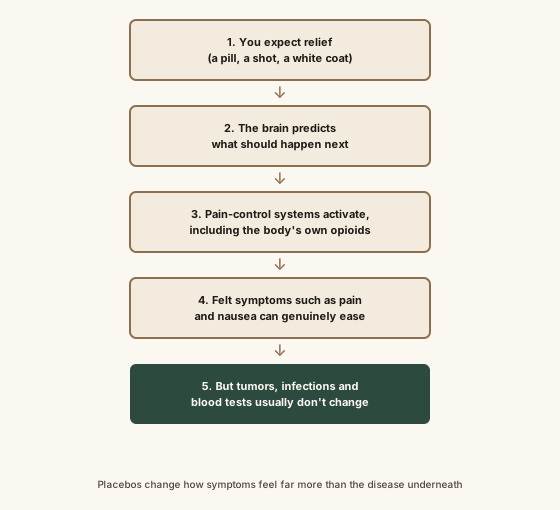
Give someone with a headache a sugar pill and tell them it's a painkiller, and a meaningful number will say the pain eased. They're not faking it. Your brain doesn't just receive pain signals; it predicts and adjusts them. When you strongly expect relief, the brain can turn down the pain volume, partly by releasing its own natural painkillers. That's why the placebo effect shows up most for things the brain helps generate, like pain, nausea and tiredness. But expecting to get better doesn't kill bacteria or shrink a tumor, and some people who "respond to placebo" were simply going to feel better anyway.
Quick check
Why does naloxone reducing placebo pain relief matter?
Worked examples
Example 1: The expensive pill (baseline case)
In the 2008 study, 82 volunteers received mild electric shocks before and after taking a pill described as a new painkiller. It was a placebo in every case. Half read that it cost $2.50 per pill; half read it had been discounted to 10 cents. About 85% of the full-price group reported less pain, compared with 61% of the discount group. Same pill, same shocks. The only thing that changed was the expectation built by the price.
Example 2: The side effects that weren't the drug (edge case)
In the SAMSON trial, 60 people who had stopped statins because of side effects took statin tablets, identical placebo tablets and no tablets in random months over a year, rating their symptoms daily without knowing which was which. Symptom scores were about as high on placebo months as on statin months; roughly 90% of the symptom burden appeared with the dummy pill. The symptoms were real, but expectation, not the drug, caused most of them. After seeing their results, about half the participants restarted statins. It's the nocebo effect: expecting harm produces harm.
Example 3: Judging a remedy that "worked" (real-world use)
You try a new herbal remedy on day 3 of a cold and feel better by day 6. Did it work? Colds typically resolve in 7 to 10 days, and you likely started the remedy when symptoms peaked, exactly when they were about to improve anyway. Add a real placebo boost to how you feel, and the remedy looks convincing. That's why medicine relies on randomized, placebo-controlled trials: the only way to know what a treatment adds is to compare it with an identical-looking dummy.
Quick check
In SAMSON, why were the symptoms on placebo months real but not caused by statins?
How it works (visual)
How expectation changes what you feel
Common mistakes
Common Mistakes
✕
Concluding a remedy works because you felt better after taking it.
→ Ask whether you'd have improved anyway, and look for placebo-controlled trials.
✕
Calling placebo relief 'all in your head,' as if it weren't real.
→ The relief is real and has measurable brain chemistry. What it usually doesn't do is treat the underlying disease.
✕
Quitting a prescribed medicine because you read side effects might be nocebo.
→ Some side effects are real. Discuss symptoms with your doctor, who can try a different drug, dose or a structured test.
Common misconception
“Placebos can cure almost anything if you believe hard enough.”
The evidence shows placebo effects are strongest for subjective symptoms like pain, nausea and fatigue, and modest or absent for objective disease measures like tumor size, infection or blood sugar. Belief can make you feel better; it rarely changes the disease. That's exactly why effective treatments have to beat placebo in trials, and why "it worked for me" can't tell you whether a remedy actually does anything.
What to do next
What to do next
Next time a remedy 'works,' ask what would have happened without it.
When reading about a treatment, check whether it was compared with a placebo in a randomized trial.
If you think a medicine is causing side effects, keep a symptom diary and discuss it with your doctor before stopping.
Notice how price, packaging and confidence shape your expectations of products.
FAQ
FAQ
Related terms
Related terms
Placebo
A treatment with no active ingredient for the condition, such as a sugar pill or saline injection.
Placebo effect
A real improvement in symptoms caused by expecting treatment, rather than by an active ingredient.
Nocebo effect
Negative symptoms, such as side effects, caused by expecting harm.
Regression to the mean
The tendency for unusually bad (or good) measurements to be followed by more ordinary ones, with no treatment involved.
Open-label placebo
A placebo given while telling the patient honestly that it contains no active drug.
This entry was researched from public sources and drafted with AI-assisted tools, then edited — errors are still possible. Spot one, or want a topic covered? Read our disclaimer.
 KnowThis