 KnowThis
Key Takeaways
Key Takeaways
- 1BMI = weight (kg) ÷ height (m)², a simple ratio originally developed for population-level statistics, not individual diagnosis.
- 2BMI correlates with body fat on average across large populations, but it cannot distinguish muscle mass from fat mass in any single person — two people with identical BMI can have very different body compositions.
- 3Health agencies including the CDC and WHO publish BMI's limitations alongside the measure itself — it is one screening input among several, not a standalone verdict on health.
The concept
None of this means BMI is useless — it means it's a rough, fast screening number that gets more useful in combination with other measures, not in isolation.
A bodybuilder with very low body fat and high muscle mass has a BMI in the 'overweight' range. What does this most likely indicate?
Worked examples
Example 1: Calculating BMI from weight and height (baseline case)
Example 2: Same BMI, different body composition (edge case / variation)
Why can't two people with the exact same BMI be assumed to have the same health risk profile?
Example 3: How BMI is actually used in a real clinical setting (real-world / applied case)
How it works (visual)
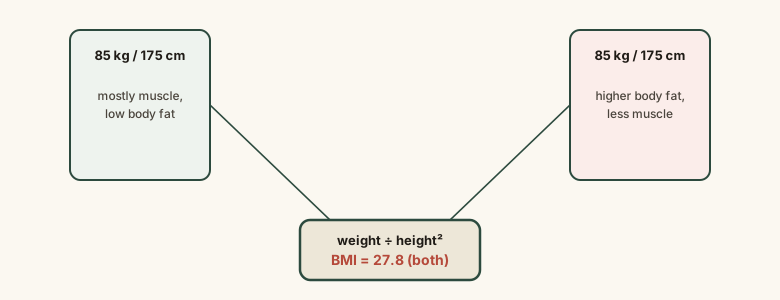
Both figures produce the identical number because the formula only ever sees total weight and height — the composition split shown underneath each figure is invisible to the calculation itself.
Common mistakes
Common Mistakes
Treating a single BMI number as a complete verdict on someone's health.
→ Use BMI as one screening input among several — waist circumference, blood pressure, and a full clinical picture matter too.
Assuming BMI category cutoffs apply identically and accurately to every population and body type.
→ Recognize that BMI can be less accurate for athletes, older adults, and some ethnic groups, per the agencies that publish it — a doctor can interpret it in the right context.
Using BMI to judge an individual's fitness or muscularity.
→ Remember BMI cannot see body composition at all — it measures a ratio of total weight to height, nothing more specific.
Common misconception
“BMI directly measures body fat percentage.”
BMI does not measure body fat directly — it is a ratio of total weight to height squared. It correlates with body fat on average across large populations, which is useful for public health research and quick screening, but for any individual person it cannot distinguish fat mass from muscle mass, bone density, or water weight. Direct body fat measurement requires different methods entirely, such as skinfold calipers, bioelectrical impedance, or DEXA scans.
What was BMI originally designed for when Adolphe Quetelet developed it in the 1830s?
Try it yourself
This calculator shows the BMI formula's arithmetic — it is a screening ratio, not an individual health assessment. Talk to a doctor about what any number means for you specifically.
What to do next
What to do next
- Treat BMI as one quick screening input, never a standalone verdict on your health.
- If your BMI falls outside the typical range, discuss it with a doctor alongside other measures like waist circumference and blood pressure.
- Remember BMI cannot distinguish muscle from fat — don't use it to judge fitness or body composition on its own.
- For an actual body composition assessment, ask a doctor about direct methods like skinfold measurement, bioelectrical impedance, or DEXA scanning.