Understanding Growth & Development Milestones (General, Informational)
Growth and developmental milestones — the ages by which most children typically sit up, speak first words, or reach a given height percentile — are published by health agencies as ranges covering most healthy children, not fixed deadlines, and are meant as a general screening tool a pediatrician interprets, not a diagnostic checklist for a parent to self-score.
Reading time
— 4 min
Updated
— Aug 22, 2026
Fact-reviewed
— Aug 22, 2026
This entry is general, population-level health literacy, not an individual assessment. Milestone ranges describe most children, not every child. If you have any concern about a specific child's development, talk to a pediatrician — they have tools and context this page does not.
Key Takeaways
Key Takeaways
1Published milestones (like 'most children walk between 9 and 18 months') are wide ranges covering typical variation among healthy children, not fixed deadlines.
2Growth percentiles compare a child's height, weight, and head circumference to a large reference population — a child tracking steadily along their own percentile line over time matters more than which single percentile they happen to sit at.
3Milestone checklists exist as a screening prompt for a pediatrician to interpret in context, not a self-diagnostic tool for a parent to score alone.
The concept
Health agencies like the CDC and WHO publish milestone ranges for skills like sitting up, saying first words, or walking — for example, most children walk independently somewhere between 9 and 18 months. That's a nine-month spread for a single "normal" skill, which is the point: healthy development doesn't happen on a single fixed schedule, it happens across a documented range of typical paces.
Knowing that milestones are ranges, not deadlines, changes how a checklist should actually be used — as a conversation starter with a pediatrician, not a pass/fail test.
Quick check
A child walks independently for the first time at 16 months. A friend's child walked at 11 months. What does this most likely indicate?
Worked examples
Example 1: Reading a milestone range correctly (baseline case)
The CDC lists first words typically appearing between 12 and 18 months. A child saying their first clear word at 17 months is still within the published typical range — not late, not early, simply within the documented normal spread for this specific skill.
Example 2: Interpreting a growth percentile over time (edge case / variation)
A child has tracked at roughly the 40th percentile for weight from age 1 to age 3, then drops to the 15th percentile at the 3-year checkup. The single 15th-percentile number, in isolation, would still be within a broadly normal range — but the drop itself, seen only by comparing to the child's own growth trend over time, is what a pediatrician would want to investigate further, since it represents a real change in trajectory rather than a stable, individually-normal pattern.
Quick check
Why might a pediatrician be more concerned about a growth percentile that suddenly drops than about a percentile that has always been low?
Example 3: Using a milestone checklist as a screening prompt, not a diagnosis (real-world / applied case)
A parent notices their 2-year-old isn't yet combining two words, one of the CDC's listed milestones for that age. Rather than concluding a diagnosis from the checklist alone, the appropriate next step is bringing the specific observation to the child's pediatrician at (or before) the next scheduled checkup — the checklist did its intended job by prompting the conversation, while the actual developmental assessment (which accounts for the whole child, not one isolated checklist item) stays with the qualified professional.
How it works (visual)
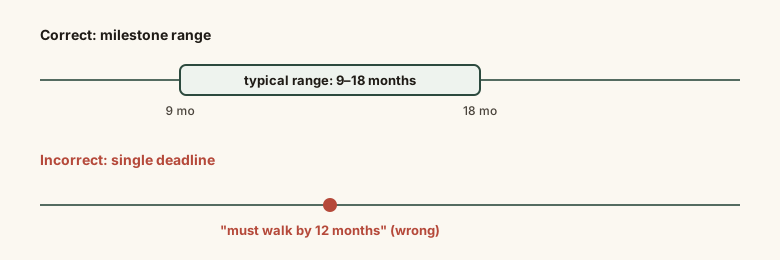
A milestone range vs. a single deadline
The shaded band, not the single point, is the accurate way to read any published milestone — a child anywhere inside that band is within the documented range of normal.
Common mistakes
Common Mistakes
✕
Treating the midpoint of a milestone range as the 'correct' or 'expected' age, and anything later as a delay.
→ Read the entire published range as normal — a child near either end of a documented range is still within it.
✕
Comparing one child's percentile directly to another specific child's percentile.
→ Compare a child's percentile to their own trend over time, not to another individual child — percentiles describe a population distribution, not a competition.
✕
Using an online milestone checklist to self-diagnose a developmental concern.
→ Bring specific observations to a pediatrician, who can assess the whole child in context rather than scoring one checklist in isolation.
Common misconception
“If a child hasn't reached a milestone by the average age often quoted, something is wrong.”
The "average age" quoted for a milestone is the middle of a documented range, not a deadline. Health agencies publish full ranges (not single average ages) precisely because a wide span of ages is genuinely typical for healthy children — falling later within that published range is, by definition, still within the normal, expected pattern of development.
Quick check
What is the primary intended use of a published developmental milestone checklist?
What to do next
What to do next
Read any milestone figure as a range, not a single deadline — check the full published span, not just the commonly quoted midpoint.
Track a child's own growth percentile trend over multiple checkups rather than judging a single reading in isolation.
Bring specific developmental observations to a pediatrician rather than self-scoring a checklist found online.
Remember that percentiles describe a normal population distribution — being below the 50th percentile is expected for roughly half of all healthy children.
FAQ
FAQ
Related terms
Related terms
Milestone range
The published span of ages within which most healthy children typically reach a given developmental skill, rather than one fixed expected age.
Growth percentile
A ranking that shows how a child's height, weight, or head circumference compares to a large reference population of children the same age and sex — not a grade or a target to maximize.
This entry was researched from public sources and drafted with AI-assisted tools, then edited — errors are still possible. Spot one, or want a topic covered? Read our disclaimer.
 KnowThis