Understanding Common Over-the-Counter Medicine Basics
Over-the-counter (OTC) medicines are organized around a small number of active-ingredient categories — like pain relievers, antihistamines, and decongestants — each with a distinct general mechanism, and understanding those categories (rather than memorizing brand names) is what makes a medicine aisle or a home cabinet legible, while any actual product choice or dose still belongs to the label instructions or a pharmacist.
Reading time
— 4 min
Updated
— Aug 22, 2026
Fact-reviewed
— Aug 22, 2026
This entry is general medicine literacy, not medical advice. It explains what categories of OTC medicine exist and generally do — it does not recommend any specific product or dose for any symptom. Always read the product's own label, and ask a pharmacist or doctor before starting any medicine, especially if you take other medications or have a health condition.
Key Takeaways
Key Takeaways
1Most OTC medicines fall into a small number of active-ingredient categories — pain relievers, antihistamines, decongestants, antacids, and cough suppressants are among the most common — each doing a distinct, specific job.
2The FDA requires every OTC product's active ingredient(s) to be listed first, in a standardized 'Drug Facts' panel, precisely so the ingredient (not the brand name) is what a consumer identifies.
3Many different brand names share the exact same active ingredient — the brand is marketing, the active ingredient is the actual chemistry doing the work.
The concept
Walk down any pharmacy aisle and the sheer number of boxes looks overwhelming, but nearly all of them are built from a short list of active ingredients — pain relievers (like acetaminophen or ibuprofen), antihistamines (for allergy symptoms), decongestants, antacids, and cough suppressants cover the large majority of what's on the shelf. Learning these categories, rather than memorizing individual brand names, is what actually makes the aisle legible.
None of this replaces reading an actual product's label — it's the background knowledge that makes reading that label faster and less confusing.
Quick check
Two different brand-name pain relievers, priced very differently, both list the same active ingredient at the same strength on their Drug Facts panel. What does this most likely mean?
Worked examples
Example 1: Recognizing a pain-reliever category (baseline case)
A shopper wants something for a headache and sees a dozen different boxes. Checking the Drug Facts panels reveals most contain one of just a few active ingredients — acetaminophen, ibuprofen, naproxen, or aspirin — each a distinct compound with its own general mechanism and its own label warnings, rather than a dozen genuinely different medicines.
Example 2: A multi-symptom product hiding several active ingredients at once (edge case / variation)
A "multi-symptom cold and flu" product often combines several active ingredients in one pill — for example a pain reliever, a decongestant, and a cough suppressant together. This is exactly where reading the full Drug Facts panel matters most: someone already taking a separate pain reliever could unintentionally double up on the same active ingredient by also taking a combination product, without realizing the combination product already contains it.
Quick check
Why is it especially important to check the full ingredient list on a multi-symptom combination product?
Example 3: Using the category system to ask a pharmacist a sharper question (real-world / applied case)
Rather than asking a pharmacist "what's a good cold medicine," understanding the category system lets someone ask a more specific, useful question: "which single-ingredient decongestant would you recommend, since I'm already taking a separate pain reliever and don't want to double up." The pharmacist can answer a specific, well-formed question faster and more precisely than a vague one — the category knowledge doesn't replace the pharmacist, it makes the conversation with them more productive.
How it works (visual)
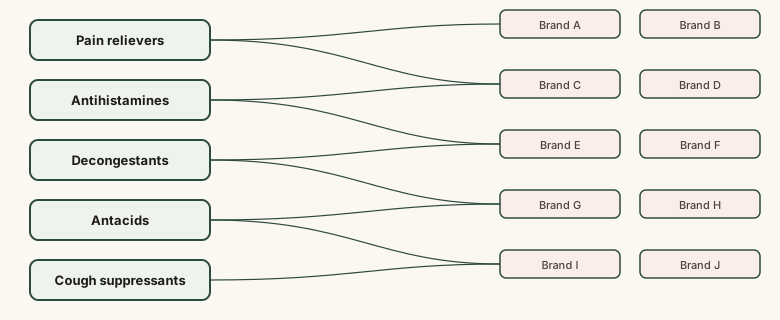
A handful of active-ingredient categories behind many brand names
Each category box on the left maps to many different products on the right — the underlying chemistry is far smaller in number than the shelf makes it look.
Common mistakes
Common Mistakes
✕
Choosing a medicine based on brand name or packaging alone.
→ Check the active ingredient on the Drug Facts panel — that's what determines the medicine's actual effect, regardless of branding.
✕
Taking a combination product without checking whether it overlaps with another medicine already being taken.
→ Read the full ingredient list on any multi-symptom product and compare it against anything else already being taken.
✕
Assuming 'over-the-counter' means a medicine has no real risks or interactions.
→ OTC status means the FDA judged it safe when label directions are followed — it doesn't mean risk-free or interaction-free, especially combined with other medicines.
Common misconception
“Over-the-counter medicine is inherently mild or 'not real medicine' compared to prescription drugs.”
OTC status reflects the FDA's determination that a medicine is safe and effective for consumers to use correctly on their own, following label directions — not that the medicine is weak or risk-free. Active ingredients in common OTC products are genuinely active pharmacologically, can interact with other medicines or health conditions, and can cause harm if the label's directions (including maximum dose and duration) aren't followed.
Quick check
What does it actually mean when the FDA classifies a medicine as 'over-the-counter'?
What to do next
What to do next
Learn to identify the active ingredient on any OTC product's Drug Facts panel, not just the brand name.
Before taking a combination product, check its full ingredient list against anything else you're already taking to avoid an unintentional double dose.
Bring a specific question (ingredient, not just symptom) to a pharmacist for a faster, more precise recommendation.
Never exceed the label's stated maximum dose or duration — 'over-the-counter' does not mean risk-free at any amount.
FAQ
FAQ
Related terms
Related terms
Active ingredient
The specific chemical in a medicine responsible for its intended effect — the part of the label the FDA requires to be listed first and most prominently on a Drug Facts panel.
Over-the-counter (OTC) medicine
A medicine the FDA has determined is safe and effective for consumers to use without a doctor's prescription, provided the label's directions are followed.
This entry was researched from public sources and drafted with AI-assisted tools, then edited — errors are still possible. Spot one, or want a topic covered? Read our disclaimer.
 KnowThis