A family health record — a written history of significant health conditions across close blood relatives — is a genuinely useful, free tool that helps a doctor assess personal risk for hereditary conditions, and health agencies recommend actively building and periodically updating one rather than relying on memory during an appointment.
Reading time
— 4 min
Updated
— Aug 22, 2026
Fact-reviewed
— Aug 22, 2026
This entry is general health literacy, not medical advice. A family health history is a tool to bring to a doctor, not a self-diagnosis method. Share and discuss yours with a qualified healthcare provider.
Key Takeaways
Key Takeaways
1A written family health history — significant conditions among parents, siblings, grandparents, and aunts/uncles — helps a doctor assess hereditary risk factors that a single appointment's memory can easily miss.
2The U.S. Surgeon General maintains a free, structured tool (My Family Health Portrait) specifically designed to help build and organize this record.
3A family health history is most useful when it's actually written down and updated periodically, not reconstructed from memory during a time-limited doctor's visit.
The concept
A family health history is simply a written list of significant health conditions that run in your close biological family — things like heart disease, diabetes, certain cancers, or other conditions affecting parents, siblings, and grandparents. Doctors use this information to judge whether you might carry an elevated hereditary risk factor for a given condition, which can change which screenings or preventive steps make sense for you specifically.
The value here isn't complicated medicine — it's simply making sure real, already-known family information actually reaches the doctor who can do something useful with it.
Quick check
Why is a written family health history generally more useful to a doctor than relying on memory during an appointment?
Worked examples
Example 1: Building a basic family health record (baseline case)
Using a free tool like the Surgeon General's My Family Health Portrait, someone records each close relative (parents, siblings, grandparents, aunts, uncles), any significant health conditions they've had, and roughly the age of diagnosis where known. The finished record can be printed, saved, or shared directly with a doctor, and updated any time new information comes up.
Example 2: Spotting a pattern that a single relative's case wouldn't reveal (edge case / variation)
One grandparent having a heart condition in their 80s is common and, on its own, doesn't suggest much. But if a written family history also shows a parent and an aunt both diagnosed with a related heart condition well before age 50, that specific pattern — early onset across multiple close relatives — is exactly the kind of signal that can prompt a doctor to consider earlier or more frequent cardiac screening, a pattern easy to miss if each relative's history were only ever discussed in isolation.
Quick check
What makes the pattern of 'a parent and an aunt both diagnosed with a heart condition before age 50' more clinically notable than one grandparent's heart condition at age 80?
Example 3: Keeping the record updated over time (real-world / applied case)
A family builds their health history record one year, then a sibling receives a new diagnosis two years later. Treating the record as a living document — updating it when new information appears, rather than a one-time project — means the next doctor's visit still benefits from the most current, accurate picture, rather than one that's already gone stale.
How it works (visual)
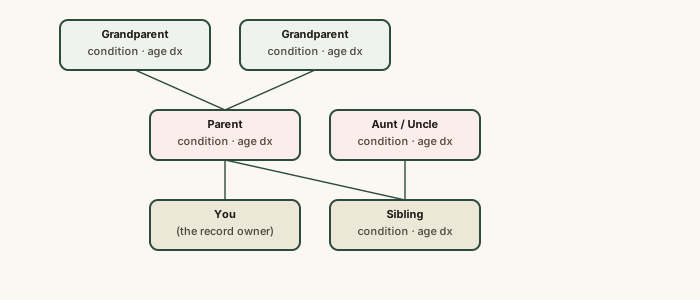
A simple family health history structure
Each box captures the same few fields — relationship, condition, approximate age of diagnosis — repeated consistently across relatives, which is what makes the resulting record easy for a doctor to scan quickly.
Common mistakes
Common Mistakes
✕
Trying to recall family health history from memory during a doctor's appointment.
→ Build and bring a written record ahead of time, so nothing important gets left out under time pressure.
✕
Treating the family health record as a one-time task, never updated again.
→ Revisit and update the record periodically, especially after any relative receives a new significant diagnosis.
✕
Only recording your own immediate household, skipping grandparents, aunts, and uncles.
→ Include the standard categories — parents, siblings, grandparents, aunts, and uncles — since hereditary patterns often show up across that wider circle.
Common misconception
“Family health history only matters if you already know your family has 'the same disease' as you might get.”
Family health history is useful precisely because it can reveal patterns you wouldn't have connected on your own — an early-onset condition across multiple relatives, or a cluster of related (not identical) conditions, can both be meaningful signals a doctor is trained to interpret. The value isn't in the patient diagnosing themselves from the pattern; it's in making sure the doctor has the complete picture to work with.
Quick check
What is the primary purpose of building a family health history record?
What to do next
What to do next
Use a free structured tool like the Surgeon General's My Family Health Portrait to start building your family health history.
Include parents, siblings, grandparents, aunts, and uncles, noting significant conditions and approximate ages of diagnosis where known.
Bring the written record to your next doctor's appointment rather than relying on memory in the moment.
Revisit and update the record whenever a relative receives a new significant diagnosis.
FAQ
FAQ
Related terms
Related terms
Family health history
A written record of significant health conditions among close blood relatives (parents, siblings, grandparents, aunts/uncles), used by doctors to assess a person's hereditary risk for certain conditions.
Hereditary risk factor
An increased likelihood of developing a condition because it runs in a person's biological family, distinct from lifestyle or environmental risk factors.
This entry was researched from public sources and drafted with AI-assisted tools, then edited — errors are still possible. Spot one, or want a topic covered? Read our disclaimer.
 KnowThis