Many widely repeated health claims — that cracking knuckles causes arthritis, that you 'lose most of your heat through your head,' that sugar causes hyperactivity in children, or that you need to 'detox' your body — do not hold up against the actual clinical and physiological evidence, which is well documented by major health agencies.
Reading time
— 4 min
Updated
— Aug 21, 2026
Fact-reviewed
— Aug 21, 2026
This entry is general health literacy, not medical advice. It summarizes what current evidence says about widely repeated claims. For any personal health question, talk to a doctor or other qualified professional.
Key Takeaways
Key Takeaways
1Cracking your knuckles does not cause arthritis — the popping sound is gas bubbles collapsing in joint fluid, a mechanical event unrelated to the cartilage damage that causes arthritis.
2You don't lose 'most' of your body heat through your head — heat loss is roughly proportional to how much skin is exposed, and the head loses heat at about the same rate per unit area as any other uncovered body part.
3Sugar has not been shown to directly cause hyperactivity in children in controlled studies — the myth persists partly because sugary foods often appear at exciting, high-stimulation events like birthday parties.
The concept
Health myths spread easily because they often sound mechanistically plausible and get repeated by well-meaning people. Three of the most persistent: cracking your knuckles causes arthritis (it doesn't — the sound is just a gas bubble popping in joint fluid), you lose most of your heat through your head (you don't — heat loss tracks exposed skin area, not a special property of the head), and sugar makes kids hyperactive (controlled studies haven't found a direct effect — the association mostly comes from sugar showing up at already-exciting events).
What makes these myths durable isn't stupidity — it's that each one has a surface-level logic that sounds right until it's actually tested against controlled evidence.
Quick check
Why did a mid-20th-century military study seem to support the claim that you lose most heat through your head?
Worked examples
Example 1: The knuckle-cracking myth (baseline case)
Claim: cracking knuckles causes arthritis. Evidence: multiple studies comparing habitual knuckle-crackers to non-crackers have found no meaningful difference in arthritis rates. The sound itself comes from a gas bubble in the synovial fluid collapsing (cavitation) — a mechanical, not degenerative, event. Verdict: not supported by evidence.
Example 2: The "detox" claim (edge case / variation)
Claim: certain juices, teas, or supplements "detox" the body of accumulated toxins. Evidence: the liver and kidneys already perform continuous filtration of the blood as their normal function, and no controlled study has shown a commercial "detox" product measurably improves on that existing process in a healthy person. Verdict: not supported — a healthy liver and kidneys are already doing this job.
Quick check
What's the general pattern behind why 'detox' products are marketed as necessary?
Example 3: The sugar-hyperactivity myth in a real-world setting (real-world / applied case)
A parent notices their child is "wired" after a birthday party with cake and soda and concludes sugar caused it. But the party also involved loud music, other excited children, games, and novelty — all independently associated with heightened activity in children. Double-blind studies (where researchers, parents, and sometimes even the children didn't know whether a sugar or sugar-free substitute was given) have found no measurable behavioral difference attributable to sugar itself. The birthday-party scenario is a confounding factor, not evidence of a sugar effect.
How it works (visual)
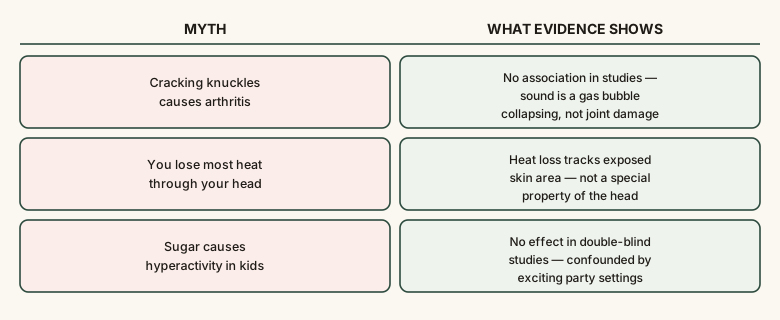
Three health myths vs. what controlled evidence actually shows
In each row, the myth has a surface plausibility that the evidence column directly contradicts once it's actually tested under controlled conditions rather than casual observation.
Common mistakes
Common Mistakes
✕
Treating a plausible-sounding mechanism as proof, without checking whether it's actually been tested.
→ Look for controlled studies, ideally double-blind ones, rather than accepting a claim because the underlying story sounds reasonable.
✕
Mistaking correlation (sugar at a party, then hyperactivity) for causation.
→ Ask what else changed at the same time — confounding factors like excitement, novelty, or noise are often the real driver.
✕
Assuming a myth must be true because 'everyone knows' it or it's repeated often.
→ Frequency of repetition is not evidence — check what major health agencies (CDC, NIH, Mayo Clinic) actually say.
Common misconception
“If a health claim is widely believed and 'makes sense' intuitively, it's probably true.”
Human intuition about physiology is frequently wrong, because the body's real mechanisms are often counterintuitive or invisible to casual observation. All three myths covered here sound reasonable on first hearing — that's exactly why they spread — but each one fails when tested against controlled evidence. The reliable filter isn't "does this sound plausible," it's "has this actually been tested, and what did the test show."
Quick check
Why is a double-blind study more convincing evidence than a parent's personal observation about sugar and hyperactivity?
What to do next
What to do next
Before repeating a health claim, check whether it's backed by a major health agency (CDC, NIH, WHO, Mayo Clinic) rather than just being widely repeated.
Watch for confounding factors whenever a claim is based on 'I noticed X happened after Y' — ask what else was different at the time.
Treat a mechanistic-sounding explanation as a hypothesis to check, not a conclusion, until it's actually been tested.
For any real personal health concern, ask a doctor rather than relying on general health myths (true or false) found online.
FAQ
FAQ
Related terms
Related terms
Cavitation
The formation and collapse of a gas bubble in the fluid of a joint — the actual physical event behind the popping sound of a cracked knuckle, unrelated to cartilage damage.
Confounding factor
An unaccounted-for variable that makes two unrelated things appear connected — the reason a busy, high-sugar birthday party 'looks like' proof that sugar causes hyperactivity, when the excitement of the party is the real driver.
This entry was researched from public sources and drafted with AI-assisted tools, then edited — errors are still possible. Spot one, or want a topic covered? Read our disclaimer.
 KnowThis