An annual health checkup is a routine, scheduled visit to a primary care provider for preventive screening and baseline tracking — distinct from an urgent-care or emergency visit, which happens only after a specific problem appears — and its value comes largely from catching silent, symptomless conditions like hypertension and high cholesterol before they cause complications.
Reading time
— 4 min
Updated
— Aug 21, 2026
Fact-reviewed
— Aug 21, 2026
This entry is general health literacy, not medical advice. Checkup frequency and content should be decided with your own doctor based on your age, history, and risk factors.
Key Takeaways
Key Takeaways
1An annual checkup is a scheduled preventive visit, not a response to feeling sick — its main value is catching asymptomatic conditions like high blood pressure or high cholesterol before they cause damage.
2Building a habit around it means treating the appointment like a recurring calendar commitment, not something you 'get around to' only when something feels wrong.
3Each visit adds to a personal baseline — tracking blood pressure, weight, and lab values over multiple years reveals trends a single visit can't show.
The concept
A checkup is different from a sick visit: you go whether or not anything feels wrong, on a regular schedule (commonly yearly for adults, though your own doctor may recommend a different interval). The reason this matters is that several common health issues — high blood pressure, high cholesterol, early blood sugar changes — typically produce no symptoms at all until they've been present for years, so a person can feel completely fine while a measurable problem is quietly developing.
The habit part is often the harder half — the screening science is well established, but skipping the appointment because "nothing feels wrong" defeats the entire purpose of a preventive visit.
Quick check
Why is a person who 'feels completely fine' still encouraged to get an annual checkup?
Worked examples
Example 1: A single checkup catching an isolated finding (baseline case)
A 40-year-old with no symptoms gets a routine checkup and a blood pressure reading comes back elevated. Because this was caught during a scheduled visit rather than after a symptom appeared, the doctor can start monitoring and discuss lifestyle or treatment options well before any cardiovascular event occurs.
Example 2: A trend visible only across multiple years (edge case / variation)
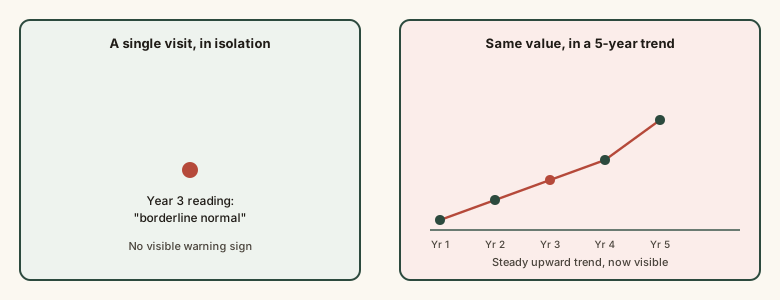
A person's cholesterol reading is technically "borderline normal" every single year for five years in a row — never flagged as abnormal at any one visit. But plotted across five annual checkups, the numbers show a steady upward trend. A doctor reviewing the full history (not just the latest single result) can flag this trajectory and intervene earlier than waiting for a single value to cross into the "abnormal" range.
Quick check
Why might a five-year trend of 'borderline normal' cholesterol values be more useful information than any single year's reading alone?
Example 3: Building the actual habit (real-world / applied case)
Someone books their checkup for the same month every year — for example, their birthday month — and sets a calendar reminder a year in advance immediately after each visit. This removes the decision of "should I go this year" (a decision easy to defer indefinitely) and replaces it with a fixed, recurring commitment, the same behavioral pattern used for other recurring maintenance tasks like an annual car inspection.
How it works (visual)
A single checkup vs. a multi-year trend line
The single point in the left panel looks unremarkable on its own — it's only visible as a warning sign once it's placed in the context of the full trend line on the right, which is exactly what a habit of annual visits builds over time.
Common mistakes
Common Mistakes
✕
Skipping the checkup because nothing feels wrong.
→ Remember the entire point is catching conditions that don't produce symptoms — 'feeling fine' isn't a valid screening result.
✕
Treating checkup scheduling as an open-ended 'someday' task instead of a fixed date.
→ Book next year's appointment (or set a firm reminder) immediately after each visit, tied to a memorable recurring date.
✕
Only looking at whether the latest single reading is 'normal,' ignoring the trend across previous visits.
→ Ask your doctor to review your values across multiple years, not just whether this year's number crosses a threshold.
Common misconception
“If I feel healthy, an annual checkup is unnecessary — it's really just for people who are already sick or elderly.”
The preventive value of a checkup comes precisely from catching conditions before they produce symptoms, which is unrelated to how a person currently feels or their age. Younger, apparently healthy adults can and do have undetected hypertension or developing metabolic issues — the whole design of routine screening is to find these things independent of subjective symptoms.
Quick check
What is the actual difference between an annual checkup and a sick visit to a doctor?
What to do next
What to do next
Book your next checkup immediately after finishing your current one, rather than leaving the timing open-ended.
Tie the appointment to a fixed, memorable date (like a birthday month) to make it a recurring habit rather than a decision made fresh each year.
Ask your doctor to review your values across multiple past visits, not just whether the latest reading is 'normal.'
Talk to your own doctor about what interval and screenings are actually right for your age and risk factors — this page describes the general concept, not a personal schedule.
FAQ
FAQ
Related terms
Related terms
Baseline
A recorded set of health measurements (blood pressure, weight, cholesterol, etc.) taken while a person is healthy, used as a comparison point for detecting future changes.
Asymptomatic condition
A health condition, like early hypertension or high cholesterol, that produces no noticeable symptoms and can only be detected through screening, not by how a person feels.
This entry was researched from public sources and drafted with AI-assisted tools, then edited — errors are still possible. Spot one, or want a topic covered? Read our disclaimer.
 KnowThis