A health screening is a test performed on someone without symptoms, aimed at catching a condition early enough that treatment works better — screening schedules are organized by age group because the statistical likelihood of specific conditions, and the age at which early detection meaningfully improves outcomes, are both well-documented and shift across the lifespan.
Reading time
— 4 min
Updated
— Aug 21, 2026
Fact-reviewed
— Aug 21, 2026
This entry describes published, general population screening guidelines as examples of how screening schedules are structured — it is not a personal screening recommendation. Which screenings make sense for you depend on your own history and risk factors; that decision belongs with a doctor.
Key Takeaways
Key Takeaways
1A screening test is given to people without symptoms, specifically to catch a condition early enough that treatment is more likely to work — this is different from a diagnostic test, which is ordered because someone already has symptoms or a specific concern.
2Screening schedules are organized by age group because the real-world likelihood of specific conditions, and the age at which early detection changes outcomes, are both statistically well documented and shift across the lifespan.
3Independent bodies like the U.S. Preventive Services Task Force grade screenings by the actual evidence that they improve outcomes — not every possible test is recommended for every age, because some screenings for some ages don't clear that evidence bar.
The concept
A screening test looks for a condition before it causes any symptoms — a blood pressure check, a cholesterol panel, a colonoscopy, a mammogram. Different screenings get recommended starting at different ages because the conditions they look for become statistically more common, or more worth catching early, at different points in life. A published screening schedule (like the ones from the CDC or the U.S. Preventive Services Task Force) is really just a table of "at this age, for this population, this test has been shown to do more good than harm."
The practical result of this evidence-grading process is a set of age-banded schedules — not because a specific birthday flips a switch, but because population-level risk for many conditions rises smoothly with age, and someone had to pick evidence-backed thresholds somewhere.
Quick check
Why doesn't the U.S. Preventive Services Task Force recommend every possible screening test for every age group?
Worked examples
Example 1: Blood pressure screening (baseline case, general adult population)
Blood pressure screening is recommended for essentially all adults starting in their 20s, repeated at a defined interval — because hypertension is common, usually symptomless until it causes damage, cheap and quick to detect, and effectively manageable once found. This is close to an ideal screening case: high prevalence, high benefit from early treatment, low cost and low risk in the test itself.
Example 2: Colorectal cancer screening's shifting starting age (edge case / variation)
For years, USPSTF guidance recommended colorectal cancer screening starting at age 50 for average-risk adults. Following a documented rise in colorectal cancer rates among younger adults, the Task Force updated its guidance to recommend starting at age 45 instead. This is a clear real-world example of a screening age threshold moving in response to new epidemiological evidence, not staying fixed forever — which is also why "the current published schedule," not an old memorized number, is the thing worth checking.
Quick check
What does it mean that the recommended starting age for colorectal cancer screening moved from 50 to 45?
Example 3: Why lead-time bias makes "earlier detection" alone an unreliable measure (real-world / applied case)
Suppose a cancer is normally diagnosed at age 60 and the person dies at 65 either way, regardless of treatment — a five-year survival-from-diagnosis figure. If a new screening test catches the same cancer at age 55 instead, and the disease's course is genuinely unaffected by the earlier catch, that same person now shows a ten-year survival-from-diagnosis figure, purely because the diagnosis date moved earlier — not because they lived any longer in real terms. This effect, lead-time bias, is exactly why the USPSTF and similar bodies insist on outcome measures like actual mortality reduction in trial data, not just "we found it earlier," before recommending a screening broadly.
How it works (visual)
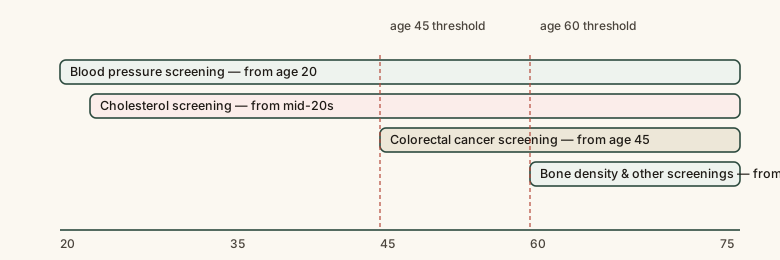
Illustrative screening timeline across adult age bands (general population example)
Reading left to right, the number of actively recommended screenings grows with age — reflecting genuinely rising population-level risk for multiple conditions, not an arbitrary bureaucratic expansion of testing.
Common mistakes
Common Mistakes
✕
Assuming a screening schedule memorized years ago is still current.
→ Screening ages get revised as new evidence comes in (as happened with colorectal cancer) — check the current published guidance rather than an old remembered number.
✕
Treating 'no screening recommended at my age' as 'this condition can't happen to me.'
→ A screening not being routinely recommended reflects population-level risk-benefit at that age — individual risk factors (family history, symptoms) can still warrant earlier or additional testing, which is a conversation for a doctor.
✕
Assuming more screening is always better.
→ Every screening test carries some risk of false positives and unnecessary follow-up procedures — evidence-based guidelines specifically weigh this against the benefit, which is why not every test is recommended for every age.
Common misconception
“If a screening test can detect a condition earlier, it must always be worth doing as often and as early as possible.”
Earlier detection only helps if it changes what treatment can achieve — and every screening test carries a real cost in false positives, unnecessary follow-up procedures, and (for some tests) direct medical risk. Bodies like the USPSTF specifically require trial evidence of improved real-world outcomes, not just earlier detection, before recommending a screening broadly — which is why screening guidelines specify starting ages and intervals instead of simply recommending "as much as possible."
Quick check
Someone reasons: 'A screening test found my relative's condition, so if I get that same test every year starting now regardless of my age, it can only help.' What's the flaw?
What to do next
What to do next
Check the current USPSTF or CDC published screening recommendations for your age and sex rather than relying on memory of an older schedule.
Bring your personal and family health history to a doctor so screening timing can be personalized beyond the general population schedule.
Understand that a screening not being routinely recommended at your current age reflects population-level evidence, not a guarantee about your individual risk.
Treat this entry as a guide to how screening schedules are built, not as a substitute for an actual conversation with a healthcare provider.
FAQ
FAQ
Related terms
Related terms
Screening test
A test performed on a person without symptoms of a specific condition, intended to detect that condition early, before it would otherwise be noticed.
Sensitivity (screening)
The proportion of people who truly have a condition that a screening test correctly identifies as positive — higher sensitivity means fewer missed cases.
Lead-time bias
The appearance of longer survival after early detection that is actually just an earlier diagnosis date, not a genuinely later death — a key reason screening benefit is measured in outcomes, not just detection timing.
This entry was researched from public sources and drafted with AI-assisted tools, then edited — errors are still possible. Spot one, or want a topic covered? Read our disclaimer.
 KnowThis