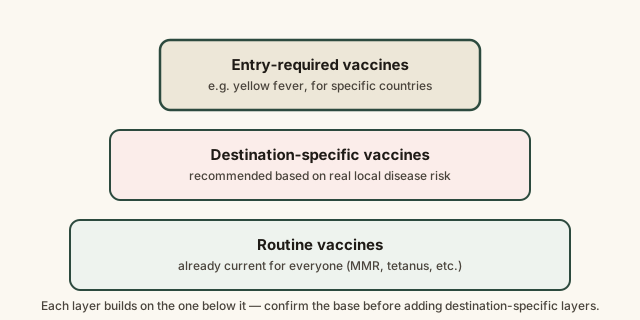
Travel health planning layers destination-specific vaccines and precautions on top of a person's routine vaccinations, because disease risk varies geographically — a vaccine irrelevant at home can be strongly recommended or even legally required for entry into a specific country, and this destination-specific risk assessment is best done well before departure with a travel medicine provider.
Reading time
— 4 min
Updated
— Aug 21, 2026
Fact-reviewed
— Aug 21, 2026
This entry explains how travel health planning is structured — it is not personalized travel medical advice. Actual vaccine and medication needs for a specific trip should be confirmed with a doctor or a travel medicine clinic, ideally four to six weeks before departure.
Key Takeaways
Key Takeaways
1Travel health needs fall into three layers: routine vaccines everyone should already have, destination-specific recommended vaccines based on real local disease risk, and a small number of destinations with legally required vaccines for entry.
2Yellow fever is the main vaccine with a formal international entry requirement, enforced through an official International Certificate of Vaccination that some countries check at the border.
3Most travel health guidance is destination- and itinerary-specific — a trip's actual risk depends on which country, which region within it, the season, and planned activities (rural vs. urban, altitude, food and water sources), not just the country name alone.
The concept
Some diseases are common in certain parts of the world and rare or absent elsewhere. A routine vaccine like MMR (measles, mumps, rubella) is recommended for nearly everyone regardless of travel. A recommended travel vaccine — like typhoid or hepatitis A for many destinations — targets a disease that's uncommon at home but a real risk at the destination. A small number of countries also have a required vaccine for entry, checked at the border, most commonly yellow fever.
Timing also matters independently of the destination: many vaccines need two to four weeks to build full immune protection, which is the main reason travel health guidance recommends a consultation well before departure rather than at the airport.
Quick check
Why might a vaccine that's not part of someone's routine home-country schedule still be strongly recommended for a specific trip?
Worked examples
Example 1: A short urban business trip (baseline case)
A traveler making a five-day business trip to a major capital city, staying in a hotel and eating at established restaurants, typically faces a lower risk profile than rural or extended travel in the same country — routine vaccines being current is usually the main check, alongside destination-specific guidance on food and water precautions for that country.
Example 2: Extended rural travel in a yellow-fever risk region (edge case / variation)
A traveler planning a month of rural travel through a region with documented yellow fever transmission faces a substantially different picture: the yellow fever vaccine may be required for entry (or for onward travel to a third country, since some countries require proof of yellow fever vaccination from travelers arriving from at-risk regions, not just those originating there), alongside recommended vaccines like typhoid and hepatitis A given extended rural food and water exposure, and possibly malaria prophylaxis medication depending on the specific region and season.
Quick check
Why might a country require proof of yellow fever vaccination from a traveler who is not visiting a yellow-fever-risk area themselves?
Example 3: Why the timing of a travel health visit matters (real-world / applied case)
Several vaccines require two doses spaced weeks apart, or take two to four weeks after the final dose to reach full protective effect. A traveler who visits a travel medicine clinic the day before departure may not have time to complete a multi-dose series or reach full immunity before arrival — which is the documented reason the CDC recommends scheduling a travel health consultation at least four to six weeks before departure, longer for complex itineraries or multi-dose vaccines.
How it works (visual)
Three layers of travel health preparation
Each layer depends on the one below it — a travel health consultation typically starts by confirming routine vaccines are current, then adds destination-specific layers on top based on the actual itinerary.
Common mistakes
Common Mistakes
✕
Assuming travel vaccine needs are the same for every country, or for every trip to the same country.
→ Check destination- and itinerary-specific guidance (CDC's destination pages are organized this way) — risk depends on region, season, and activities, not just the country name.
✕
Waiting until just before departure to seek travel health guidance.
→ Schedule a travel health consultation at least four to six weeks before departure, since some vaccines need multiple doses or weeks to reach full protection.
✕
Assuming routine vaccines are automatically covered and don't need checking before travel.
→ Confirm routine vaccines (like MMR and tetanus) are current as part of travel planning — some outbreaks abroad specifically involve diseases routine vaccination already protects against.
Common misconception
“If a vaccine isn't legally required for entry into a country, it isn't worth getting for that trip.”
Legal entry requirements (like yellow fever for certain countries) are a narrow, specific category — most travel-relevant disease risk is addressed through recommended, not required, vaccines and precautions. A destination can have serious, well-documented typhoid or hepatitis A risk, for example, with no legal vaccine requirement at all — the CDC and WHO's risk-based recommendations, not entry-requirement law, are the more complete guide to real travel health risk.
Quick check
Someone checks that their destination has no legally required vaccines and concludes no travel health precautions are needed. What's the flaw in this reasoning?
What to do next
What to do next
Check the CDC's destination-specific travel health page (or WHO's international travel guidance) for every country on your itinerary, not just the primary destination.
Schedule a travel health consultation four to six weeks before departure to allow time for multi-dose vaccines or vaccines that need weeks to reach full protection.
Confirm routine vaccines are current as part of travel planning, not just destination-specific ones.
Check yellow fever entry requirements specifically if your itinerary includes any country with documented transmission risk, even if it's not your final destination.
FAQ
FAQ
Related terms
Related terms
Routine vaccine
A vaccine recommended for essentially everyone in a country's standard schedule regardless of travel plans, such as MMR or tetanus.
Recommended travel vaccine
A vaccine advised for a specific destination based on real disease risk there, even though it isn't part of a traveler's home-country routine schedule.
Required vaccine (entry requirement)
A vaccine a country legally requires for entry (most commonly yellow fever, under International Health Regulations), documented on an International Certificate of Vaccination.
This entry was researched from public sources and drafted with AI-assisted tools, then edited — errors are still possible. Spot one, or want a topic covered? Read our disclaimer.
 KnowThis