 KnowThis
Key Takeaways
Key Takeaways
- 1The clavicle is the only bone connecting the arm to the rest of the skeleton, sits just under the skin with little muscle padding, and takes force directly from falls or shoulder hits.
- 2About 80% of collarbone fractures happen at the middle third of the bone — the thinnest, most curved section, where the S-shape transitions and cortical bone is at its weakest.
- 3Most collarbone fractures heal without surgery in 6-12 weeks using a sling, since displacement in the middle third is usually mild enough that surgical hardware isn't needed.
The concept
That combination of exposure and a built-in thin point explains why the collarbone shows up so often in injury reports — from a toddler's tumble to a professional athlete's shoulder-first tackle.
Why does the middle third of the clavicle break more often than the ends near the shoulder or breastbone?
Worked examples
Example 1: A fall onto an outstretched hand (baseline case)
Example 2: A direct hit to the shoulder (edge case / variation)
Example 3: Why kids heal faster than adults (real-world / applied case)
Why do children's clavicle fractures typically heal faster than adults' fractures from a similar injury?
How it works (visual)
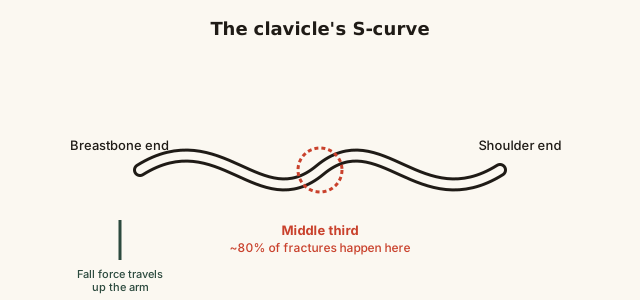
Notice where the diagram marks the fracture zone — right at the point where the two curves of the S-shape meet, which is both the thinnest part of the bone and the part exposed with the least muscle covering.
Common mistakes
Common Mistakes
Assuming a frequently broken bone must be an unusually fragile or weak bone.
→ The clavicle's fracture rate comes from its exposed position and thin midpoint, not from the bone tissue itself being weaker than other bones.
Assuming every collarbone fracture needs surgery.
→ Most middle-third fractures, especially with minimal displacement, heal well with a sling and time — surgery is generally reserved for significantly displaced or shortened breaks.
Trying to fully immobilize the arm and shoulder for weeks without any guided movement.
→ Most treatment plans include early, gentle movement of the hand, wrist, and elbow to prevent stiffness, even while the shoulder itself stays supported — follow a clinician's specific guidance rather than assuming total stillness is safest.
Common misconception
“Bones like the collarbone break often because they're inherently weak or poorly designed.”
The clavicle's fracture rate is a matter of exposure and geometry, not weak material. It's the only bony strut linking the arm to the torso's skeleton, runs almost entirely just beneath the skin with minimal muscle padding, and has a built-in S-curve whose midpoint is naturally thinner than the rest of the bone. Falls onto an outstretched hand and direct hits to the shoulder both funnel force into that exact spot — the same reason many long bones with far more muscle protection, like the femur, break far less often despite bearing much greater everyday loads.
What to do next
What to do next
- If you suspect a broken collarbone (visible deformity, inability to lift the arm, severe pain at the shoulder), seek medical evaluation rather than self-diagnosing from symptoms alone.
- Follow a clinician's specific sling and movement instructions rather than assuming full immobilization is always correct — early guided movement of the hand and wrist is often part of recovery.
- In contact sports, ask about shoulder-pad fit and tackling technique — proper form reduces the direct-impact mechanism responsible for many collarbone fractures.