 KnowThis
Key Takeaways
Key Takeaways
- 1A bruise's color comes from blood trapped under intact skin after small vessels break — the color changes over days to weeks as the body chemically breaks that trapped blood down and clears it away.
- 2The typical progression is red/purple in the first day or two, then blue or blackish-purple, then green, then yellow or brown as the bruise fades — driven by hemoglobin degrading into biliverdin, then bilirubin.
- 3Bruise color and size depend heavily on where the injury is and how loose the overlying tissue is, not just how hard the impact was — a relatively minor bump near the eye can look far more dramatic than a harder hit on the shin.
The concept
Because the timeline varies so much between people and situations, it's worth walking through a few concrete cases to see how the same underlying mechanism plays out differently depending on where and how the bruise happens.
A bruise on someone's arm has turned from purple to a greenish color after about five days. What does the green color indicate is happening?
Worked examples
Example 1: A typical shin bruise (baseline case)
Example 2: A black eye from a much smaller impact (edge case / variation)
Example 3: Older adults and people on blood thinners (real-world / applied case)
Why might an older adult's bruise from a minor bump look larger and take longer to fade than the same bump would in a younger person?
How it works (visual)
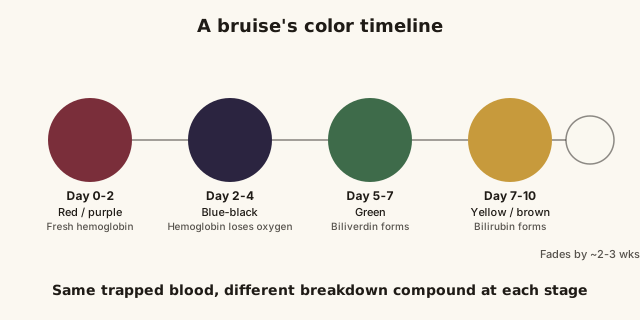
Each block in that timeline corresponds to a different chemical compound, not just a different shade of the same bruise — which is exactly why the sequence tends to run in the same general order every time, even though the exact number of days varies from person to person.
Common mistakes
Common Mistakes
Assuming a darker or more colorful bruise always means a more serious underlying injury.
→ Color and size are strongly influenced by the tissue location (looseness, blood supply, skin thickness), not just impact force — a dramatic-looking bruise near the eye can come from a much smaller hit than a duller one on the shin.
Trying to precisely date how old a bruise is just from its color.
→ Treat the color sequence as a rough general guide only — individual factors like age, skin tone, medication, and bruise depth shift the timing enough that color alone isn't considered a reliable way to date an injury.
Ignoring bruises that appear with no clear cause, or that keep appearing repeatedly.
→ Bruising that shows up without a clear bump or injury, or that happens unusually often, is worth mentioning to a healthcare provider rather than assuming it's routine.
Common misconception
“The darker or more colorful a bruise looks, the worse the injury underneath must be.”
Bruise appearance depends heavily on where it is on the body, not just how hard the impact was. Areas with thin skin, loose tissue, and blood vessels close to the surface — like around the eyes — can produce large, dark, dramatic-looking bruises from relatively minor bumps, while a harder impact on the shin, which has little cushioning tissue but thicker, tighter skin, might look comparatively mild. The color itself simply tracks a predictable sequence of hemoglobin breaking down into biliverdin and then bilirubin over time — it's informative about healing stage, but on its own it's not a reliable way to judge how serious the original injury was.
What to do next
What to do next
- Apply a cold pack for the first 24-48 hours after a bruising injury to help limit swelling, then consider gentle warmth afterward to support circulation, as general first-aid guidance.
- Elevate a bruised limb above heart level where practical in the first day or two, which can help reduce pooling and swelling in the area.
- See a healthcare provider for bruising that's unusually large, extremely painful, doesn't start improving within about two weeks, appears with no clear cause, or is accompanied by other symptoms — this general information isn't a substitute for medical evaluation.