The American College of Emergency Physicians and CDC both publish general categories of warning signs (sudden severe pain, trouble breathing, sudden confusion, uncontrolled bleeding, among others) where the correct action is the same regardless of the underlying cause: call emergency services immediately, rather than trying to determine a diagnosis first.
Reading time
— 4 min
Updated
— Aug 21, 2026
Fact-reviewed
— Aug 21, 2026
This entry lists general emergency warning-sign categories published by health agencies — it is not a diagnostic tool. It cannot tell you what is wrong with a specific person. If you or someone near you experiences any of these general categories, call emergency services immediately rather than trying to match symptoms to a cause first.
Key Takeaways
Key Takeaways
1Health agencies like the American College of Emergency Physicians (ACEP) publish general categories of warning signs — not specific diagnoses — where the correct response is always the same: call emergency services.
2The categories are intentionally broad (sudden severe pain, trouble breathing, sudden confusion, uncontrolled bleeding, among others) because many very different underlying causes can produce the same urgent-looking symptom.
3Trying to figure out exactly what's wrong before calling for help is itself a documented mistake — the categories exist precisely so bystanders don't need a diagnosis to know it's time to act.
The concept
Emergency medicine organizations publish lists of general emergency warning signs — categories like sudden difficulty breathing, sudden severe pain, sudden confusion or trouble speaking, or uncontrolled bleeding. The point of these categories is that you don't need to know the cause to act correctly: any of them is a reason to call emergency services right away, rather than waiting to see if it resolves or trying to work out a diagnosis first.
None of the categories below require you to know what's actually happening medically — that's the entire design of publishing them this way.
Quick check
Someone feels sudden, severe chest pain but isn't sure if it's 'serious enough' to call for help, and decides to wait 20 minutes to see if it passes. What does ACEP's guidance say about this approach?
Worked examples
Example 1: The general warning-sign categories as published (baseline case)
ACEP's published categories include: difficulty breathing or shortness of breath; chest or upper abdominal pain or pressure; fainting, sudden dizziness, or weakness; sudden changes in vision; confusion or changes in mental status; any sudden severe pain; uncontrolled bleeding; severe or persistent vomiting; coughing up or vomiting blood; and suicidal or homicidal feelings. None of these requires identifying a cause — the category itself is the signal to act.
Example 2: Why the same category covers very different real causes (edge case / variation)
"Sudden confusion or changes in mental status" could reflect a stroke, severe low blood sugar, a serious infection, or several other conditions — each with a different specific treatment. A bystander cannot reliably distinguish between these in the moment, which is exactly why the guidance doesn't ask them to: the category alone is sufficient reason to call for emergency evaluation, where trained clinicians can determine and treat the actual cause.
Quick check
Why does ACEP group very different medical causes (like stroke, low blood sugar, and infection) under one broad warning-sign category like 'sudden confusion'?
Example 3: What actually happens after you call (real-world / applied case)
Once emergency services are contacted, dispatchers are trained to ask structured questions to gauge urgency and can often give real-time guidance (such as basic first-aid instructions) while help is on the way. Emergency departments then use triage to prioritize patients by the urgency of their presenting signs — meaning the system, not the caller, is designed to sort out what's actually happening and how urgently.
How it works (visual)
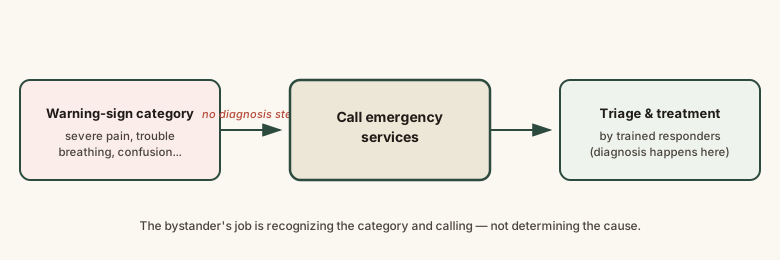
From warning-sign category to emergency response — no diagnosis required
The diagram has no diagnosis step between noticing a warning sign and calling for help — that omission is intentional, since figuring out what's actually wrong is the job of the people who arrive after the call, not the bystander who makes it.
Common mistakes
Common Mistakes
✕
Trying to determine a diagnosis before deciding whether to call for help.
→ Match the situation to a general warning-sign category instead — if it fits, call. Diagnosis is the responders' job, not the bystander's.
✕
Waiting to see if a warning sign resolves on its own before acting.
→ Health agencies explicitly recommend acting on warning signs immediately rather than adopting a wait-and-see approach.
✕
Assuming a warning sign only counts as an emergency if it happens to someone with a relevant known medical history.
→ The categories apply regardless of prior history — a first-time occurrence of a warning sign is treated the same as a recurring one.
Common misconception
“You need to be fairly confident something is 'actually serious' before it's appropriate to call emergency services.”
ACEP's own guidance states it is better to be evaluated and found not to have an emergency than to delay care for something serious. The warning-sign categories are deliberately broad and inclusive precisely so people don't have to be certain before acting — uncertainty itself is not a reason to wait.
Quick check
What is the core practical purpose of publishing broad, cause-agnostic warning-sign categories rather than a detailed diagnostic checklist?
What to do next
What to do next
Learn the general warning-sign categories (sudden severe pain, trouble breathing, sudden confusion, uncontrolled bleeding, and similar) so you can recognize them without needing a diagnosis.
If a situation matches one of these categories, call emergency services immediately rather than waiting to see if it improves.
Stay on the line with the dispatcher — they're trained to ask questions and can often give real-time guidance while help is on the way.
Don't let uncertainty about 'how serious this really is' delay the call — acting on the category is the intended response.
FAQ
FAQ
Related terms
Related terms
Emergency warning sign
A general category of symptom (such as sudden severe pain, trouble breathing, or sudden confusion) that health agencies flag as a reason to seek immediate emergency care, regardless of the specific underlying cause.
Triage
The process emergency responders and hospital staff use to sort patients by the urgency of their condition, so the most time-critical cases are treated first.
This entry was researched from public sources and drafted with AI-assisted tools, then edited — errors are still possible. Spot one, or want a topic covered? Read our disclaimer.
 KnowThis