Choking First Aid Basics (Heimlich Maneuver Overview)
The American Red Cross frames choking response around one key distinction: whether the airway is mildly or severely obstructed, judged by whether the person can still cough, speak, or breathe at all — mild obstruction calls for encouragement to keep coughing, while severe obstruction is the situation abdominal thrusts (the maneuver popularly called the Heimlich) are meant to address, and this is a hands-on physical technique that certified training teaches safely.
Reading time
— 4 min
Updated
— Aug 21, 2026
Fact-reviewed
— Aug 21, 2026
This entry is a general, informational overview of choking response — it is NOT first aid instruction and cannot teach you to safely perform abdominal thrusts. Abdominal thrusts are a physical technique that can cause injury if done incorrectly and require certified, hands-on training (American Red Cross or American Heart Association) to perform safely and effectively. In any real choking emergency, call emergency services immediately.
Key Takeaways
Key Takeaways
1The Red Cross's central distinction is mild vs. severe airway obstruction — judged by whether the person can still cough, speak, or breathe at all, not by how the choking looks from the outside.
2Mild obstruction (some air is still moving) calls for encouraging continued coughing, not intervention — coughing is the body's own most effective clearing mechanism at that stage.
3Severe obstruction (no air moving, unable to cough, speak, or breathe) is the situation abdominal thrusts are meant to address — a hands-on physical technique that certified training teaches to perform safely.
The concept
When someone is choking, the Red Cross's public guidance draws one key line: can they still cough, speak, or breathe at all? If yes, that's a mild airway obstruction, and the recommended response is to encourage them to keep coughing — their own airway-clearing reflex is doing the work. If no air is moving at all, that's severe obstruction, the situation abdominal thrusts are meant to address, and someone should call emergency services immediately.
Getting the mild-vs-severe distinction right is the single most important judgment call in this whole topic, which is why certified courses spend real training time on how to assess it correctly.
Quick check
A person is coughing forcefully and can still make some sound. According to Red Cross guidance, what category of obstruction is this, and what's the recommended response?
Worked examples
Example 1: Assessing mild vs. severe in the first few seconds (baseline case, conceptual only)
Per Red Cross guidance, the first assessment is simple: ask "are you choking?" If the person can answer or cough forcefully, obstruction is mild — encourage continued coughing and stay with them. If they cannot speak, cough, or make more than a weak sound, and may be clutching their throat, that's severe obstruction and warrants immediate action, including calling emergency services.
Example 2: Why the response differs for infants (edge case / variation, conceptual only)
Both the AHA and Red Cross teach a modified, distinct technique for infants under one year old, involving back blows and chest thrusts rather than standard abdominal thrusts, due to differences in infant anatomy. This is exactly the kind of detail — different technique for a different age group — that certified infant/child first-aid courses cover explicitly and a general overview like this one is not equipped to teach safely.
Quick check
Why does the recommended choking response differ for infants compared to adults?
Example 3: What happens if the object doesn't clear (real-world / applied case)
If a choking person becomes unresponsive, Red Cross and AHA guidance shifts to CPR-style chest compressions (checking the mouth for a visible, removable object between cycles), alongside continued emergency services response. This transition — from thrusts to CPR — is another certified-course detail illustrating why this overview stops at explaining the concept rather than attempting to instruct the full technique.
How it works (visual)
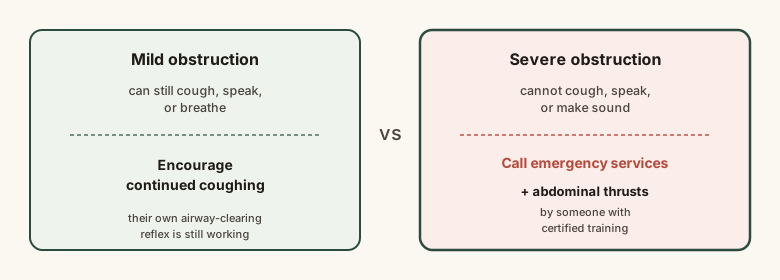
Mild vs. severe airway obstruction — the Red Cross's key decision point
The whole decision tree branches from one observable question — can air and sound still get through — rather than from any attempt to identify the choking object itself.
Common mistakes
Common Mistakes
✕
Performing back slaps or abdominal thrusts on someone who is still coughing forcefully (mild obstruction).
→ Let their own coughing continue — physical intervention is reserved for severe obstruction, when no air is moving at all.
✕
Assuming a general overview like this one is sufficient preparation to safely perform abdominal thrusts.
→ Take a certified Red Cross or AHA course, which uses hands-on practice with training manikins to teach correct hand placement and force.
✕
Using the same technique on an infant as on an adult.
→ Certified infant/child first-aid courses teach a distinct, anatomy-appropriate technique — never assume the adult method applies.
Common misconception
“If someone is choking, the first thing to do is start abdominal thrusts (the 'Heimlich') right away.”
The Red Cross's actual guidance starts with assessment, not action: can the person still cough, speak, or breathe? If yes, obstruction is mild and coughing should continue uninterrupted. Abdominal thrusts are specifically reserved for severe obstruction, when no air is moving at all — jumping straight to thrusts skips the assessment step that determines whether they're even the appropriate response.
Quick check
What is the single most important practical takeaway from this overview?
What to do next
What to do next
Take a certified Red Cross or AHA first-aid course to learn correct, safe abdominal thrust technique through hands-on practice.
Learn the universal choking sign (hands clutched to the throat) so you can recognize it even if the person can't speak.
Understand the mild-vs-severe distinction (can they cough, speak, breathe?) so you know when intervention is or isn't the recommended response.
In any real choking emergency with severe obstruction, call emergency services immediately alongside any trained response.
FAQ
FAQ
Related terms
Related terms
Airway obstruction
A blockage of the throat or windpipe that partially or fully prevents air from moving into the lungs, ranging from mild (some air still passes) to severe (no air passes at all).
Abdominal thrusts
A first-aid technique (popularly called the Heimlich maneuver) using inward and upward pressure below the ribcage to try to force a lodged object out of the airway during severe choking — a hands-on skill taught through certified training.
A person is coughing forcefully and can still make some sound. According to Red Cross guidance, what category of obstruction is this, and what's the recommended response?
This entry was researched from public sources and drafted with AI-assisted tools, then edited — errors are still possible. Spot one, or want a topic covered? Read our disclaimer.
 KnowThis