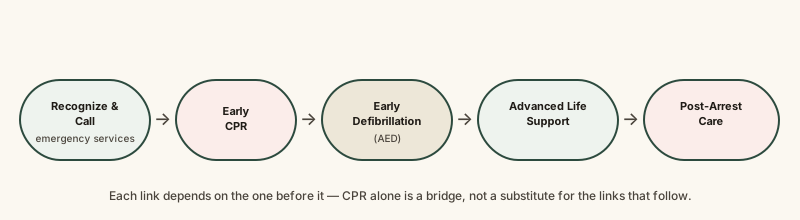
The American Heart Association frames CPR as one link in a documented 'chain of survival' — recognize cardiac arrest, call emergency services, begin chest compressions, use an AED if available, and hand off to advanced care — and while the general sequence is public information, performing effective compressions and using an AED correctly are physical skills that can only be reliably learned through certified, hands-on training.
Reading time
— 4 min
Updated
— Aug 21, 2026
Fact-reviewed
— Aug 21, 2026
This entry is a general, informational overview of CPR as a concept — it is NOT CPR instruction and cannot teach you to actually perform CPR. Effective chest compressions and AED use are physical skills that require certified, hands-on training (American Heart Association or American Red Cross) to perform competently and safely. In any real cardiac emergency, call emergency services immediately — do not rely on this page to guide real-time action.
Key Takeaways
Key Takeaways
1CPR (cardiopulmonary resuscitation) is one link in what the American Heart Association calls the 'chain of survival' for cardiac arrest — recognition, calling for help, CPR, defibrillation, and advanced care, in sequence.
2Cardiac arrest is not the same as a heart attack: arrest is a sudden electrical malfunction that stops the heart, breathing, and consciousness, while a heart attack is a circulation blockage that can, but doesn't always, lead to arrest.
3Knowing the general sequence exists is informational value; performing effective compressions and using an AED correctly are physical, hands-on skills that only certified training (AHA or Red Cross) can actually teach.
The concept
When someone's heart suddenly stops (cardiac arrest), the American Heart Association's public guidance describes a sequence: call emergency services first, then begin chest compressions to keep blood moving until help arrives or an AED is available. This general shape of the response is public information — but doing it correctly, at the right depth and rate, is a trained physical skill, not something read once and reliably performed under real pressure.
This entry exists to explain what CPR is and why the sequence is structured the way it is — not to function as a stand-in for the hands-on practice that certified courses are specifically built around.
Quick check
Someone reads a general overview of CPR online and feels confident they could perform it correctly if needed. What's the concern with that confidence?
Worked examples
Example 1: The general public-information sequence (baseline case, conceptual only)
Per AHA public guidance, the general shape of bystander response to a suspected cardiac arrest is: check responsiveness and breathing, call emergency services (or have someone else call while you stay with the person), begin chest compressions if trained to do so, and use an AED as soon as one is available, following its voice prompts. This is the conceptual sequence — not step-by-step instruction for performing it.
Example 2: Why "calling emergency services" is explicitly the first action, not an afterthought (edge case / variation)
A common misconception is that CPR itself is the priority and calling for help can wait. The AHA's chain-of-survival framing places calling emergency services as an early, near-simultaneous action specifically because it starts the arrival clock for defibrillation and advanced care — actions that CPR alone cannot substitute for, only bridge toward.
Quick check
Why does AHA guidance emphasize calling emergency services early rather than treating it as something to do only after CPR has been attempted for a while?
Example 3: Why certified training exists as a distinct, hands-on product (real-world / applied case)
AHA and Red Cross CPR courses use practice manikins with feedback sensors specifically so a trainee can see, in real time, whether their compression depth and rate are correct — a detail that's essentially impossible to self-assess from reading a description. This is precisely why these organizations built physical, supervised courses rather than relying on written guidance alone to prepare bystanders.
How it works (visual)
The American Heart Association's chain of survival
Each link exists because the one before it alone isn't sufficient — CPR keeps some blood moving, but restoring a normal heart rhythm generally requires the links that follow it.
Common mistakes
Common Mistakes
✕
Assuming reading about CPR is a substitute for certified, hands-on training.
→ Treat informational overviews (like this one) as context for why training matters — take an actual AHA or Red Cross course to be genuinely prepared.
✕
Delaying the emergency services call to begin compressions first.
→ Call (or have someone else call) as an early, near-immediate step — it starts every subsequent link in the chain of survival.
✕
Hesitating to use an AED because of uncertainty about how it works.
→ Modern AEDs are designed with voice guidance for use by untrained bystanders — hesitating to use one when available can cost critical time.
Common misconception
“Cardiac arrest and a heart attack are basically the same thing, so they'd be treated the same way.”
A heart attack is a circulation problem (blocked blood flow to part of the heart muscle), while cardiac arrest is an electrical malfunction that stops the heart, breathing, and consciousness suddenly. A heart attack can trigger cardiac arrest, but many heart attacks do not, and someone can go into cardiac arrest without a preceding heart attack. The response to suspected cardiac arrest — calling emergency services and beginning the chain of survival — is specifically what CPR and AEDs address.
Quick check
What is the single most important practical takeaway of this overview?
What to do next
What to do next
Take an official CPR certification course through the American Heart Association or American Red Cross to actually learn the physical technique.
Learn where AEDs are located in places you frequent (workplace, gym, school) — they're increasingly common in public spaces.
In any real emergency, call emergency services immediately — don't wait or rely on general knowledge alone.
Understand the chain-of-survival concept so you know why each step (calling, compressions, defibrillation, advanced care) matters, even before or alongside getting certified.
FAQ
FAQ
Related terms
Related terms
Cardiac arrest
A sudden loss of heart function, breathing, and consciousness, caused by an electrical malfunction in the heart — distinct from a heart attack, which is a circulation problem, though a heart attack can trigger cardiac arrest.
Chain of survival
The American Heart Association's term for the sequence of actions — early recognition, calling for help, early CPR, early defibrillation, and advanced care — that together give a person in cardiac arrest the best chance of survival.
AED (automated external defibrillator)
A portable device that analyzes a person's heart rhythm and, if needed, delivers an electric shock to try to restore a normal rhythm — designed with voice prompts for use by a trained or even untrained bystander.
This entry was researched from public sources and drafted with AI-assisted tools, then edited — errors are still possible. Spot one, or want a topic covered? Read our disclaimer.
 KnowThis