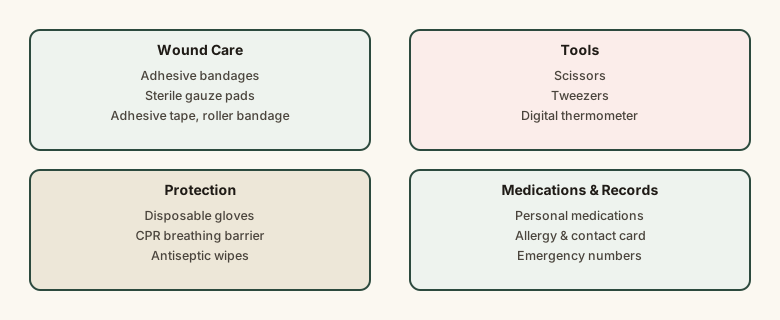
A basic first aid kit, per American Red Cross guidance, is organized around four functions: treating wounds, tools for managing an injury, protective supplies for the responder, and space for any personal medications — each item earns its place by addressing a specific, common home or travel injury.
Reading time
— 4 min
Updated
— Aug 21, 2026
Fact-reviewed
— Aug 21, 2026
This entry is general safety information, not medical advice. A first aid kit supports minor, everyday injuries — it is never a substitute for professional medical care or certified first aid training. For any serious injury or medical emergency, call emergency services immediately.
Key Takeaways
Key Takeaways
1A real first aid kit is organized around four functions: wound-care supplies, tools, protective equipment for the responder, and space for personal medications — not a random assortment of bandages.
2The American Red Cross publishes a specific, real supply checklist for a basic home kit — following it (rather than guessing) is what turns a box of supplies into something actually useful in a minor emergency.
3A kit is only as good as its maintenance — expired antiseptic, missing supplies after use, and a kit nobody in the household can find are the three most common ways a first aid kit fails when it's actually needed.
The concept
A basic first aid kit holds a handful of adhesive bandages and sterile gauze pads in a few sizes, tape to hold them in place, an antiseptic wipe to clean a wound first, scissors, tweezers, disposable gloves, and a card with emergency numbers. That short list covers the overwhelming majority of everyday minor injuries — small cuts, scrapes, splinters, and minor burns.
None of this requires anything exotic — the value of a first aid kit comes almost entirely from having the right basic items in one known, accessible place, not from any specialized equipment.
Quick check
Someone stocks their first aid kit with 40 adhesive bandages but no gauze pads, tape, or antiseptic. What's the practical problem?
Worked examples
Example 1: Building a basic home kit from the Red Cross checklist (baseline case)
Following the Red Cross's published list for a household of four: 20 adhesive bandages (assorted sizes), 5 sterile gauze pads (3x3 in), 1 roll of adhesive tape, 1 roller bandage, 2 pairs of disposable gloves, scissors, tweezers, a digital thermometer, antiseptic wipes, and a card listing each family member's allergies and emergency contacts. This is a complete, checklist-driven kit, not a guess.
Example 2: Adapting the base kit for a specific household (edge case / variation)
A household with a child who has a known bee-sting allergy adds an epinephrine auto-injector prescribed and provided by their doctor (never purchased or added independently) and a written action plan, stored with — not inside — the general kit, since it requires separate handling and expiration tracking. The base kit doesn't change; a documented, prescribed addition is layered on top of it.
Quick check
Why should a prescribed item like an epinephrine auto-injector be stored separately from — rather than mixed into — the general first aid kit?
Example 3: A travel-sized kit for a car or backpack (real-world / applied case)
A compact travel kit drops the roller bandage and thermometer but keeps a smaller quantity of every core category: a handful of adhesive bandages, 2 gauze pads, antiseptic wipes, a small roll of tape, and one pair of gloves — enough to handle a minor cut or scrape away from home, while staying small enough to actually be carried and therefore actually used.
How it works (visual)
A first aid kit's four functional categories
Checking a kit against these four categories, rather than restocking whatever looks empty, is the fastest way to spot a real gap before it matters.
Common mistakes
Common Mistakes
✕
Buying a pre-made kit once and never checking it again.
→ Check the kit at least twice a year, replacing expired antiseptic or medication and restocking anything used since the last check.
✕
Overloading on one item (like bandages) while missing others (like gauze, tape, or antiseptic).
→ Check coverage across all four functional categories — wound care, tools, protection, and medications/records — not just quantity of one item.
✕
Storing the kit somewhere no one in the household actually knows about or can reach quickly.
→ Keep the kit in a consistent, known, easily reached location, and make sure every household member knows where it is.
Common misconception
“Any first aid kit is basically as good as any other, so it doesn't matter what's actually inside it.”
A first aid kit's usefulness comes entirely from what's inside it matching real, common needs — the American Red Cross publishes a specific checklist for exactly this reason. A kit heavy on one item and missing others (like antiseptic or gauze) can look "stocked" while actually being unable to handle a basic wound properly.
Quick check
What is the single most reliable way to know whether a first aid kit is actually adequate?
What to do next
What to do next
Check your current first aid kit against the Red Cross's four categories: wound care, tools, protection, and medications/records.
Set a twice-a-year reminder to check expiration dates and restock anything used.
Make sure every household member knows exactly where the kit is kept.
For any known medical condition requiring an emergency device (like an epinephrine auto-injector), store it separately with clear labeling and its own expiration check, per your doctor's instructions.
FAQ
FAQ
Related terms
Related terms
Adhesive bandage
A small self-sticking dressing (like a Band-Aid) sized for minor cuts and scrapes, one of the most-used items in any first aid kit.
Sterile gauze pad
An individually wrapped, germ-free absorbent pad used to cover larger wounds or control bleeding before being secured with tape or a roller bandage.
Antiseptic wipe
A single-use wipe containing a mild antimicrobial solution used to clean a wound or the skin around it before a dressing is applied.
This entry was researched from public sources and drafted with AI-assisted tools, then edited — errors are still possible. Spot one, or want a topic covered? Read our disclaimer.
 KnowThis