 KnowThis
Key Takeaways
Key Takeaways
- 1Carbon monoxide (CO) forms whenever a fuel burns without enough oxygen to fully convert its carbon to carbon dioxide, and it has no color, smell, or taste to warn anyone of its presence.
- 2A CO detector's electrochemical sensor tracks concentration over time, not just a single reading — a very high level trips the alarm within minutes, while a lower level takes longer, mirroring how CO actually accumulates in the blood.
- 3CO is dangerous because it binds to hemoglobin more readily than oxygen does, crowding oxygen out of the blood — this is a chemical and physiological fact, not a reason for alarm about ordinary daily activities where detectors and proper venting are in place.
The concept
Because CO exposure is a function of both concentration and time, a single sniff test or a one-time reading tells a household almost nothing — continuous monitoring is the only mechanism that actually matches how the hazard behaves.
Why can't a person simply notice dangerous carbon monoxide levels building up in a room without a detector?
Worked examples
Example 1: A furnace with a cracked heat exchanger (baseline case)
An aging gas furnace develops a small crack in its heat exchanger, allowing combustion byproducts, including CO, to mix into the air the same blower that a thermostat cycles on and off pushes through the house, instead of venting entirely outside. Over the course of a heating cycle, CO concentration in the home climbs gradually. A properly placed CO detector tracks this rising ppm level over time and sounds its alarm once the combined concentration-and-duration threshold is crossed — well before symptoms would typically appear in most people. Keeping the furnace's intake side clear also matters here: a badly clogged filter forces the burner to work harder and can worsen incomplete combustion, which is one more reason the same regular filter replacement that keeps a system running efficiently also supports safer combustion.
A furnace slowly leaks CO into the home over several hours rather than all at once. How does a CO alarm handle this kind of gradual buildup?
Example 2: A portable generator running in an attached garage (edge case / variation)
Why does a portable generator running in an attached garage pose a faster-acting CO hazard than a slowly leaking furnace?
Example 3: Deciding where to install CO detectors in a home (real-world / applied case)
A homeowner installing new CO detectors places one on every level of the house and within earshot of each sleeping area, matching common safety-organization guidance rather than clustering them all near the furnace. Because CO mixes fairly evenly through room air rather than pooling in one predictable spot, coverage across levels and near where people sleep matters more than precise placement relative to a single appliance. If an alarm sounds, the appropriate response is to move everyone to fresh air immediately and call emergency services or the fire department from outside — not to try to locate the source personally before leaving.
What is the recommended first response if a CO alarm sounds in a home?
How it works (visual)
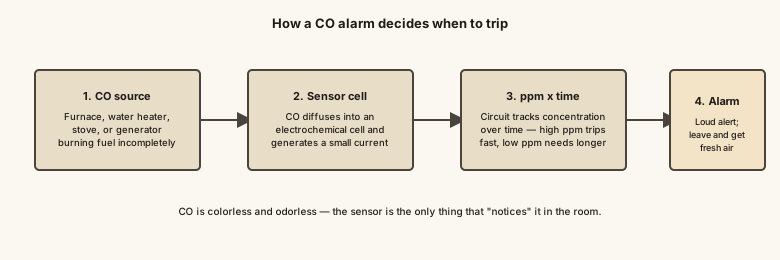
The key relationship to notice is the ppm-times-time step — it's why a CO alarm can seem to react instantly to a large leak but take longer to trip on a small, steady one.
Common mistakes
Common Mistakes
Assuming a smoke detector also covers carbon monoxide unless it's specifically labeled as a combination alarm.
→ Check the unit's labeling and install a dedicated CO alarm, or a labeled smoke/CO combination alarm, on every level and near sleeping areas.
Running a generator, grill, or other fuel-burning engine in a garage, even with the door partly open, during a power outage.
→ Run generators outdoors, well away from windows, doors, and vents, per manufacturer and CPSC guidance — never inside a garage, attached or not.
Trying to diagnose or locate the CO source personally after an alarm sounds, before leaving the building.
→ Get everyone to fresh air immediately and call emergency services from outside; let trained responders investigate the source.
Common misconception
“If a room doesn't smell strange or feel different, carbon monoxide isn't present.”
Carbon monoxide has no color, smell, or taste at any concentration relevant to human safety, so there is no sensory signal — strange smell, visible haze, discomfort — that reliably indicates its presence. Early poisoning symptoms like headache, dizziness, and fatigue are easy to mistake for common illness, which is exactly why an electrochemical sensor is the mechanism that actually catches it, not human perception. A working CO alarm, tested regularly, is the only realistic substitute for a warning sense the body simply doesn't have for this particular gas.
What to do next
What to do next
- Install a CO alarm on every level of your home and near each sleeping area, following manufacturer and NFPA placement guidance.
- Test CO alarms monthly with the built-in test button and replace units per the manufacturer's stated sensor lifespan, commonly 5 to 10 years.
- Never run a generator, grill, or other fuel-burning engine indoors or in an attached garage, even briefly or with a door open.
- If an alarm sounds, get everyone to fresh air immediately and call emergency services from outside rather than investigating the source yourself.