 KnowThis
Key Takeaways
Key Takeaways
- 1A thermostat doesn't generate heat or cold itself — it senses room temperature, compares that reading to a setpoint, and switches the heating or cooling system on or off to close the gap.
- 2A small buffer called a deadband keeps the system from switching on and off constantly right at the setpoint, at the cost of letting the room drift slightly above or below the target temperature.
- 3Cranking a thermostat far past the desired temperature doesn't heat or cool a room any faster — most systems run at one fixed output rate, so the room warms or cools at the same speed regardless of the setpoint chosen.
The concept
Because a thermostat is only comparing a sensor reading to a target number, the setpoint itself doesn't control how fast the room changes temperature — it only controls when the system switches on and off, which is the source of one of the most common thermostat misunderstandings.
What does a thermostat's deadband (hysteresis) actually do?
Worked examples
Example 1: A basic heating cycle on a cold morning (baseline case)
A thermostat is set to 68°F overnight. The room drifts down to 67°F, crossing the deadband, and the thermostat sends a call for heat. The furnace runs, the room climbs back past 68°F, and once it crosses roughly 68.5°F the thermostat cuts the call for heat and the furnace shuts off. The room then slowly cools again — through normal heat loss to the outside air — until it crosses 67°F once more, and the whole cycle repeats. This on-off cycling around a narrow band, not a continuously running furnace, is how most homes are actually heated.
Example 2: Setting the thermostat far past the target does not heat the room any faster (edge case / variation)
Setting a thermostat to 80°F instead of 70°F when a cold house needs to warm up quickly will generally:
Example 3: Why a hallway thermostat can make one room too cold and another too warm (real-world / applied case)
A single thermostat mounted in a central hallway is set to 72°F, and it holds the hallway near that number reliably. A bedroom at the far end of the house, on a longer duct run and with more exterior wall exposed to the weather, ends up consistently a few degrees off from the hallway reading — the kind of room-to-room gap covered in more depth in why some rooms are always hotter or colder. The thermostat isn't malfunctioning — it's doing exactly its job of controlling temperature at its own sensor location. It has no way to know what's happening in a room it isn't installed in, which is why a single central thermostat can't guarantee uniform temperature throughout an entire house on its own.
A hallway thermostat holds 72°F reliably, but a back bedroom always runs a few degrees colder. What does this most likely indicate?
How it works (visual)
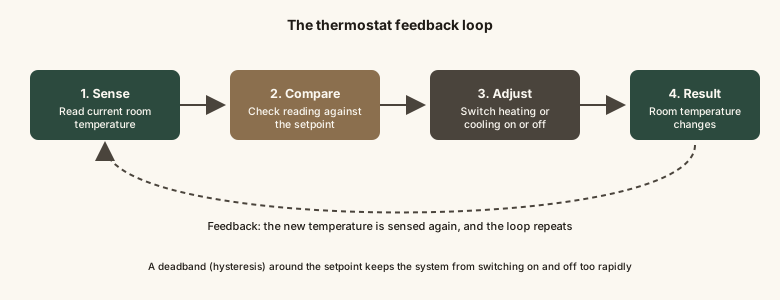
Every one of those four steps repeats continuously, day and night — a thermostat is never really "done," it's constantly re-checking and re-deciding, which is exactly what makes it a feedback loop rather than a one-time switch.
Common mistakes
Common Mistakes
Setting the thermostat far above or below the desired temperature to try to heat or cool the room faster.
→ Set the thermostat directly to the temperature you actually want — most systems run at a fixed output rate, so an exaggerated setpoint only causes overshoot, not faster warming or cooling.
Assuming one thermostat in a hallway or central location accurately represents the temperature in every room of the house.
→ Expect rooms with longer duct runs, more exterior exposure, or more sun to differ from the thermostat's reading, and address those rooms individually rather than adjusting the whole-house setpoint.
Constantly nudging the setpoint up and down by a degree or two throughout the day.
→ Let the deadband do its job and leave the setpoint alone between adjustments — frequent small changes mostly just add extra on-off cycles without meaningfully changing comfort.
Common misconception
“Turning the thermostat up higher than you actually want makes the room heat up faster.”
Most residential furnaces and heat pumps run at a single fixed heat output — they don't "run harder" because the setpoint is farther away from the current temperature. The room warms at the same rate whether the thermostat is set to 71°F or 85°F; the only difference is that a much higher setpoint means the system keeps running well past the point where the actually-desired temperature was reached, which wastes energy and risks an uncomfortably overheated room once someone remembers to turn it back down. The thermostat's job is to decide when to switch the system on and off, not how strongly it runs while it's on.
What to do next
What to do next
- Set the thermostat directly to the temperature you want rather than overshooting it to try to speed up heating or cooling.
- Check where the thermostat is mounted — away from direct sun, drafts, and supply vents — since a poorly placed sensor gives a reading that doesn't represent the rest of the house.
- If one room consistently runs hotter or colder than the thermostat's reading, look at that room's duct run, insulation, and window exposure rather than adjusting the whole-house setpoint.
- Avoid frequent small setpoint changes throughout the day — let the deadband manage normal temperature drift instead of chasing it manually.