 KnowThis
Key Takeaways
Key Takeaways
- 1A home security system isn't a single all-purpose intrusion sensor — it's a set of different sensor types, each reacting to one specific physical signal: a magnet separating, a moving heat source, or the sound of breaking glass.
- 2The control panel and monitoring center never directly witness the intrusion itself — they only receive whatever report each sensor is built to send, which is why sensor placement and type matter as much as having a system at all.
- 3Most false alarms trace back to a sensor doing exactly what it's designed to do in response to something harmless — a pet crossing a motion sensor's field of view, a door left ajar — rather than a system malfunction.
The concept
Because each sensor type is watching for a completely different physical signal, the specific mix and placement of sensors in a home determines what kind of intrusion attempt actually gets caught, and how quickly.
What does a home security system's control panel actually receive from its sensors?
Worked examples
Example 1: A door contact sensor triggering while armed (baseline case)
With the system armed and everyone away, a back door is opened, separating the contact sensor's magnet from its switch. The panel immediately registers "open" on that zone, checks that no valid entry code was entered, and starts (or skips, depending on configuration) a brief exit/entry delay before treating it as a real alarm and alerting the monitoring center. This is the most straightforward and reliable detection case: a binary magnetic state change with essentially no ambiguity about what happened.
Why is a contact sensor's detection considered very reliable compared to some other sensor types?
Example 2: A motion sensor triggered by a pet, not an intruder (edge case / variation)
Why can a standard PIR motion sensor be triggered by a pet moving through a room, even when working correctly?
Example 3: An alarm signal reaching the monitoring center at 2 a.m. (real-world / applied case)
A glass-break sensor near a first-floor window triggers overnight, sending an alert through the control panel to a monitoring center. Following a fairly standard protocol, the center first attempts to call the homeowner's listed phone number to verify the alarm isn't a false trigger; if there's no answer, or the homeowner can't provide the correct verbal passcode, the center typically dispatches police to the address and continues trying to reach any other listed contacts. This verification step exists specifically to reduce false dispatches to law enforcement, since the center itself never directly observes what actually happened — it only knows a specific sensor reported its specific signal.
Why does a monitoring center typically try to call the homeowner before dispatching police after an alarm signal?
How it works (visual)
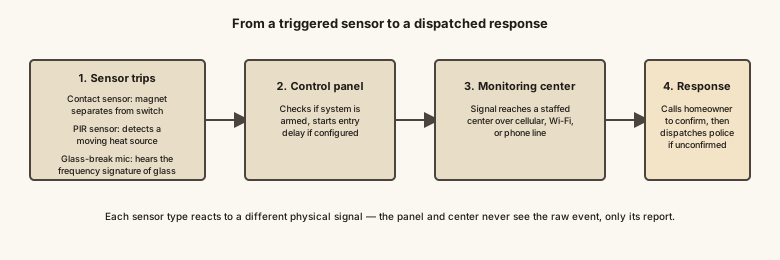
Notice that each arrow in the chain only carries a report of what the previous step detected — nobody downstream is watching the actual event happen, only its reported signal.
Getting that first report right starts with a solid physical mount: locating framing with a stud finder before drilling, or using a properly rated wall anchor on a hollow section, keeps a sensor or keypad from loosening or misaligning over time, which can cause exactly the kind of intermittent, hard-to-diagnose false trigger a homeowner would otherwise blame on the electronics.
Common mistakes
Common Mistakes
Mounting motion sensors aimed directly at heat sources like vents, radiators, or sun-facing windows.
→ Position motion sensors away from strong, changing heat sources and confirm 'pet-immune' settings if applicable, to reduce nuisance triggers.
Mounting a keypad or sensor on hollow drywall with adhesive only, then having it fall or loosen over time.
→ Locate solid backing before drilling, and use a proper wall anchor rated for the device's weight on any hollow-wall mount.
Skipping a stud finder pass before drilling into a wall for a sensor or keypad, then guessing at what's behind the drywall.
→ Use a stud finder to confirm what's actually behind the wall before drilling, especially near wiring or plumbing runs.
Assuming every sensor type detects every kind of intrusion attempt equally well.
→ Layer sensor types — contact sensors at entry points, motion coverage in open areas, glass-break sensors near windows — rather than relying on just one type throughout the home.
Common misconception
“A home security system 'sees' an intruder the way a person would.”
A security system has no general awareness of an intrusion — each sensor only detects one specific physical signal it was built to react to: a magnetic separation, a changing infrared pattern, or an acoustic signature matching breaking glass. The control panel and monitoring center only ever know that a specific sensor reported its specific trigger, not what actually happened in the room. This is exactly why sensor type and placement matter so much, and why false alarms — a pet, a loose window, a dropped object — happen: the sensor is reacting correctly to its signal, even when that signal didn't come from an intruder.
What to do next
What to do next
- Map which sensor types cover which areas of your home, and add layered coverage — contact, motion, glass-break — rather than relying on one type alone.
- Locate solid backing with a stud finder before mounting sensors or a keypad on drywall, or use a properly rated wall anchor on hollow sections.
- Position motion sensors away from vents, radiators, and direct sun exposure, and confirm pet-immune settings if applicable.
- Confirm your monitoring center's verification process and keep contact numbers and passcodes current, so a real alert isn't delayed by an out-of-date phone number.