 KnowThis
Key Takeaways
Key Takeaways
- 1Extinguisher class ratings (A, B, C, D, K) exist because different fuels need different physical or chemical actions to actually stop burning, not because of arbitrary labeling.
- 2Using the wrong class isn't just ineffective — on some fuels, like a grease fire hit with water, it can actively spread flaming fuel and make the fire dramatically worse.
- 3A multipurpose A-B-C extinguisher covers the fuel types found in most homes, but a kitchen with a deep fryer or a workshop with reactive metals may genuinely need a Class K or Class D unit as well.
The concept
Because the class rating describes a genuine chemical or physical match to a fuel type, the label isn't a suggestion — using an extinguisher outside its rated classes can turn a small, manageable fire into a much larger one.
What does a fire extinguisher's class rating (A, B, C, D, K) actually indicate?
Worked examples
Example 1: A small wastebasket paper fire (baseline case)
A lit cigarette starts a small fire in a wastebasket full of paper — a straightforward Class A fuel. A multipurpose A-B-C extinguisher, or even a controlled amount of water, cools the burning paper below its ignition point and stops the fire with no unusual risk. This is the simplest and most forgiving case: ordinary combustibles are the fuel type water and most common agents were originally designed around.
Why is water generally an effective and safe choice on a small paper or wood fire?
Example 2: A grease fire on a stovetop (edge case / variation)
Why is throwing water on a stovetop grease fire specifically dangerous, compared to a Class A fire?
Example 3: Choosing which extinguishers to keep in a home (real-world / applied case)
A homeowner stocking fire safety equipment puts a multipurpose A-B-C extinguisher in the garage and hallway, and adds a small Class K unit specifically in the kitchen because of regular deep frying. This mirrors how NFPA and fire-safety guidance actually recommend equipping a home: a general-purpose extinguisher for most rooms, supplemented by a specialty-rated unit anywhere a specific higher-risk fuel — deep frying oil, a metalworking bench with magnesium shavings — is a regular part of that space's normal use. The goal is matching the extinguisher to the fuel actually present, not assuming one unit covers every room equally well.
Why might a household keep a Class K extinguisher in the kitchen in addition to a general A-B-C unit elsewhere in the home?
How it works (visual)
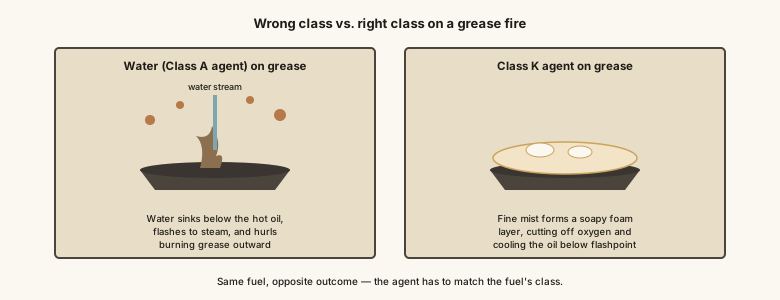
Same fuel, same starting fire — the outcome flips entirely based on whether the agent's method actually matches how that fuel needs to be extinguished.
Common mistakes
Common Mistakes
Using water, or a water-based extinguisher, on a grease or oil fire.
→ Smother a grease fire with a metal lid or use a Class K (or B-rated) extinguisher — never water, which can scatter burning oil.
Using a conductive extinguishing agent, like a plain water stream, near live electrical equipment.
→ Use a Class C-rated (or multipurpose) extinguisher near anything electrical, since a conductive stream risks shocking the person holding it.
Assuming one general-purpose extinguisher covers every fuel type equally well in every room.
→ Match specialty extinguishers — Class K for deep-frying kitchens, Class D for metalworking areas — to any room with a specific higher-risk fuel.
Common misconception
“Water works fine on any small fire — it's cooling, so it can't make things worse.”
Water is genuinely effective at cooling ordinary solid fuels like wood and paper below their ignition temperature, which is why it works well on Class A fires. But on a flammable-liquid or hot-oil fire, water's higher density means it sinks beneath the burning fuel and flash-boils into steam almost instantly, which can violently scatter burning liquid outward rather than putting the fire out. Water is also conductive, making it dangerous near live electrical equipment. "Cooling" isn't the universal mechanism every fire needs stopped — some fuels need smothering, some need a non-conductive agent, and matching the method to the fuel is the entire reason class ratings exist.
What to do next
What to do next
- Check the class letters on any extinguisher you already own, and confirm they match the fuel types actually present in that room.
- Add a Class K extinguisher near any kitchen with regular deep frying, and a Class D unit near any workshop with reactive metal shavings.
- Keep at least one multipurpose A-B-C extinguisher easily accessible on each level of the home, per NFPA guidance.
- If a fire is larger than a small, contained flame, or you're unsure of the correct extinguisher class, evacuate and call the fire department rather than attempting to fight it yourself.