 KnowThis
Key Takeaways
Key Takeaways
- 1A smoke detector senses smoke particles in the air, not flame or heat directly — a separate device, a heat detector, is what actually watches for temperature.
- 2Ionization sensors react fastest to the small, fast-moving particles from a flaming fire, while photoelectric sensors react fastest to the larger, denser particles from a slow, smoldering fire — which is why many modern alarms combine both.
- 3Most nuisance alarms come from sensor-type mismatch with a location, not a defective unit — cooking smoke and steam are common triggers for ionization sensors placed too close to a kitchen.
The concept
Because the two mechanisms respond to different particle characteristics, the type of fire in front of them — not just the presence of smoke — changes how quickly each one reacts.
What is a smoke detector actually sensing when it triggers an alarm?
Worked examples
Example 1: A flaming wastebasket fire (baseline case)
A small flaming fire starts in a wastebasket, producing mostly tiny, fast-moving combustion particles that spread quickly through the air. An ionization detector nearby reacts within seconds — those small particles rapidly attach to the ions carrying current across the sensing chamber, dropping the current below the trip threshold almost immediately. This is the classic scenario ionization sensors are built to catch fastest: a fire that's already flaming and spreading quickly, where every extra second of warning matters.
Why does an ionization smoke detector typically respond very quickly to a small, actively flaming fire?
Example 2: Smoldering wiring inside a wall (edge case / variation)
In a slow, smoldering fire with no open flame, which sensor type is generally faster to respond, and why?
Example 3: A kitchen alarm going off every time someone cooks (real-world / applied case)
A homeowner's hallway smoke alarm, an ionization-only model, keeps triggering nuisance alarms whenever someone sears meat or makes toast in the adjacent kitchen. Cooking smoke and steam both produce particles that can interfere with an ionization sensor's current, even without any real fire hazard present. The practical fix isn't disabling the alarm — it's relocating it slightly farther from the kitchen per the manufacturer's minimum-distance guidance, or replacing it with a photoelectric or dual-sensor unit, which tends to be less prone to cooking-related nuisance trips while still covering the same room. Many newer homes hardwire smoke alarms into a dedicated branch circuit protected by a standard circuit breaker, with a battery only as backup, so relocating a hardwired unit is a job for an electrician rather than a simple swap — battery-only units draw so little current, measured against the same amps, volts, and watts relationship that governs any household circuit, that a single small battery can run one for a year or more.
A hallway ionization smoke alarm near a kitchen keeps triggering false alarms during cooking. What's the appropriate response?
How it works (visual)
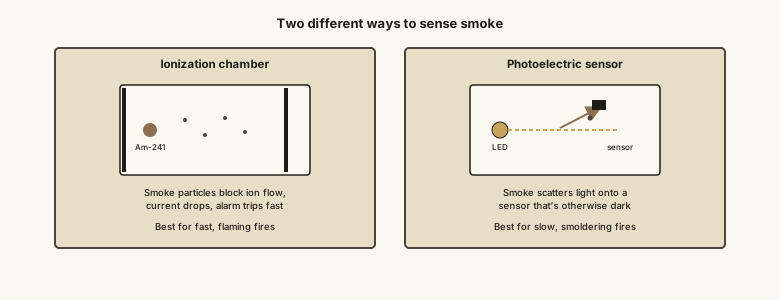
Notice that neither mechanism directly detects fire or heat — both are indirect measurements of smoke particles disturbing a baseline condition inside the chamber.
Common mistakes
Common Mistakes
Removing the batteries or disabling an alarm permanently after a nuisance trip near a kitchen or bathroom.
→ Relocate the alarm to meet minimum-distance guidance from cooking appliances and steam sources, or switch to a photoelectric or dual-sensor unit instead of disabling protection.
Assuming a single sensor type — ionization or photoelectric — provides equal protection against every kind of fire.
→ Install dual-sensor or combination alarms, or use a mix of both types throughout the home, since each responds fastest to a different fire behavior.
Never replacing smoke alarms and assuming they work indefinitely as long as the battery is fresh.
→ Replace smoke alarms entirely on the manufacturer's recommended schedule — commonly around 10 years — since the sensing components themselves degrade with age, independent of the battery.
Common misconception
“All smoke detectors work the same way, and they detect fire itself.”
Smoke detectors detect smoke particles, not flame or heat, and they do it through two genuinely different mechanisms. An ionization sensor watches for smoke particles disrupting a small electric current, which makes it especially responsive to fast, flaming fires. A photoelectric sensor watches for smoke particles scattering a light beam onto a sensor, which makes it especially responsive to slow, smoldering fires. Neither type is simply a better version of the other — they're tuned to different physical behavior, which is exactly why current safety guidance favors combining both rather than relying on just one.
What to do next
What to do next
- Test every smoke alarm in your home monthly using its built-in test button, not just when the low-battery chirp starts.
- Install dual-sensor or combination alarms, or a mix of ionization and photoelectric units, so both flaming and smoldering fires are covered quickly.
- Keep alarms interconnected where possible so every unit sounds together, and relocate any alarm that has repeated nuisance trips near cooking or steam.
- Replace every smoke alarm on the manufacturer's recommended schedule, commonly about every 10 years, regardless of how well it still seems to work.