 KnowThis
Key Takeaways
Key Takeaways
- 1Volts measure electrical pressure, amps measure the rate of current flow, and watts measure the resulting power — three different quantities, not interchangeable words for the same thing.
- 2The three are linked by one formula: watts equal volts multiplied by amps, which is why the same wattage of power can be delivered at high voltage and low current, or low voltage and high current.
- 3A device's amp draw, not its voltage rating alone, is what a household circuit's wire gauge and breaker are actually sized to handle.
The concept
Once amps, volts, and watts are separated into pressure, flow, and power, a lot of household electrical labeling stops being confusing — including why some heavy appliances run on a different voltage than everything else in the house.
If two devices deliver the same wattage, but one runs on double the voltage of the other, what must be true about their current draw?
Worked examples
Example 1: Finding the amp draw of a standard 120-volt appliance (baseline case)
A space heater is rated at 1,200 watts and plugs into a standard 120-volt household outlet. Rearranging watts = volts × amps to solve for amps gives current = watts ÷ volts, or 1,200 ÷ 120 = 10 amps. That's a useful number on its own: a 15-amp circuit has roughly 5 amps of headroom left for anything else plugged in alongside it.
Example 2: The same wattage on a 240-volt circuit draws far less current (edge case / variation)
Why are high-power appliances like electric dryers often wired for 240 volts instead of the standard 120 volts?
Example 3: Checking whether a kitchen circuit can handle several appliances at once (real-world / applied case)
A kitchen outlet is on a standard 15-amp, 120-volt circuit. A toaster rated at 900 watts and a coffee maker rated at 1,000 watts both get plugged in and switched on together. Converting each to amps: 900 ÷ 120 = 7.5 amps, and 1,000 ÷ 120 ≈ 8.3 amps, for a combined draw of roughly 15.8 amps — already slightly over the circuit's 15-amp rating before anything else is added. That's the practical reason a breaker trips in exactly this kind of everyday scenario: the total current draw, not just the wattage printed on any single appliance, is what the circuit and its breaker are rated against.
A 15-amp, 120-volt kitchen circuit is running a 900-watt toaster and a 1,000-watt coffee maker at the same time. What best explains why the breaker might trip?
How it works (visual)
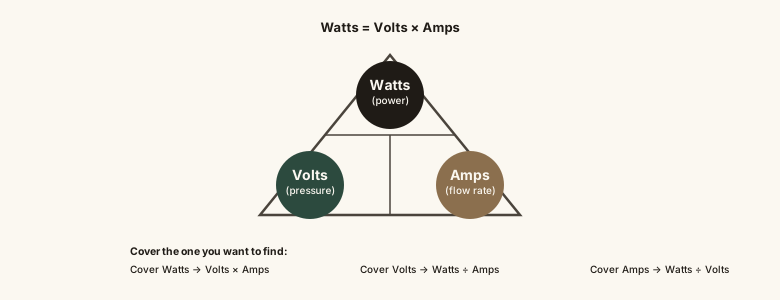
The triangle is a memory shortcut, not a separate law of physics — it just visualizes the one relationship, watts = volts × amps, rearranged three different ways depending on which quantity is unknown.
Common mistakes
Common Mistakes
Treating volts, amps, and watts as roughly interchangeable ways of describing "how much electricity" something uses.
→ Keep them separate: volts is pressure, amps is flow rate, watts is the resulting power — and only watts directly tells you the rate of energy an appliance consumes.
Adding up appliance voltages instead of their current draw when checking if a circuit is overloaded.
→ Convert each appliance's wattage to amps (amps = watts ÷ volts) and add the amp values — that total is what the circuit's breaker rating actually limits.
Assuming a higher-voltage appliance is automatically more dangerous or draws more current than a lower-voltage one.
→ Check the actual amperage or wattage rating — a higher voltage paired with the same or lower wattage can mean a lower current draw, not a higher one.
Common misconception
“Voltage is what makes electricity dangerous, so a low-voltage source is basically harmless.”
It's the current (amps) passing through the body that causes physiological harm, not voltage by itself — but voltage is what pushes that current through the body's resistance in the first place, so the two aren't really separable in practice. A source with enough voltage to overcome the resistance of even slightly damp skin can still drive a harmful amount of current, which is why low-voltage claims of safety don't hold up in wet conditions. Treating any energized household wiring or outlet as hazardous, regardless of its labeled voltage, is the standard safety approach rather than assuming "low voltage" means "low risk."
Try it yourself
Enter a circuit's voltage and an appliance's amperage draw to see the resulting wattage (watts = volts × amps).
What to do next
What to do next
- Check an appliance's nameplate for its wattage or amperage rating before assuming how much of a circuit's capacity it uses.
- Convert wattage to amps (amps = watts ÷ volts) when adding up several appliances on the same circuit, rather than adding wattages to a voltage figure.
- Remember that a higher circuit voltage, like the 240 volts used for some large appliances, generally means lower current for the same power — not automatically more danger.
- Read How a Circuit Breaker Actually Protects Your Home next to see exactly how a breaker uses this amperage figure to decide when to trip.